3.05 pm. My bottom line? A home run. Simply constructed, carefully reframed, aggressive while positive: the Obamaites have been listening to critics and are responding. If this is his message, and if he is able to keep articulating it this clearly, he will win. And in my view, the experience of the last thirty years is that he should win. If I have to choose between a governing philosophy espoused by Bill Clinton or one espoused by George W. Bush, it's a no-brainer. And I can't stand Bill Clinton.
3.03 pm. Finally a vote of confidence in the American future. He says he sees even in deep economic distress "a stubborn hope and a fierce pride and a determination to overcome whatever challenges we face." It's a stem-winding patriotic ender – and a call for unity against the allure of cynicism. We have gone from "change you can believe in" to "change we need right now."
2.58 pm. He redirects the attacks on him. "That may be a way to win an election. It is not a way to grow the economy." I love the phrase "the scary voice in the commercials." His position is that he wants a real debate about these two visions, a defining moment between 1980s conservatism or 1990s liberalism as the way forward. We're watching a fusion of Obama and Clinton here in his case for a second term. And there is the inevitable unstated pairing of Romney and Bush.
Then the return to the 2008 election: "I will work with anyone in any party who believes we are in this together."
2.57 pm. "The only people who can break the stalemate is you."
2.56 pm. He insists that the only reason we have not made a Grand Bargain is the GOP insistence on protecting the very rich from any tax increases: "the biggest source of gridlock in Washington today."
2.50 pm. Now the deficit and a withering attack on those who only care about the deficit when the other party is in office, but not when they are. "If you really want to do something about it …" then the tax code has to ask the wealthiest Americans to contribute. Then he's essentially running on Clinton's record of raising taxes on the rich and precipitating a jobs and millionaire boom.
Brilliant line: "We don't have a choice to bring down our deficit. We have a choice about how we bring down our deficit." I like the adjective about deficit reduction: "honest" and "balanced". And then he actually says that cutting the deficit should not be done by giving Mitt Romney a new tax cut while rendering sick seniors insecure. Brutal. Effective. The argument is there. And he's beginning to put it together.
2.47 pm. There's an interesting emphasis on science and innovation in this speech. "Why would we reverse this commitment right now when it's so important?" Someone should count the number of times he has said "science."
Then a line straight from Ron Paul: "Instead of paying for war, let's do some nation-building right at home!" This is an aggressive confident speech that is all but begging the GOP to oppose him on these grounds. And it's all forward-looking – exactly the approach he needs.
2.45 pm. "We're producing more oil than at any time in a decade." He's boosting natural gas and cleaner coal, and renewable energy. The all-of-the-above approach. "Let's double down on a clean energy industry." He's making the choice starker and starker. And he does not seem afraid.
2.43 pm. Now he's stressing education as the last thing we should cut if we want to have a middle class economy in the future. And then a dig at Romney: "I want to hire more teachers." Ouch. Then a pitch to young immigrants with education: "we won't deport them." Another direct tackle.
2.40 pm. Now he's invoking Lincoln and Eisenhower and even Nixon and Reagan on the need for common projects for the common good – from the interstate highway to the EPA and reforming social security. He's giving a speech to a highly partisan crowd, but this is a speech delivered to all those centrists and independents who backed him in 2008. And given the cogency of his case, it's a powerful message. Because it engages the facts of the last two decades and gets concrete on what he, compared with Romney, wants to do in the next four years.
2.36 pm. Now we have a passage declaring that he is not a big government liberal; he wants to cut and streamline regulations, cut unnecessary taxes, reduce the government's size and inefficiency. He's touting a $2 trillion deficit reduction. "I do not believe the government is the answer to all our problems. I do not believe that we should be in the business of helping people who will not help themselves." Then he invokes Lincoln as his mentor – doing things together we cannot do alone.
2.34 pm. His pitch is basically a "balanced" approach to deficit reduction (i.e. not balancing the budget entirely on the backs of the middle class and the poor). Then serious investment in education and infrastructure. But he's framing this in a very Clintonian way – touting his own tax cuts, decent private sector job growth. and deficit plans. He is, in my view, nailing it.
2.30 pm. "We tried this." It didn't work. The speech began with a statement of a clear choice, then pivots to a brutal attack on Romney's return to the past, and then a peroration on his "different vision." Let's see how persuasive it is.
2.27 pm. Now he's arguing that the tax reform Romney proposes would effectively be a big tax increase on the middle class. Money quote: "This is nothing new. It's what Bill Clinton described as old ideas on steroids." And if you want to return to big tax cuts, huge spending cuts and the agenda of the Bush years, then vote for Romney! That's a great line: he's telling people who miss the policies of George W Bush to vote for Romney. Awesome line. Except he can't quite say the word "Bush."
2.23 pm. Now he outlines Romneyism as an extension of Bush's tax cut policy – but with the legacy of even greater debt. It's a story of massive gains for the very rich and a brutal attack on core government functions. He's strongest here on cuts in science and medical research. But he's very clear that the cuts would be greater and deeper than any in modern times. And he calls their Medicare plan a "voucher system" eventually "ending Medicare as we know it".
2.22 pm. The debate is not about the state of the economy; we all agree it sucks. The debate Obama wants is "about how we grow faster and how we get more jobs and how we pay down our debt". So far, this is about as good a summary of the case as those of us who support him could have expected.
2.19 pm. Now he's telling a rather convincing story about the failure of tax cuts in 2001 to give us growth in the last decade – and explaining how the current recession is not a normal one, how it usually takes a decade to recover from that kind of financial crisis. Then a pivot to the European nations unable to get any growth at all, compared with America's resilient private sector. Then the record of private sector jobs – more in the last two years than in the seven years before the crisis.
He has yet, however, to mention the word Bush.
2.12 pm. The election is about ending the "stalemate in Washington." Making a final choice about where we go from here. And now he starts to tell the story of middle class stress for the past three decades. "You know that. You lived it."
2.11 pm. So far, it's all about choices for the future, which he is portraying as a defining moment for the survival of the middle class.
2.10 pm. Within a few minutes, he is saying that this election is about the economy and a clear choice about how to tackle it.
2.09 pm. He jokes about his "unique contribution" to the press and media frenzy last week. But he's telling his supporters not to get too jumpy about short term ups and downs.
2.07 pm. The intro was by a mother who spoke about her daughter. They're going to cling to their gender gap as tightly as they can.
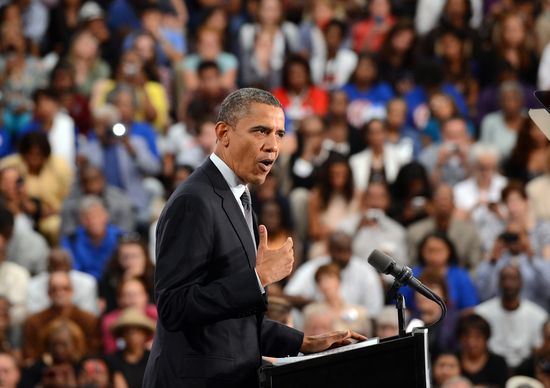
(Photo: Jewel Samad/Getty)
 The Dish