Americans And Empire

Never a good fit. Ackerman summarizes an internal Pentagon report which finds that "U.S. troops didn’t understand the basic realities of society, culture and power structures in Iraq and Afghanistan, and couldn’t explain what they were doing to skeptical populations": 

The study is designed to help shape the military of the 2020s — which could accordingly see a greater emphasis on both local knowledge of foreign hotspots and, well, spin. For the most part, the study is agnostic on the wisdom of the wars. That’s understandable, since the military is supposed to consider the merits of a given war beyond its purview. But the study contains not-so-oblique references to unrealistic strategy that made success difficult. “In operations in Iraq, Afghanistan and elsewhere,” the report reads, “a failure to recognize, acknowledge and accurately define the operational environment led to a mismatch between forces, capabilities, missions and goals.” The report considers that less a strategy failure than an intelligence failure, and it doesn’t point fingers at anyone outside of the military. But the military’s intelligence structure, once in Iraq and Afghanistan, was entirely focused on discovering and locating its enemies, which left it blind to the experiences of the local population, which nourished them. 

Did They Just Have A Coup In Egypt?

Egypt_Wire

Marc Lynch believes Egypt's transition has failed:

Weeks before the SCAF's scheduled handover of power, Egypt now finds itself with no parliament, no constitution (or even a process for drafting one), and a divisive presidential election with no hope of producing a legitimate, consensus-elected leadership. Its judiciary has become a bad joke, with any pretence of political independence from the military shattered beyond repair.

Tony Karon labels SCAF's actions a "coup":

The events that saw Mubarak unceremoniously wheeled off stage-left in February 2011, and later imprisoned, were more of a palace coup than a revolution. A junta of generals responded to the crisis presented by the massive protests in Tahrir Square and elsewhere to ease out the helmsman in order to save the regime. They weren’t guided by a clear plan or even a coherent strategy; the generals and their allies have simply improvised their way through the political turmoil of the past 18 months to emerge in an improbably dominant position.

Zeinobia, who's live-blogging in Egypt, concurs. Max Fisher is unsure:

Is it a coup? A number of the more liberal-minded Egyptians who dominate its social media seem to think so. Members of Muslim Brotherhood, who just saw their power-hold on Parliament dissolve and have to wonder if their candidate will get a fair race against Shafiq, are unlikely to be happy…. But calling it a coup might be giving the military and its pawns a little too much credit. Whatever the motivation behind the dissolution of Parliament, like so many of Egypt's painful post-Mubarak moments, it looks less like a master-mind conspiracy and more like the kind of panicky, by-the-seat-of-their-pants stumbling that has long characterized the still-creaking Mubarak machine. 

Michael Koplow unfavorably compares Egypt's situation to Turkey's coup-prone past:

There are no serious outside influences pressuring it to democratize, and it is not dependent on the U.S. and other Western democracies to the same extent that Turkey was. It is not joining the EU, it does not need protection from the Soviet Union, and its military aid from the U.S. is not ever going to be really endangered because of the way in which it is bound up with the peace treaty with Israel. In short, Egypt in 2012 looks very little like Turkey from 1950 onwards, and the pressures that existed on the Turkish military that ensured quick handovers to civilian governments following military coups do not apply on anything like the same scale to the SCAF. It is understandable that those who are disappointed with today’s events might look to Turkey as a ray of hope for what can eventually happen after the military intervenes in politics, but the comparison is an unsuitable one. Turkey had a democratic head start and a host of reasons to ultimately consign the military to the barracks for good, and Egypt unfortunately has neither of these things.

Robert Mackey is live-blogging

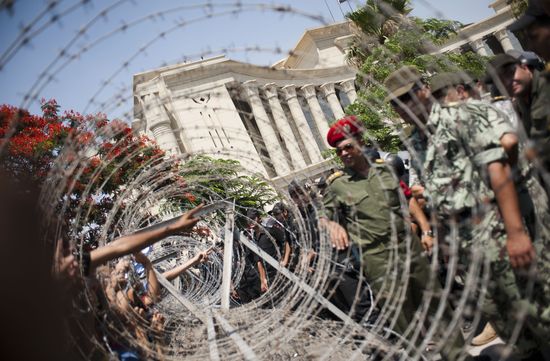
(Security forces guard Egypt's Supreme Constitutional Court in Cairo as demonstrators gather outside on Thursday, June 14, 2012. In a highly anticipated ruling that put the legitimacy of Egypt's legislature and future constitution in question, Egypt's Supreme Constitutional Court ordered the dissolution of one-third of the nation's first democratically elected parliament and allowed former Egyptian President Hosni Mubarak's last prime minister to run in this weekend's presidential election. By James Lawler Duggan/MCT via Getty Images)

An Obama-Evangelical Alliance On Immigration

My view is that alongside a clear choice between balancing the budget on the backs of the poor or on the backs of everyone, Obama should highlight one other major contrast with Romney in this election: immigration reform. Obama should invoke Jeb Bush in describing the GOP's ever greater extremism, and ally with evangelicals and Latinos on immigration reform as his top priority in a second term. He'll have some allies that will make Romney squirm:

The so-called "Evangelical Immigration Table," which includes evangelicals Jim Wallis on the left and Richard Land on the right, unveiled its plan Tuesday (June 12) on Capitol Hill… Though the group is reaching out to evangelicals, Congress, and the president, there's not yet a specific framework in place.

"Much, much work remains to be done on the specifics," admitted Tom Minnery, senior vice president of Focus on the Family. "As difficult as it was getting all these signers together, the next step, getting politicians together, is a much greater task." Wallis, president and CEO of the social justice organization Sojourners, said change will depend on evangelicals uniting together for the cause. "Big things don't change in Washington first. They change in the nation's capital last," he said. "Together we will create a national groundswell for comprehensive immigration reform."

Obama should embrace it. Romney is stuck with a brutally inhumane immigration policy and he cannot change it without a grass roots revolt. Obama will only win if Hispanics turn out in force. The president is already in favor of it – and can blame lack of progress in his first term on the economic challenges and the GOP's total obstructionism. It's a perfect narrative for change; and for casting this election as between the America of the future and the America of the past.

Egypt’s Revolution Enters The Critical Phase

That is: when the old regime strikes back. The Supreme Court's dissolution of the first directly-elected parliament, where the Muslim Brotherhood had a very strong plurality, ups the stakes dramatically. It could ultimately disqualify the MB candidate for president. But the runoff presidential election is this weekend. The NYT's take-away:

The ruling — which critics said amounted to a back-door coup — means that whoever emerges as the winner of the runoff scheduled for this weekend will take power without the check of a sitting Parliament and could even exercise some influence over the election of a future Parliament.

The Dish is busy scanning online expertise on what this means for a reax post soon. But to my untrained eye, this is likely to prompt a surge in votes for the Brotherhood candidate if the election is free and fair. Which, given this provocation, would be entirely understandable.

“Limitless”

That's the word being used to describe Sheldon Adelson's determination to advance Greater Israel and continued Jewish settlement of the West Bank. He's given $10 million to Romney's Super Pac for starters but that could reach $100 million … or more. This is the campaign the Roberts court wanted.  Payback enough for a lifetime in a black robe.

The Tragic New Life Of Sally Quinn

Chait "mourns" a lost Washington. This is what we're missing, according to Sally:

In the past, we might have attended five-course dinners a couple of nights a week, with a different wine for each course, served in a power-filled room of politicians, diplomats, White House officials and well-known journalists. Those gatherings don’t exist anymore. Now, we host and go to small dinners with close friends, dinners with some meaning to them, dinners that are celebrations of something.

The horror.