Obama And The Future, Ctd

A reader writes:

The real question of this election is 145960124experience" narrative, and it's unclear whether that's working or whether it's even the right narrative to build. I'm not sure what sort of narrative Obama is trying to build. Maybe it's "we inherited bad conditions, and have made good progress, so don't change horses mid-stream". But that's clearly not as concise or digestible as "business experience". Basically, Obama has done a poor job thus far crafting a positive narrative.

On the other hand, Obama has done a very good job crafting a negative narrative for Romney. That is, "he's rich/out of touch and doesn't care about you". And so far that's stuck. Romney, however, has not done a very good job at creating a negative narrative for Obama. The Republican party hasn't been interested in an honest narrative since day one of his presidency. Instead they screamed about socialism and Obama's secret desire to strangle the precious, vulnerable America-our-founders-dreamed-of. That's the narrative Romney has to work with; he has no way around it.

And so to the extent Obama's gaffes don't easily fit that narrative, Romney's in trouble. Indeed, most of Obama's gaffes don't fit easily into that narrative.

Obama's playing the long game, and has NOT spent like a socialist since day one, etc. Eventually independents will tune in and realize the socialist narrative is bunk.

This all stemmed from Obama's "private sector is fine" gaffe. I think that gaffe is unlikely to hurt Obama in the long run, no matter how many times Romney runs ads on it. It's not part of the "socialist" narrative and Romney can't construct an "out of touch" narrative at this point: the polling shows independents wouldn't believe him. Whereas Romney's response about firemen and teachers and policemen is likely to hurt Romney. It fits his negative narrative perfectly.
Libya Learns To Vote

Sean Kane delivers a long and fascinating dispatch on Libya's progress and lack thereof:

As Libya's first plebiscite in 42 years approaches the popular mood is a mix of fulfillment, confusion, and even a little apprehension. Ordinary people are excited to vote as the culmination of the revolution and have flocked in the millions to register. They feel a genuine burden to select the right people for building a modern state but are not sure how to cast their ballot or what they are voting for (a constitutional assembly rather than president). Participants at workshops on elections that my former organization held across Libya repeat straightforward but profound questions that are difficult to answer: What is the purpose of political parties? How do I decide who to vote for? And, most earnestly, how can I be sure they will do a good job once elected? If only we knew.

David And Rebekah: “We’re In This Together!”

Screen shot 2012-06-14 at 10.58.36 AM

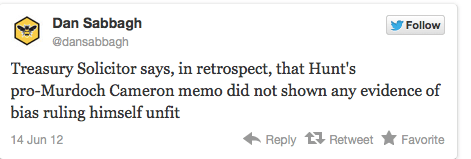
The grilling of prime minister David Cameron is going on as I type this. For live video, go here. So far, he seems to have avoided any incriminating evidence that he had any role in rigging Murdoch's bid for BSkyB. But by far the most interesting and damaging news is raw evidence of an intensely close relationship between Rebekah Brooks, the queen of phone-hacking, and Cameron, desperate for Murdoch's support before the last election. Lesson of the day – texts are dangerous:

Brooks's text, written the day before Cameron was due to address the Conservative conference, said: "I am so rooting for you tomorrow not just as proud friend but because professional we're definitely in this together!" Sent a week after the Sun had come out in support of the party, Brooks went on to encourage the political leader by saying: "Speech of your life? Yes he Cam!"

The prime minister said the common cause identified in the text referred to the fact his party and Brooks's newspapers had the same agenda. "I think what it means is that we were, as she put it, we were friends, but professionally we as leader of the Conservative party and her in newspapers, we were going to be pushing the same political agenda."

Brooks's text began by sympathizing with the prime minister over an unspecified "issue with the Times" – most likely a hostile article – and suggested that she could placate him over "country supper soon".

Jay asked if the country supper reference was "the sort of interaction you often had with her?" Curtly, the prime minister replied: "Yes, we were neighbours."

Cameron later said they hung out every six weeks or so.

Poseur Alert

"To capture sound is to isolate a moment, canonize it, enter it into the historical register. The genius of vinyl is that it allows – commands! – us to put our fingerprints all over that history: to blend and chop and reconfigure it, mock and muse upon it, backspin and skip through it. Vinyl spins like the earth on its axis, the planets around the sun, the hands of a clock. Unspools like time itself. Our ability to control it symbolizes a power greater than any we have over our own lives," – Adam Mansbach, Salon.

Invisible

"I can’t do any sports that I’ve lived my whole life doing; nobody asks me to be on the team anymore. Remember how you used to stand around, saying “you there, no no next to you, then take you, you, you. I’m standing there and nobody wants me because I can’t move very well. This is a metaphor. But. I miss it," – president George H W Bush.

How Big Can Africa Get?

The UN projects that sub-Saharan Africa will increase its population by roughly 1.4 billion people over the next 5o years. Noah Millman doubts this is possible:

The growth in the sub-Saharan African population is projected to be larger than the entire population of China. The population of Europe is expected to barely change over the period, going from 738 million in 2010 to 702 million in 2060. The population of northern America – the United States and Canada – is expected to grow from 345 million to 466 million. Put together, Europe and Northern America go from 1.08 billion to 1.17 billion. Again, the increase in the the sub-Saharan African population is projected to be larger than this entire region.

Ad War Update

The Romney campaign is calling this their first negative ad of the general election: 

The DNC highlights Romney's disdain for – and confusion about – public sector employees: 

Ahead of Obama's speech, the RNC claims the president lost focus on the economy on "day one": 

Meanwhile, the Romney campaign renews its commitment to repealing Obamacare on "day one": 

The Obama campaign returns to a few classic Romney gaffes: 

And is spending close to $14 million on TV in June. 

Previous Ad War Updates: June 12June 11June 8June 6June 5June 4June 1May 31May 30May 29May 24May 23May 22May 21May 18May 17May 16May 15May 14May 10May 9May 8,  May 7May 3May 2May 1Apr 30Apr 27Apr 26Apr 25Apr 24Apr 23Apr 18Apr 17Apr 16Apr 13Apr 11Apr 10Apr 9Apr 5Apr 4Apr 3Apr 2Mar 30Mar 27Mar 26Mar 23Mar 22Mar 21Mar 20Mar 19Mar 16Mar 15Mar 14Mar 13Mar 12Mar 9Mar 8Mar 7Mar 6Mar 5Mar 2Mar 1Feb 29Feb 28Feb 27Feb 23Feb 22Feb 21, Feb 17, Feb 16, Feb 15, Feb 14, Feb 13, Feb 9, Feb 8, Feb 7, Feb 6, Feb 3, Feb 2, Feb 1, Jan 30, Jan 29, Jan 27, Jan 26, Jan 25, Jan 24, Jan 22, Jan 20, Jan 19, Jan 18, Jan 17, Jan 16 and Jan 12.

The Left’s Prohibition Problem, Ctd

A reader writes:

Jack Meserve says, "[B]ans on activities like drug use are seen as naive or old-fashioned, but legal vices like cigarette smoking are public-health or collective-action problems to be solved through brute government action." Bans and regulations are not the same thing. Most liberals who support the legalization or decriminalization of drugs, gambling and/or prostitution also expect and support major regulations for those same activities if legalized. No one’s calling for a free-for-all. (Well, except maybe libertarians.)

Another writes:

I get really pissed off when commentators, such as Meserve, lump in public smoking bans with other bans like trans fats, salt content, sugary drinks, etc. This is because public cigarette smoking affects those nearby in ways people's eating habits can't.

And it's not even hard to understand why this is! Apart from smelling terrible, tobacco smoke has this annoying way of impregnating itself into your clothes and hair, making it difficult to shake even when the smoker is long gone. And while we can probably go back and forth all day about the dangers of secondhand smoke, we certainly can agree it's not good for us, right? Meanwhile, some guy could be eating a Triple Whopper three feet away … and nothing happens to me! I'm certainly unaware of fine particulate mayonnaise flying off his sandwich, seeping into my skin and clogging my arteries.

Another piles on:

Meserve makes some truly horrible arguments in his piece when it comes to "the left's" desire to see pot legalized.  He says "it’s hard to believe that reforming its legal status would be high on the priority list of someone solely concerned with public health."  Actually, this isn't hard to believe.  That's because legalization isn't being pursued as a public health issue.  It's being pursued to make sure people don't face fines, criminal charges, arrest, or jail time for using a substance that is less harmful and addictive than other legal substances.  Any public health aspects come into play when you discuss how pot would be regulated ONCE it is legal.  But Meserve doesn't discuss or raise any public comments about what happens post legalization in the piece.

Another cites a specific case:

Why is the pot legalization initiative on the ballot in Washington when legalization has failed to qualify so many times before, despite our alleged libertinism?  Well, this one contains a 25% excise tax dedicated to substance abuse prevention and healthcare in general, a state-run store regime was added, age limits put in, and specific concentrations of THC in the bloodstream for DUI were defined.  These things were absent in prior initiatives, meaning that had they qualified and passed, anyone could have set up shop across from a kindergarten to sell. It’s almost instead of us being a bunch of stoned hippies just out for a good time, we wanted to make sure that this vice was legalized in the most thoughtful, responsible way possible, while also making provisions for ameliorating possible social harms caused by legalization.  That’s left-wing social engineering at its best.