Joe Scarborough’s Moment Of Ron

He found himself "quickly check[ing]" Ron Paul's name on his absentee ballot before making his daughter a peanut butter and jelly sandwich: 

I cast my vote for the only candidate who spent his entire public career standing athwart history yelling "stop" to an ever-expanding centralized state. While Romney was distancing himself from Ronald Reagan, Paul was fighting with Republicans to balance the budget for the first time in a generation. While Santorum was supporting an unprecedented expansion of entitlement spending, Paul was warning of a great recession that would be caused by government interference in the housing market. And while Gingrich was talking about how he would build up the federal government to push his conservative agenda, Congressman Paul spent all his waking hours focused on dismembering that big government beast. It was the first "protest" vote I’ve ever cast, and it felt … well, it felt good. … Do I think a Ron Paul presidency is ever possible? No, I don’t. But I do want some of the Pauline virtues of candor and non-poll-tested conviction to play a larger role in our politics. So now I’ve cast my protest vote. It felt good.

I guess Joe and I have more in common than I imagined. But I think he perfectly captures Paul's appeal to those of us in the "alienated conservative" camp.

The Left’s Prohibition Problem

Jack Meserve identifies it:

[T]hink of a few of the currently illegal vices: recreational drug use, gambling, prostitution. With some exceptions, the left has been in favor of legalization or decriminalization of these activities. Now think of legal vices: gluttony, cigarette smoking, alcohol use. On these habits, we’ve supported bans, onerous restrictions on place and time of consumption, and increasingly aggressive fines and taxes. There seems very little consistency between these positions, and few have even attempted justifying the differences. Progressives have been guilty of letting our temperament rather than our reason guide the policies; bans on activities like drug use are seen as naive or old-fashioned, but legal vices like cigarette smoking are public-health or collective-action problems to be solved through brute government action.

He thinks a form of "cultural elitism" is to blame:

Someone who buys a 20-ounce, 330-calorie Starbucks cinnamon dolce latte is viewed differently than someone buying a 20-ounce, 290-calorie Mountain Dew from McDonald’s. The latte would be allowed under Bloomberg’s ban, the Mountain Dew not. Similarly, marijuana smoking has a cultural cachet that cigarettes have lost. In fact teenagers now smoke pot more than they smoke cigarettes.

The Young And The Godless

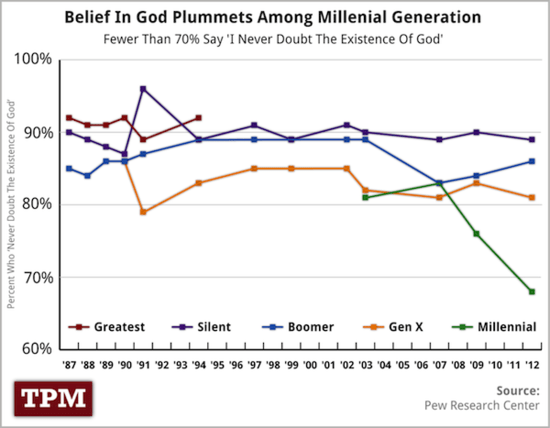
Millennials increasingly doubt the existence of God:

Young_Nonbelievers

Dan Merica looks at the entire population:

Despite the findings on millennials, the survey shows that the United States continues to be a highly religious nation, with most Americans identifying with a particular faith. Seventy-six percent of all respondents said prayer is an important part of their lives and agreed that “we all will be called before god at the Judgment Day to answer for our sins.” About 80% said they have never doubted the existence of God.

Stephanie Mencimer considers the political consequences:

The trend lines join other bad polling news for evangelicals, namely that younger Christians are turned off by attacks on gays and lesbians. Such trends don't bode well for the Republican Party. By 2020, Millennials will make up the largest single voting bloc in the country, some 90 million strong, and they are already showing a distaste for GOP politics.

They will have come of age when the GOP revealed itself as the party of intolerance, anger, and spite. Even if Obama is defeated, the generation who brought him to power will change this country without him.

How Obama Could Play The GOP On Taxes

Pete Orzag imagines a hypothetical approach to the 2013 "fiscal cliff" that might get Republicans to back down:

The Administration, having tried valiantly but failing during the lame-duck session to extend the tax cuts only for those with incomes below $250,000, allows all the tax cuts to expire at the end of the year. Taxes rise, the debt limit looms, and commentators on CNBC say the world is about to end. Rather than continuing the unproductive debate over extending part or all of the tax cuts, though, the Administration then steps forward with an entirely new tax cut, which could take many forms. One example would be a substantially larger payroll-tax holiday, combined with an increase in the standard deduction. The Administration also offers modest entitlement changes while dialing back the immediate spending cuts. Amid all the external demands for a deal that lifts the debt limit and resolves the uncertainty, it then dares the Republican House to vote against a large tax cut and some modest entitlement changes. Stranger things have happened.

This is a post-election take similar to Tomasky's daydream yesterday. Dan Drezner, noting significant pressure from Wall Street on the GOP to cut a deal, interprets the impasse as a key piece of evidence in understanding American politics:

 If money is the honey, then a deal will be cut, and well before December.

As the myriad articles suggest, what freaked out business wasn't just the rank partisanship during the last debt deebacle, it was how close things got to a breakdown.  They don't want to see that happen again. If ideology is what counts, however, then the House GOP won't budge, if at all, until the last minute.  They don't want to see taxes go up, but I'm not sure that they would be willing to make a compromise that would permanently eliminate tax deductions in order to preserve the status quo in income tax rates. 

Poseur Alert

"For the longest time, we've been reaching for a typeface that wasn't there. We knew it was something spare and tranquil, its letterforms reaching ambitiously outward, and we could hear it speaking in hushed but captivating tones. We imagined it as industrious, combining space-age optimism with the confidence and composure of a master craftsman. We could see the typeface among the realm of satisfying things, objects designed not merely to be used but to be enjoyed: a well-balanced knife, a performance engine; the tool that fits the hand just so," – Typography.com, reviewing the new Idlewild font. Update from a reader:

I don't know if you realize this, but Typography.com is the seller of that font, not a reviewer. It's marketing copy. And it seems in the ballpark of normal marketing copy to me – especially when you consider its audience is typographers, not laypeople.

What Keeps The Romneyites Up At Nights

Here's a question: if Barack Obama had to go through a brutal process of defending the doctrines, sermons and ideology of a church he merely attended, why is Mitt Romney exempted from explaining the doctrines and statements and ideology of a church he was an actual leading official in? I've been doing my best to read up on Romney's life and career and the more you read, the more you agree with one of his fellow worshippers who told the New York Times that Mormonism is

at the center of who he really is, if you scrape everything else off.

You could argue, as I do, that politics and religion are separate spheres and that a candidate's faith 226px-Book_of_Mormon_1830_edition_reprintshould not be a major issue for anyone. But Romney is running as the leader of a party whose modern incarnation is defined by an insistence that religion and politics are inseparable, and Romney's runner-up memorably described president Kennedy's strict affirmation of political secularism as puke-worthy. So there really is no solid defense against an examination of Romney's faith and how it formed him – or questioning some of his faith's stranger doctrines. The media thus far have trod gingerly around the subject for good reason. Anti-Mormon bigotry, like racism, has been part of this country for a long while and in many ways, an election between a black man and a Mormon is a stupendous achievement for toleration in America.

And yet. There must be a way to tell a story about Romney's Mormonism that is illustrative and helpful in understanding a man we could put in the Oval Office rather than bigoted. In my view, this should be a priority for Romney, and he should soon give a speech, like Obama's bright shining moment after the Jeremiah Wright onslaught. But I fear he won't, because any day he is talking aout Mormonism rather than the economy is a lost day. But if Romney thinks Mormonism will somehow not be a factor in this election, he's deluding himself. A new paper suggests a surge in anti-Mormon sentiment in the past few years, and a very stable and resilient anti-Mormon bias among evangelicals – who didn't give Romney a single majority in any of the primary states. Money quote from Buzzfeed's summary:

According to the paper, concern about Mormonism has remained relatively stable among Evangelicals, with 36 percent expressing aversion to an LDS candidate in 2007 and 33 percent doing so in 2012. But among non-religious voters, that number shot up 20 points in the past five years, from 21 percent in 2007 to 41 percent in February. There were also substantial increases in Mormon-averse voters among liberals — 28 percent in 2007 and 43 percent in 2012 — as well as moderates, who went from 22 percent in 2007 to 32 percent this year…

The new study argues that the single most accurate predictor of how a voter views Romney is how he views Mormons — whether or not they are Christian, patriotic, hard-working, and friendly. Strikingly, the correlation between attitudes about Mormonism and support for Romney is even stronger than political ideology or party identification.

Perhaps most potentially distressing to Romney's campaign is the study's finding that conservatives who said they were less likely to vote for a Mormon were much more likely to say they were undecided or would not vote at all in a contest between Obama and Romney.

My italics. One caveat may be that the study was conducted before Romney clinched the nomination – so partisanship may help assuage conservative jitters. But if Karl Rove were running the Obama campaign, we wouldn't be discussing if this would emerge as an issue but how. I don't believe that the Obama campaign, in contrast, can or should touch it. But what I expect is that at some point the sheer enormous new prestige and legitimacy that winning the American presidency would give to the Mormon church will give conservative evangelicals the willies. That won't matter in the South – but it could factor in in Pennsylvania or Colorado or Ohio. And there may be some secular independents who really distrust the LDS Church.

Unless race trumps everything. And unless these very evangelicals also think the dude running against the Mormon is a Muslim. Is this a great country, or what?
Marriage And Parenting

The core case of those opposing marriage equality or touting the irrelevant study by Mark Regnerus is based on the idea that society can and does pre-emptively judge groups of people by their parenting skills and adjusts their right to marry or have kids accordingly. But that, mercifully, has never happened. Until gay parents came along:

There is no basis in the recent history of American social policy for testing the parenting skills of a class of citizens before we grant them permission to parent — or to marry. Given all the research on the hardships of children raised by single parents, there is still no movement to preemptively remove kids from broken homes after every divorce or to ban single people from having kids; such policies would be patently inhumane and unenforceable. Growing up in poverty increases the risk of a wide range of social and psychological ills, yet since the craze for eugenics died down, no one is proposing banning poor people from marriage or child rearing. And some ethnic and racial groups are statistically less likely to get or stay married, yet there is no ethnic litmus test for marriage or parenting — only a gay one.

Prometheus And The Origins Of Life

Zen Faulkes considers the science in Ridley Scott's newest film:

If aliens created humans, how would we know? Would it be as simple as ordering up a galactic paternity test? Detecting the difference between the evolved and the constructed is… not simple. This is the problem faced by Creationists and Intelligent Design. They claim that they have methods of detecting design in biological organisms, except that instead of the designer being Prometheus’s engineers, they see the designer as God. One potential criterion for distinguishing the designed from the evolved is is “specified complexity.” So far, biologists have not found “specified complexity” useful, but the question of distinguishing the built from the biological is a good one.

Distinguishing the designed from the evolved could increasingly be a relevant problem as synthetic biology progresses. Researchers have been able to build viruses from scratch for a decade now. We had the first organism with an artificial genome a few years ago. There, the team at the J. Craig Venter Institute deliberately implanted “watermark” in the DNA sequence of the bacteria. Not everyone might be so helpful as to sign their work, however. How could you determine if a flu virus was a natural mutation versus one that was deliberately built in a lab? You probably couldn’t, as far as I can tell. There’s no way to tell DNA made in a lab apart from DNA made in an organism. It’s all atoms.

James Gorman recently raised [NYT] similar concerns. Angela Watercutter sees similarities in the treatment of science and religion in the film:

The movie’s incessant sly references to faith shed light on the fact that, when it comes to how we answer life’s big questions, some use the scientific method, some use catechism, others use both, and everyone believes something. Scientific theories can be proven more readily than the existence of deities, but the path of the righteous in both cases starts with a leap of faith.

James Bradley sees a paucity of true religion in the film:

"It’s what I choose to believe" the characters in Prometheus say more than once, as if this somehow answers any challenge to their beliefs, or is a meaningful answer to the somewhat sizeable question of what happens to us after death. … Despite its religiosity American culture has largely given away the symbols and narratives that underpin traditional religion. This might seem an odd thing to say given the rise in fundamentalism, but in fact the two aren’t incompatible: what matters isn’t the narratives but belief, not just in God but in America. A threat to one becomes a threat to the other.

The culture of Hollywood may be less religiose, but in many ways it’s part of the same phenomenon. Severed from the traditional narratives of religion, writers and filmmakers fall back on the inane language of personal growth and faith, a language and discourse that is incapable of plumbing deep because it’s essentially ungrounded. In place of the deep symbols of religion we have exhortations to belief and faith, as if these were ends in themselves.

I'm off to see it tonight. Aaron and I watched Alien and Aliens to prep. Alien stands out to me as easily the superior movie.

Are Drones Defensible? Ctd

Obama_and_Biden_await_updates_on_bin_Laden

I wrote that the position Greenwald and Friedersdorf hold against the the drone campaign "kind of assumes 9/11 didn’t happen or couldn’t happen again, and dismisses far too glibly the president’s actual responsibility as commander-in-chief to counter these acts of mass terror." Greenwald counters:

I absolutely believe that another 9/11 is possible. And the reason I believe it’s so possible is that people like Andrew Sullivan — and George Packer — have spent the last decade publicly cheering for American violence brought to the Muslim world, and they continue to do so (now more than ever under Obama). Far from believing that another 9/11 can’t happen, I’m amazed that it hasn’t already, and am quite confident that at some point it will. How could any rational person expect their government to spend a full decade (and counting) invading, droning, cluster-bombing, occupying, detaining without charges, and indiscriminately shooting huge numbers of innocent children, women and men in multiple countries and not have its victims and their compatriots be increasingly eager to return the violence?

This passage is so overwrought it barely merits a response. Now George Packer and I are the real reasons for 9/11 or 7/7 or the brutal mass murders we just saw conducted by Islamists in Iraq? And the idea that I have "spent a decade" "cheering for American violence" is, well, ridiculous. For the last nine years, I have been a brutal critic of policies I once cheered on, and campaigned furiously against the pure, protracted violence of torture, which I always opposed. Ditto the notion that Bush = Obama or that Obama = Bush in the war on Jihadist terrorism. Not true, by a mile. Digby seconds Greenwald:

A great nation would not delude itself into believing that it can kill its way to security. And that's what this is — a violent version of security theater where we all feel soothed that the president is "taking out", one by one, all the foreigners who want to hurt us. And it's as ridiculous today as it was five years ago. Killing individuals, some bad I'm sure, along with innocents and lowly hangers-on cannot fix this problem.

In a later post Greenwald points out how unpopular drones are in other parts of the world. And that is a worry, as I wrote in my original post. But it seems to me that Glenn sees no difference between invading and occupying whole countries with the attendant blowback and infinitely larger civilian casualties, mistakes and ill-will, alongside a program of torture for prisoners (Bush) and a successful exit from Iraq and an attempt to defeat al Qaeda more surgically and precisely in its original heartland, while stopping torture and by that and other means dramatically improving intelligence (Obama).

I agree – how could one not? – that the drone program can backfire. Which is why I said it has to be conducted with extreme care. But the notion that the fundamental reason the US is now targeted simply because we defended ourselves from a brutal attack (and aims for more attacks) seems far too simplistic to me. Yes, we always have to worry about stirring more violence in defending ourselves from violence. But we also have to worry about the violence directed at us. There is a distinction between the motives of an arsonist and the errors of a fire-fighter.

And Digby has the same delusion: killing people doesn't win wars, she says. She would have opposed the Abottabad raid? Would Glenn? If Glenn is going to accuse me of being an imperialist, it seems to me he should be prepared to say he would not have killed bin Laden. The blowback in Pakistan has been intense. By Glenn's argument, bin Laden should still be sitting in his room, planning new assassinations and terror attacks. Does he think it's even halfway credible for any American president to have contented himself with that? Or is he not living on the same planet I am?