The brilliant campaign of the current hierarchy to alienate their own flocks with political posturing, moral baseness, intellectual rigor mortis, and reactionary theology, along with purging the seminaries of any gays or gay-friendly candidates, was supposed to create a more committed, more orthodox, purer, smaller church. It's working! Congrats to Dolan and Ratzinger. Very soon they will have their church. And it will be empty.
Month: June 2012
Ask Tina Anything: The Worst Thing About Living In England?
Why Romney Can Lie
Drum worries that "even on a national stage you can lie pretty blatantly and pay no price":
This discovery — that you can tell almost any lie without paying a price — is, in some sense, an example of national politics becoming a lot more like local politics. Blatant lying has always been routine in local races that don't get a lot of press coverage, but the brighter media spotlight kept at least a bit of a lid on it in higher profile races. However, with the splintering of the mainstream national media in recent years and the rise of the web and social media, national politics is local again. And being called on your lies by the occasional earnest fact checker now matters about as much as it does when a local columnist for a weekly newspaper calls you on it.
A Static Campaign
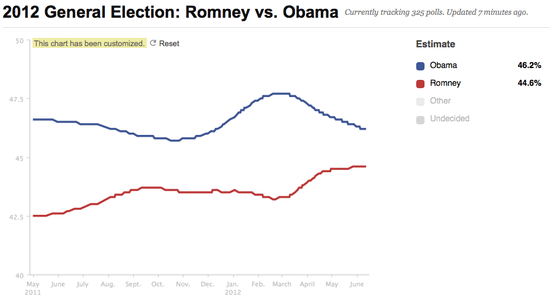
We are in the throes of panic or near-panic as Democrats realize how tough it is for an incumbent in these economic straits. And, for what it's worth, I obviously agree that so far, the campaign has been too negative about Romney, too positive about the economy, and without the critical argument about who is better to tackle the actual budget choices we face. But this is June. It's going to be a tight race throughout. The polling shows deep skepticism of both candidates' policies for the economy. Despite what you might hear, Nate Cohn finds little movement over the last month:
Why is the race so stable? For starters, the electorate is deeply polarized and there aren’t very many persuadable voters. Of course, many of those persuadable voters aren’t turned into the race. Most haven’t heard of Cory Booker, let alone care about his musings on Meet the Press. Obama’s comments about the state of the private sector may hurt him, but probably not until deployed aggressively by the Romney campaign.
The voters most likely to follow the intricacies of the race are also those most likely to have firmly made up their minds.
Gay Families Are Not A Theory
Millman delivers a reality check to opponents of marriage equality:
The case for gay marriage – the Burkean case, you might say – is simply that what amount to common-law gay marriages already exist. Numerous gay couples settle down for long-term, even life-long relationships of mutual support. They jointly own property. They bear, adopt, and rear children. These are already existing realities, not hypotheticals. They are not the product of state diktats; they are the product of organic cultural change which, in turn, has shaped changes in the law. The question before the people is whether to recognize these realities, and, if so, as what.
This is basically the point I have been making for twenty years to conservatives. The point of conservatism is to harness inevitable social change to the best ends possible, in ways that maintain as much as possible the institutions and habits of the past. Openly gay people exist and have thrived in the last decade in the US. This is the reality. The salient question then becomes: Is it better that society includes gay couples (and often children) in its already-existing institutions for love and family, or deny they exist at all, or set up new untested contraptions, called civil unions or domestic partnerships, to keep them in a segregated and balkanized holding area? Of those three choices, the first is obviously the socially conservative one; it adjusts by inclusion, not exclusion; it is pro-family (because gay people are part of families); it does not balkanize people on the basis of their identity; and it encourages mutual responsibility independent of the state.
This is a case where bigotry meets social conservatism, and in the GOP today, bigotry, not social conservatism, is in the driving seat.
Piers Morgan, Post-Modernist

We are asked to believe the following: that while the practice of phone hacking was epidemic in British tabloids, and while Piers Morgan was an aggressive tabloid editor at the height of the abuse, and while he had publicly mocked someone based on her private telephone messages, and had told others how easy it was to tap phones – he had no idea whatsoever that phone hacking was going on in his newspaper. Completely clueless. Shocked.
Then this fantastic nugget from a Mike Giglio report. It's about Morgan's purchase of the shares of a company called Viglen, a day before his own paper's financial column recommended them. The columnists did exactly the same, buying up Viglen stocks, then wrote a column which doubled their price, then cashed in. They were fired and convicted of market manipulation. But Morgan, as is his wont, kept his job, because there was no solid proof that he hadn't heard about the stock by some other means. Still, investigators – and yes, this is like pulp fiction – had tapes of his phone call to his broker. And it goes like this:
“I want to just pile into something … Viglen”; “There is something big coming on the Internet”; and, “It’s imminent, very imminent, so I want to get into these. It’s a rather convoluted route I’ve heard about it, but it’s kosher.”
When later asked to explain this formulation, spoken the day before the column appeared and the stock doubled, Morgan actually said:
‘Imminent’ to me is a bit like ‘long-term’. I would not hold too much weight to the final definition of the word.
He makes Bill Clinton look like the Dalai Lama. And somehow we're all supposed to maintain the fiction that he is ethical enough to be CNN's senior interviewer.
(Photo: TV hosts Jerry Springer and Piers Morgan arrive to BritWeek 2012's 'Evening with Piers Morgan' on May 4, 2012 in Beverly Hills, California. By Alberto E. Rodriguez/Getty Images.)
Simple Bets
To entertain your friends:
Kottke adds his own:
My favorite bet of this type is seeing who can empty a 2-liter bottle faster. The trick is to swirl the water to create a vortex in the bottle. That way, the air can quickly enter the bottle through the middle of the vortex while the water shoots out around the edge…no slow glug glug glug.
The Rise Of Child Allergies
It's worse in cities, where "nearly 9.8 percent of kids had food allergies." In rural America "only 6.2 percent did":
The so-called hygiene hypothesis holds that exposure to "dirt" (which includes bacteria, viruses and worms) forces young children's bodies to develop a healthy immune system. It follows that if you're not exposed to all the nastiness that the natural environment has to offer—which you might not be if you grew up in a concrete jungle and have parents who douse you in Purell—you'll be more likely to have a weak immune system that does things like have allergic reactions.
J. Bryan Lowder cautions:
The main problem is that researchers rely on responses to surveys, which, of course, are subject to the biases of self-reporting and memory. And parents who take the time to respond to such a survey are likely already invested in the subject emotionally, further clouding their answers.
America’s Poorest Whites
Monica Potts visits Owsley County, Kentucky, "the poorest county in the United States with a majority-white population:"
Kentucky began calling Owsley County a "pauper county" as far back as the 1890s, because it took more state tax revenue than it contributed. Since the federal government began tracking poverty rates in 1959, Owsley has ranked as one of the nation’s poorest counties. By the 1960s, when much of the United States had moved into prosperity, Southern Appalachia’s shoeless children, living in mountain shacks without electricity or plumbing, seemed like relics—trapped in a sticky poverty that modernity had yet to solve. The people of Owsley County translated all the attention as criticism. They weren’t descendents of pioneers. They were a problem.
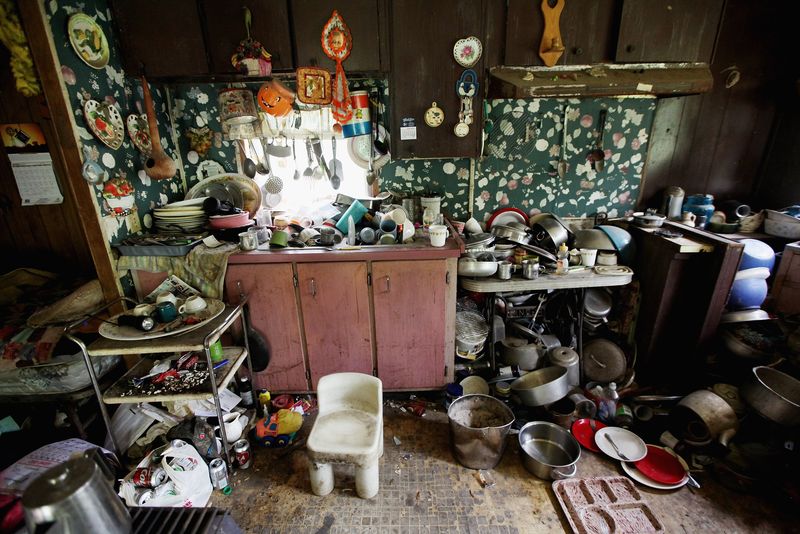
(Photo: Former chimney sweeper Mose Noble's kitchen is seen in Owsley County on April 21, 2012 in Booneville, Kentucky.
Noble is no longer employed but does volunteer cleaning graveyards from time to time. His trailer has no electricity or running water but he receives governmental and neighborly assistance. Daniel Boone once camped in the Appalachian mountain hamlet of Owsley County, which remains mostly populated by descendants of settlers to this day. The 2010 U.S. Census listed Owsley County as having the lowest median household income in the country outside of Puerto Rico, with 41.5% of residents living below the poverty line. Familial and community bonds run deep, with a populace that shares a collective historical and cultural legacy uncommon in most parts of the country. However, the community of around 5,000 struggles with a lack of jobs due to the decline in coal, tobacco and lumber industries along with health issues including drug addiction without effective treatment. By Mario Tama/Getty Images.)
When Justices Google
Josh Rothman summarizes Allison Orr Larsen's findings in the Virginia Law Review. How have judges traditionally evaluated cases:
All legal cases, Larsen points out, rest to some degree on facts, and, traditionally, the courts have relied upon what's called the "adversary system" to deal with them. Either side can introduce factual evidence into argument; if the other side thinks the facts are wrong, they can dispute them in court. Judges try to work with facts which have been vetted by both sides.
How the web has changed this:
Now, Supreme Court justices spend time Googling around, looking for facts to support their opinions. Around half of the facts cited in a typical Supreme Court brief now come, Larsen writes, "from sources that are not strictly 'legal.'"
And that means bias can creep in:
Liberal and conservative justices, like anyone else, tend to engage in "motivated reasoning," and will seek out information from sources which they know, in advance, will agree with them. Moreover, even the most objective justices can be biased unintentionally, since bias of some kind is the inevitable result of using search websites, which shape the results you find according to your preferences and tastes. Because of the way Google works, Larsen warns, searches "could produce different results for different chambers depending on, for example, the internet history (or Facebook profile!) of the users."
 The Dish