It contained the words "bisexual" and "transgender." And we all know what Mitt would have done to them in high school.
Month: June 2012
“America’s Hidden Austerity Program”

Ezra Klein breaks it down:
I ran the numbers on total government employment after the 1981, 1990, 2001 and 2008 recessions. I made government employment on the eve of the recession equal to "1," so what you’re seeing is total change in the ensuing 54 months, which is how much time has elapsed since the start of this recession. As you can see, government employment tends to rise during recessions, helping to cushion their impact. But with the exception of a spike when we hired temporary workers for the decennial census, it’s fallen sharply during this recession. Note that a Republican was president after the 1981, 1990 and 2000 recessions. Public-sector austerity looks a lot better to conservatives when they’re out of power than when they’re in it.
The implications are huge:
If state and local governments had followed the pattern of the previous two recessions, they would have added 1.4 million to 1.9 million jobs and overall unemployment would be 7.0 to 7.3 percent instead of 8.2 percent.
Obama’s Legacy
George Packer believes foreign policy will largely define it:
If Obama loses—a possibility that’s become the wisdom of the week—I think he’ll be remembered most for his foreign-policy achievements. And if he wins, the same will be true, except that he’ll have a chance of being a great foreign-policy President. [Ben Rhodes, speechwriter and deputy national security advisor] is right: foreign policy defines every President more than he expects coming in, and it does so in completely unexpected ways. It’s both more out of the President’s control than domestic issues and more under his control. It’s played to all of Obama’s strengths. In this sense, a one-term Obama Presidency would look less like the one that’s often held up as a spectre of failure, Jimmy Carter’s, and more like the one that’s increasingly considered a success, that of George H. W. Bush, the living President about whom Obama has had the most nice things to say.
My support for Obama is primarily because of foreign policy. And thus far, he has exceeded my expectations.
Does Believing In Evolution Matter?

Countering me, Kevin Drum argues that it doesn't:
The fact is that belief in evolution has virtually no real-life impact on anything. That's why 46% of the country can safely choose not to believe it: their lack of belief has precisely zero effect on their lives. Sure, it's a handy way of saying that they're God-fearing Christians — a "cultural signifier," as Andrew puts it — but our lives are jam-packed with cultural signifiers. This is just one of thousands, one whose importance probably barely cracks America's top 100 list.
And the reason it doesn't is that even creationists don't take their own views seriously. How do I know this? Well, creationists like to fight over whether we should teach evolution in high school, but they never go much beyond that. Nobody wants to remove it from university biology departments. Nobody wants to shut down actual medical research that depends on the workings of evolution. In short, almost nobody wants to fight evolution except at the purely symbolic level of high school curricula, the one place where it barely matters in the first place.
Ryan Cooper disagrees:
I say a lack of wide understanding of evolution is hurting the country, most obviously in the form of antibiotic resistance. Industrial feedlots grow their animals stewed in powerful antibiotics to shave their operating costs, which isleading to bacteria evolving past them and resistant infections cropping up in humans. It’s a classic case of concentrated benefits and dispersed costs, which are tough to overcome in any case, but an understanding of evolution makes the situation immediately and alarmingly obvious, while disbelief can cloud the situation. Witness hack "scientists" at Liberty University, who publish work quibbling with the details of the evidence and thereby muddy the conversation. I’m not saying that’s the only factor, but surely if 80 percent of the country had a strong understanding of evolution, it would be easier to horsewhip the FDA into outlawing antibiotic use in non-sick animals.
A Gay Man Leading A Straight Life, Ctd
Dan Savage agrees with the basic lesson I draw but worries:
But "free to be you and me" is not the lesson anti-gay religious conservatives are going to draw from Josh Weed's case. They will hold Weed up as proof that there's no need for marriage equality or domestic partnerships or civil unions—no need to recognize same-sex couples under the law at all—because all gay people everywhere should follow Josh Weed's example. Society should encourage each of us to find an opposite-sex partner who is willing to marry us and who we can either fuck successfully while thinking about gay sex or whom we feel so strongly about that we 1. actually enjoy fucking or 2. will claim we enjoy fucking in blog posts that our opposite-sex partners help us write. Unicorn Marriages—Weed describes himself as a unicorn—will be pushed as Plan B for gays and lesbians who flunk out of ex-gay ministries.
On that note, a reader points out:
Josh Weed is a family and marriage counselor. According to his employer's website:
As a therapist, Josh works with many people struggling with difficult life issues, but focuses his efforts mainly on adolescent and adult sexual addiction issues, with an emphasis on youth treatment. His work is dedicated to helping people combat patterns and beliefs that cause feelings of shame, hopelessness and despair. Josh also works helping those with sexual identity issues and unwanted sexual attractions and/or behaviors. Before transitioning to private practice, his clinical work revolved around his role at Kent Youth and Family Services, where he still performs Drug and Alcohol assessments. Josh particularly enjoys working with youth; helping them feel hope as they face many life challenges.
How many of his clients go on to fully accept "the gay lifestyle"? What does he think about that choice? Surely, you have someone on staff who can dig a little deeper before announcing your support for this man and his choices.
Another reader shares Dan's concern:
I do feel for Josh Weed. His story of a gay teenager desperate (his word, not mine) to meet the expectations of his church, desperate to be loved by someone ("If YOU won’t consider marrying me, then who will?") and totally incapable of exploring something deeper with another man is heartbreaking. As an adult, his inability to see the difference between "lust" and "passion", and his seeming incapability of seeing the value of nonbiological families and adopted children (on his lesbian psychologist’s daughter: "a girl, whom she considered her daughter") is similarly tragic. I fear the reality behind his mask is not as proper as his blog post makes it appear. I feel for him.
But I don’t quite agree with your assessment of Josh. While he certainly makes, by FAR, the most clear-headed, honest and endearing appeal I’ve ever heard from an ex-gay (I know he doesn’t use that term, but that’s essentially what he is), I don’t think his story is benign. In a perfect world – one with no homophobia or religious intolerance towards gay people – gay men who want to marry women should be free to do so without criticism.
But we don’t live in a perfect world. We live in a world where rampant homophobia means that millions of gay couples are desperately fighting for the right to marry and protect their children, where young gay kids are killing themselves at astonishing rates and where far too many young gay men and women are torturing themselves in therapies that promise conversions to straightness. Taking stories like Josh’s at face value hurts all of us.
Josh seems like a nice guy who may not intend to use his story to influence other men in similar situations, but rest assured, his story WILL be used as fodder by the anti-gay industry. Every homophobic Mormon (or Catholic or Protestant or Jew or Muslim) who reads this will now have at least one more story where a gay man was able to overcome his desires ("see, just because you’re born that way doesn’t mean you have to act on it!"), only helping to cement their intolerance.
Alan Jacobs, on the other hand, finds Weed's story applicable to all types of relationships:
The really interesting thing about the story has nothing to do with homosexuality, but with the possibility that our society has the logic of attraction all backwards: we start with sexual desire and hope to generate other forms of intimacy from that, but this model suggests that it could make more sense to start with the kind of intimacy that is more like friendship than anything else, and to trust that sexual satisfaction will arise from that.
On what planet does Jacobs live? Planet lesbian?
Are Drones Defensible?

Friedersdorf believes that my posts on drones are at odds:
Sullivan is … celebrating Obama's drone kills and suggesting that they're part of why he deserves reelection. And yet, in more considered moments, he asserts that the drone campaign (a) violates the constitutional imperative to get Congressional permission for war; (b) constitutes the use of a technology that inclines us to blowback and permanent war; (c) effectively ends the Founders' vision; (d) empowers an unaccountable and untrustworthy agency; and (e) kills lots of innocent children.
Hold on. (a) The war against al Qaeda in Afghanistan and Pakistan was explicitly authorized by the Congress back in 2001. (b) recent research suggests blowback is not inevitable in all cases (although I certainly agree it is a major drawback) and the attacks themselves are extremely effective in what they are trying to do:
On the basis of comprehensive analyses of data on multiple terrorist and insurgent organizations, [two new] studies conclude that killing or capturing terrorist leaders can reduce the effectiveness of terrorist groups or even cause terrorist organizations to disintegrate … [R]eligious terrorist groups were almost five times more likely to end than nationalist groups after having their leaders killed.
(c) What ends the Founders' vision is religious terrorists from mountains in Middle Asia successfully invading and terrorizing major cities in the US and killing thousands. What frustrates me about Conor's position – and Greenwald's as well – is that it kind of assumes 9/11 didn't happen or couldn't happen again, and dismisses far too glibly the president's actual responsibility as commander-in-chief to counter these acts of mass terror. If you accept that presidential responsibility, and you also realize that the blowback from trying to occupy whole Muslim countries will be more intense, then what is a president supposed to do? I think the recourse to drone warfare is about as reasonable and as effective a strategy as we can find. It plays to our strengths – technology, air-power, zero US casualties, rather than to our weaknesses: occupying countries we don't understand with utopian counter-insurgency plans that end up empowering enemies Moqtada al Sadr and crooks like Hamid Karzai, and turn deeply unpopular at home. Given our country's fiscal crisis, massive expensive counter-insurgency is no longer a viable option.
Not that blowback isn't a real worry; not that all of Conor's concerns shouldn't be part of the equation. It's possible, for example, that wiping out the entire mid and top leadership of al Qaeda could make things worse:
What is coming next is a generation whose ideological positions are more virulent and who owing to the removal of older figures with clout, are less likely to be amenable to restraining their actions. And contrary to popular belief, actions have been restrained. Attacks have thus far been used strategically rather than indiscriminately. Just take a look at AQ’s history and its documents and this is blatantly clear.
But as Will McCants explains:
Al-Qaeda Central’s senior leaders seek to kill as many citizens as possible in the non-Muslim majority countries they don’t like, particularly the United States and its Western allies … It is hard to imagine a more virulent current in the jihadi movement than that of al-Qaeda Central’s senior leaders. Anyone with a desire or capability of moderating that organization was pushed out long ago.
Daveed Gartenstein-Ross and Clint Watts side with McCants. Bill Roggio returns to basics:
Nine years into the drone program, it is now clear that while drones are useful in keeping al Qaeda and its affiliates off-balance, the assassination of operatives by unmanned aircraft has not led to the demise of the organization or its virulent ideology. During both the Bush and Obama administrations, US officials have been quick to declare al Qaeda defeated or "on the ropes" after killing off top leaders, only to learn later that the terror group has refused to die. Instead of being defeated, al Qaeda has metastasized beyond the Afghan-Pakistan border areas, and has cropped up in Yemen, Somalia, North Africa (including in Mali), and even in the Egyptian Sinai.
And there does seem a danger, especially in Yemen, that drones may be focusing the Islamists' attention away from their own government and onto ours. Which is why this program needs to be very carefully monitored, excruciatingly reviewed, constantly questioned. So yes, I'm with Conor on the need for more accountability and transparency on this.
But if you'd asked me – or anyone – in 2001 whether it would be better to invade and occupy Afghanistan and Iraq to defeat al Qaeda, or to use the most advanced technology to take out the worst Jihadists with zero US casualties, would anyone have dissented? And remember the scale of civilian casualties caused by the Iraq war and catastrophic occupation: tens of thousands of innocents killed under American responsibility for security. The awful truth of war is that innocents will die. Our goal must be to minimize that. Compared with the alternatives, drones kill fewer innocents.
Of course, we need to be incredibly careful to limit civilian casualties even further. Counting every military-age man in the vicinity of a Jihadist as a terrorist is a total cop-out. We should see the real casualty numbers and adjust accordingly. But we also have to stop the Jihadist threat. It is real. And a president does not have the luxury of pretending it isn't.
(Photo: A MQ-9 Reaper unmanned aerial vehicle prepares to land after a mission in support of Operation Enduring Freedom in Afghanistan. The Reaper has the ability to carry both precision-guided bombs and air-to-ground missiles.)
The View From Your Window Contest: Winner #106

A reader writes:
A VFYW contest from India that's a bit easier than last week's, perhaps? My guess is the glass house of the Lal Bagh Botanical Gardens in Bangalore.
Another:
Well, once again this week's VFYW is California, my home state (although I now live in Victoria, British Columbia). The view is of the Golden Gate Park Arboretum, and if I were on my yearly visit I'd go down to the park and find the exact vantage point. No such luck, so let's say the photo was taken from the second floor balcony of the De Young Museum, or third, or something like that …
Another:
My confidence in my VFYW answers is undermined by how often I'm way off, so I'll just say I THINK I know where that is because I did study abroad in Madrid, Spain for six months and it looks very familiar. Specifically it's the Palacio de Cristal, located in the Parque del Retiro. It's a gorgeous glass structure in the heart of the Parque del Retiro that makes Central Park look like a garbage dump.
Another:
I don't have the time to do an extensive search to determine longitude, latitude, forward facing direction and such, but I'm pretty sure this is the Butterfly House at the Hofburg Palace in Vienna. Somebody else will get the window book, but I'll just be happy if I'm correct.
Another:
The Gardens of Vatican City? I know this is a long shot, and considering the source I doubt The Dish would be highlighting the Vatican, but it reminds me of a photo I took out the window of the Hall of Maps on my honeymoon. It is a beautiful scene there and something the Vatican should show off more often.
Another gets on the right track:
This looks like Italy, with the cypress trees, pines, tile roofs, and the villa in the distance. However, I have no idea what city.
Another does:
Short and sweet: Giardino dell'Orticultura, Via Vittorio Emanuele II, Florence, Italy. The photo is probably taken from a room on the top floor of the Hotel Relais Amadeus, Via 20 Settembre. Never been there; looks beautiful; should put it on my bucket list.
Another sends an aerial shot:

Another:
Every week, I only give myself five minutes to figure these out. If I get it in five minutes, fine. If not, I move on. I seldom succeed. But this one I found just like that. Searched images for "Stanford University greenhouse." Nope. Searched images for "tuscany greenhouse." Bingo.
A close-up shot from a reader:

Another writes:
It was built by someone by the name of Giacomo Roster in 1879. The glass house (or Tepidario) opened in 1880. The main entrance of the park is located at Via Vittorio Emanuele II, 4. A smaller side entrance next to Via Bolognese, 17, is closer to the glass house and helped me find the window that is my guess this week. It took me a day and a half to find the location searching every "glass house," "greenhouse," "orangery," etc. that could viably be surrounded by cypress trees and terracotta roofs. (I was unaware of the term "tepidario" or "tepidarium" when I began the search.) Thus, after an exhaustive study of glass houses in the U.K., the apparent epicenter of Victorian glass houses, and confirmation that I wouldn't find terracotta roofs of this style there, I limited my search to Italy, Spain, France, Australia, Argentina, Brazil, Southern California and Florida.
Thanks to you, I now know more about Victorian (and later) glass houses than I'd ever have expected to know.
Another:
This is my first time writing in for the VFYW contest, but after seeing the photo, I recognized the place immediately, having lived in Florence for a little more than two years. The tepidarium of the Giardino dell'Orticultura is instantly recognizable, and the typical Tuscan buildings in the background help to confirm that. From the perspective, I'm guessing the picture was taken from somewhere near Via Bolognese, 5. I'm sure one of your other readers will come up with the precise address.
There are actually a surprisingly large number of art nouveau (called Stile Liberty in Italy) buildings in that city. One of my blog posts from that time shows some of the highlights. I'm sure most tourists rush by these beautiful buildings on their way between the Renaissance attractions, which is a shame.
Another:
When I studied abroad in Florence during my junior year at Vanderbilt, my back patio looked onto this garden. The physical location is off of Via Bolognese in northern Florence, which leads up to the Etruscan-turned-Roman town of Fiesole. While I lived in the apartment, the garden was mainly used by locals (often elderly) who relaxed for hours on the benches. For what it's worth, I remember a fair number of young children, as well, but a surprising lack of parents. The greenhouse also hosted a few noisy parties during my stay, but otherwise laid fairly dormant. The building was more of an enigma to me, as it was quite a remarkable building in a pleasant setting.
In any case, my guess as to the physical location that the photo was taken was from the southernmost window/door of the north-side apartment on the third floor of #5 Via Bolognese. The height seems consistent with the trees and the top-right shadow seems consistent with the overhang. More photos of the building can be found here.

So close to the exact address. Another:
So, here's what we're looking at. You can see the house with the two-tone paint job in the foreground in this pic courtesy of Google maps. I think we're looking down from the window/door in the middle of the picture – the one that is perched atop the house, with the teal door that is directly to the left of the trees trunk (it abuts it). You can tell by the slight bit of roof in the right hand side of the pic. This house is one the Via Bolonese, too, and is probably #8, although I'm not certain.
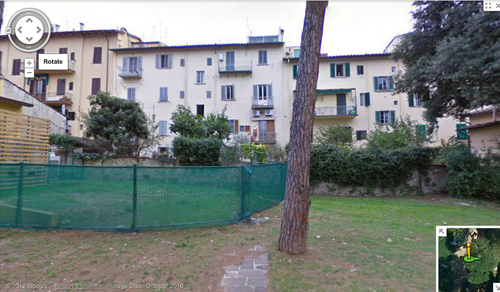
Even closer. Another zooms in further:
This picture was taken from one of the buildings on the Via Bolognese that overlooks the Horticultural Garden (Giardino dell'Orticultura) in Florence. The greenhouse is called the Tepidarium del Roster and is the largest greenhouse in Italy. My best guess as to the specific window – or balcony door – is shown in the attached Word file with a blue arrow:
You should get dozens, if not hundreds, of correct answers.
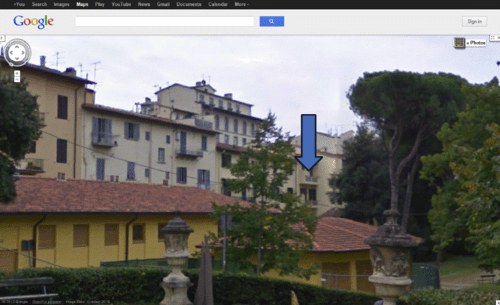
Forty-one to be exact. About a dozen guessed the correct address – 7 Via Bolognese – but only a few nailed the correct floor as well. One of them is the following reader, who broke the tie by having correctly answered previous views without yet winning:
You are either taking pity and going easy on us lately or I am just lucky. This is the second time in a month I "knew" where the picture was taken at first glance (Depoe Bay was the other). Everything in the picture, especially the villa in the distance, screamed Florence. My wife and I were married there and the architecture of the villa evokes some wonderful memories:
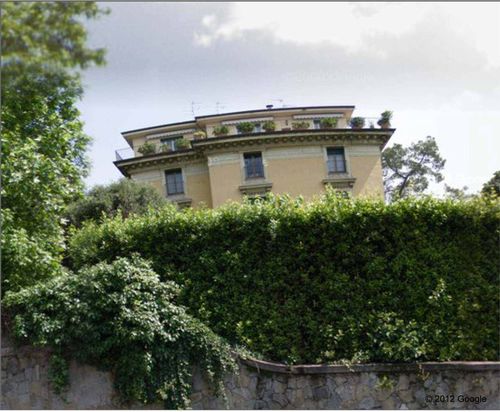
Figuring the exact address was more problematic. Estimating the angles by looking at the position of the trees and the smaller buildings in the foreground, I came to #7 Via Bolognese. The photo was taken from a window on the third floor in the rear of the building. The third picture is of that beautiful villa on Via Trento from Google street view. My wife and I have decided we could be very happy there.
And we hope you will both be happy with the window book. Details from the submitter:
Taken today from the rear of our third floor apartment at 7 Via Bolognese, Florence, Italy overlooking the Giardino dell'Orticultura. It is the beginning of the old road to Bologna. Our friend's family has owned this apartment for a very long time. He is in his 70s now and grew up there. He remembers the nearby Ponto Rosso (bridge), which is less than 100 yards away from the apartment, being blown up in WWII.
(Archive)
The Psychology Of Pooping, Ctd
A Very Crappy Christmas
Get More: SOUTH
PARKmore…
A reader pinches her nose at the popular thread:
The proper receptacle for some substances is a white porcelain bowl, not a public forum. Not interesting to most of us over the age of five.
Well, our readership seems to consist of the under-5s then, given the dozens of emails still piling up. A final push to get it all out of our system:
Since you’re on the subject, this Craigslist story one of my all-time favorites. I don’t know what it says about me that I think this is one of the funniest things I’ve ever read. I guess I’m a child.
Another:
In York, England, there’s a Viking museum whose featured display is a 7-inch petrified “log” known as the “Lloyds Bank Coprolite“. Money quote:
In 1991, paleoscatologist Andrew Jones made international news with his appraisal of the item for insurance purposes: “This is the most exciting piece of excrement I’ve ever seen. In its own way, it’s as valuable as the Crown Jewels.”
Another:
I know your thread is about the Psychology of Pooping, but you may want to share this link on the Mechanics of Pooping. In short, you’re doing it wrong: grab your ankles. I took this advice, and I’ve shared it with friends, and we agree it’s the shit.
Another:
There’s an interesting cross-cultural comparison to be made, as well. When I visited Germany, I noticed that many toilets had a curious design. At the back of the bowl was a sort of shelf just at or above the waterline. After I asked the first German why they were like that, I absolutely had to ask several others, independently of each other. They each gave exactly the same response: “So you can inspect what came out.”
Another:
While growing up, I went to sleep-away summer camp for nine years. For me, camp was a stressful experience, mainly due to my pooping anxiety. I used to never poop outside my house, so going to sleep-away camp for the summer posed many problems. I had chronic stomach aches and I was constantly nervous about how I was going to be able to poop. This issue continued with me in college, but I scouted out “secret bathrooms” and I would go to these areas at times when no one else was around.
Then I studied abroad in West Africa, where desperate times called for desperate measures. The food and water did strange things to my stomach, so I had to gain the flexibility of when and where I was willing to poop. This was the most liberating experience. Though I learned a lot when I was abroad, the ability to poop in many different settings changed my life.
And another:
I’ve been following your thread on pooping with interest, because you’re missing an opportunity to address one of the great pooping issues of all time while simultaneously reaching out to female readers, who we all know are underrepresented on your blog. That question is, of course, the following: why do men take so much longer to take a shit than do women?
Women are in and out. Unless they have dysentery, they take care of business and get on with the rest of their day. Men, on the other hand …
So what is it? Does it physically take longer for men to excrete poop? Or do they consider this a reprieve from their lives, a meditative interlude, a spa break? Or is it something else altogether?
I work in the heart of venture capital – Sand Hill Road – and I’ve noticed a disturbing trend in my office complex, which is filled with august venture firms, which remain almost entirely male (a topic for another thread). The men’s restroom and the women’s restroom are next to one another, and so I see this trend, up close in all its horror. I see men – grown men! rich men! – TAKING THEIR IPADS INTO THE RESTROOM, without a second thought, without even a hint of abashment.
iPads are today’s newspapers. Never borrow a man’s iPad.
Or an iPhone:
iPoo, a social-networking app that connects people sitting on toilets, sounds like a joke, but it exists. More than 200,000 people have paid $1 apiece to download iPoo since it launched two years ago, say the app’s creators, enough to help put one of them through Harvard Business School. And tens of thousands use it every day, they say. “In hindsight it was a great idea, but we weren’t expecting it to be anything more than a joke amongst ourselves,” says Amit Khanna, a 30-year-old accountant in Toronto. He says one of his fellow iPoo co-creators is ashamed to be associated with it.
A website that pushes even us to our limit:
If you are going to introduce your friend’s story of the water-breaker, you need to include a link to ratemypoo.com [NSFW], where there is an entire universe of people pretty well obsessed with their own waste. I am generally only able to go about four clicks deep before I simply have to turn away, a reaction I do not have to diaper changes. Some years back, my sister and I shared that site with our parents, trying to gross them out. They spent like half-hour clicking, giggling and gasping – transfixed. I was mortified.
Some readers don’t need a site:
My group of close male friends are obsessed with our dumps. We send each other pictures of remarkable ones, along with notes detailing our diet over the past 24-36 hours, length of time we were sitting on the can, the smelliness of the excrement, and our level of satisfaction post-dump, on a scale of 1-10.
But the most important detail is where the dump took place. Was it in the office building’s restroom with high traffic, where everyone was left wondering who was stinking up the place? Was it in the church bathroom next to the office with poor sound insulation, where the absurdly proper and delicate church secretary could hear the sound of your poo hitting the water, and your overblown sighs of relief? And did she make eye contact with you on the way out?
In our own dictionary, the single long one that breaks the surface of the water is called “Nessie”. My most notable contribution – bloody stool mixed with vomit from a food poisoning incident during a post-disaster relief operation – is called “The Death Star”.
One more email:
Not sure how this is going to make it through your spam filter, but: For my money nothing beats a “potato gun”. You know, a nice compact poop that shoots out cleanly and doesn’t even require a wipe (of course, I do a couple safety wipes anyway). Shits of this nature will often be accompanied by a mid-level whooshing sound which is the reason for the name.
Is this thread an all-time low or all-time high for The Dish? I can’t decide.
My secret: Yerba Prima Daily Fiber Caps. Seriously changed my life. They come out like large, clean, perfectly formed rabbit poops, leaving nothing but white on your toilet paper. Heaven.
How Many Ways Can Mitt Deceive People?
Andrew Sprung counts 'em.
Are Gay Parents Worse Than Straight Parents?

Mark Regnerus has a new study, funded by socially conservative organizations, that claims to compare gay parents with straight parents. Except it doesn't:
Instead of relying on small samples, or the challenges of discerning sexual orientation of household residents using census data, my colleagues and I randomly screened over 15,000 Americans aged 18-39 and asked them if their biological mother or father ever had a romantic relationship with a member of the same sex. I realize that one same-sex relationship does not a lesbian make, necessarily. But our research team was less concerned with the complicated politics of sexual identity than with same-sex behavior.
Unsurprisingly, this methodology found that the children of "gay" parents were "comparable to those from heterosexual stepfamilies and single parents." Jim Burroway double-takes:
When you look at the data, the study’s real findings become obvious. Children of parents who have had a same-sex relationship — a group that includes very large numbers of children of divorced parents, single parents, adopted parents, step-parents and "other" family structures — have developmental outcomes which are remarkably similar to children of divorced, single, adopted, step-, and "other" family structures overall when compared to intact, non-adoptive heterosexual families.
Regnerus designed his study to show this result by constructing samples which mimicked these characteristics. By constructing his [LM (child of a lesbian mother), and GF (child of a gay father)] samples the way he did, the only legitimate comparison he could make would be to children of divorced, single, adopted, step-, and "other" family structures. But that’s not the comparison he made. He focused the study on making the wrong comparison, and then concluded that children of gay and lesbian parents have more negative outcomes than children of straight parents in intact households.
John Corvino puts it more bluntly:
Question: What do the following all have in common? A heterosexually married female prostitute who on rare occasion services women. A long-term gay couple who adopt special-needs children. A never-married straight male prison inmate who sometimes seeks sexual release with other male inmates. A woman who comes out of the closet, divorces her husband, and has a same-sex relationship at age 55, after her children are grown. Ted Haggard, the disgraced evangelical pastor who was caught having drug fueled-trysts with a male prostitute over a period of several years. A lesbian who conceives via donor insemination and raises several children with her long-term female partner.
They are all defined in the study as committed same-sex parents with civil marriage, like their heterosexual peers. William Saletan has similar concerns. The lesson he draws:
[K]ids from broken homes headed by gay people develop the same problems as kids from broken homes headed by straight people.
But that finding isn’t meaningless. It tells us something important: We need fewer broken homes among gays, just as we do among straights. We need to study Regnerus’ sample and fix the mistakes we made 20 or 40 years ago. No more sham heterosexual marriages. No more post-parenthood self-discoveries. No more deceptions. No more affairs. And no more polarization between homosexuality and marriage. Gay parents owe their kids the same stability as straight parents. That means less talk about marriage as a right, and more about marriage as an expectation.
Exactly. It's also important to note that one of the reasons the study asks about a parent's sexual orientation – but not about whether that parent is in a committed, stable relationship – is that it's dated. It's about current adults who grew up in mostly dysfunctional homes, where one of the parents may have had a homosexual affair, or is leading a double life, or is self-medicating to cope with being gay while acting straight. In so far as the study reflects the difficulties for children growing up in such unstable homes, it is surely making the case for stable civil marriage as a critical institution for the rearing of children. I of course agree. But this won't be how the reactionary right will spin this:
Unfortunately, this study is bound to be misused in the ongoing debate over same-sex marriage, as evidence for the oft-repeated claim that "children do best with their own biological mother and father." That claim, as I argue in my new book Debating Same-Sex Marriage (with Maggie Gallagher), "conflates a number of distinct variables, including parental number, parental gender(s), marital status, and biological relatedness…. But to the extent that researchers have isolated parental gender, comparing same-sex to different-sex parents, they have found that the children fare just as well in each case." That finding is in no way undermined by the Regnerus study. And that’s the correct interpretation of the "no differences" paradigm that Regnerus aims, and fails, to counter.
Douthat uses the study to argue for marriage equality federalism:
Same-sex marriage is a social experiment, and like most experiments it will take time to understand its consequences. We don’t know how relationship norms and expectations will evolve in the gay community – where the ongoing Dan Savage-style debates about monogamy and fidelity will lead, for instance, or how closely same-sex marriage will be associated with childrearing. We don’t know how plausible Saletan’s vision of wedlock and parenting running on parallel tracks for gays and straights really is. And the near-universal liberal optimism on the subject notwithstanding, we don’t really know how straight culture will be influenced on the long run by the final, formal severing of marriage from procreation. If gay marriage gains ground on its current trajectory – state by state, steadily but still somewhat gradually, driven mostly by generational change – then there will be time to watch these trends and debate their implications. But if the Supreme Court (that is, Anthony Kennedy) simple nationalizes gay marriage, there will be no room for debate and no chance for any reconsiderations.
I'm with Ross on this. This deeply flawed study simply shows we do not know the impact of more stable, committed civil marriages for gays on the social and personal outcomes for their kids. The only way to figure that out definitively is to try it in the real world. We're only a few years into the marriage equality experiment in the first state, Massachusetts. It will be years before real studies of actual child-rearing by married gay couples can be conducted. So let us move forward gradually. I should add, by the way, that a conservative would surely see parents who are committed for life in stable civil marriages as the best possible. And yet they are doing their damnedest to prevent that for gay people and our kids. There is no logic here; just panic.
(Graphic by Rob Tisinai)
 The Dish