Grimm Tales

Fairy tales weren't for children at first:

In [the original] "Cinderella," birds peck the stepsisters’ eyes out after the girls cut off their heels and toes to try to fit their feet into the glass slipper. In the 1812 and 1815 editions of "Children’s and Household Tales," there is a story in which children pretend to be butchers and slaughter the child who plays the part of the pig. … When the Grimms began gathering the first versions of "Snow White" before it was published, it was a tale about a mother who is jealous of her daughter and wants to have her killed. The Brothers Grimm went through eight revisions and by the second edition in 1819, Wilhelm Grimm began embroidering the story, making it more sexist. He has Snow White saying ‘I’ll be your good housekeeper’ to the dwarves; he changed the mother to a stepmother. It changes a lot.

The latest iteration of the classic tale, Snow White And The Huntsman, tries to sever its sexist roots:

[The film] is a triumph of feminist storytelling not because the female leads look invincible but because they are fully dimensional.

Other critics have suggested that all this feminist reimagining is eventually hijacked by an attempt to masculinize the story, literally dressing Snow White in a suit of armor. It’s true that things come to a predictable end, with a saber-rattling battle. But director Rupert Sanders didn’t turn the two female leads into men. "That happens sometimes when films turn women into action heroes," he told USA Today. "But I made a decision not to have Kristen [Stewart] do anything that she wouldn’t realistically be able to do. The men follow her into battle because of the spirit within her." The men follow but do not lead in Snow White.

Melissa McEwan counters with an unconvincing case that the film remains sexist, and then claims that its casting decisions were prejudiced against real-life dwarves. Chris Orr, on the contrary, considers the dwarf characters "among the best elements of the film."
“Nature, Increasingly, Is Us”

Christopher Mims considers how humans have taken over the planet:

We consider “nature” to be whatever we experienced as children, and, limited by our incomplete grasp of history and our short lifespans, are only capable of recognizing short windows of change in what is by now the most profound transformation the Earth has experienced since the great extinctions of yore — that is, the human experiment. As a result, few of us are aware that Boston harbor used to be so full of lobsters that the crustacean was considered a food fit only for the poor. 

His conclusion:

There is no "nature" left — only the portion of nature that we allow to live because we imagine it serves some purpose — as a thing to eat, a place to reprocess our waste, or an idea that fulfills our dwindling desire to maintain "the natural" for aesthetic or ideological reasons.

Ad War Update

In the aftermath of Obama's royal verbal screw-up, the campaigns issue dueling web videos:

And the ensuing "off-key" Romney response: 

Ari Shapiro tracks the rise of the political web video. Meanwhile, the SEIU and Obama's Super PAC team up for a series of anti-Romney Spanish-language ads, part of a $4 million ad buy in Colorado, Nevada and Florida: 

Priorities USA's latest Bain attack ad here. Lastly, the Obama campaign courts black voters with a new radio spot. Joy Ann-Reid has details

The 60-second ad, entitled "We’ve Got Your Back," appeals to black voters’ nostalgia about the election of the nation’s first African-American president, calling for those voters to stand with the president again in November. … Reach Media, which handles advertising for the "Tom Joyner Morning Show," among the most popular national programs reaching a primarily black audience, confirms to theGrio that the ad is slated to begin running tomorrow. A source tells theGrio the spot will also run on the nationally syndicated "Steve Harvey Show."

Previous Ad War Updates: June 8June 6June 5June 4June 1May 31May 30May 29May 24May 23May 22May 21May 18May 17May 16May 15May 14May 10May 9May 8,  May 7May 3May 2May 1Apr 30Apr 27Apr 26Apr 25Apr 24Apr 23Apr 18Apr 17Apr 16Apr 13Apr 11Apr 10Apr 9Apr 5Apr 4Apr 3Apr 2Mar 30Mar 27Mar 26Mar 23Mar 22Mar 21Mar 20Mar 19Mar 16Mar 15Mar 14Mar 13Mar 12Mar 9Mar 8Mar 7Mar 6Mar 5Mar 2Mar 1Feb 29Feb 28Feb 27Feb 23Feb 22Feb 21, Feb 17, Feb 16, Feb 15, Feb 14, Feb 13, Feb 9, Feb 8, Feb 7, Feb 6, Feb 3, Feb 2, Feb 1, Jan 30, Jan 29, Jan 27, Jan 26, Jan 25, Jan 24, Jan 22, Jan 20, Jan 19, Jan 18, Jan 17, Jan 16 and Jan 12.

The Definition Of Insomnia

It's broader than many assume:

Consistent difficulty in falling or staying asleep that causes problems during the day is all it takes to be an insomniac. That can mean instead of getting, say, 7 hours of sleep each night, one gets only 5 or 6 a handful of nights a week. That can happen, for example, if you devote 7 hours to sleep but it takes you 30 minute to fall asleep and then you wake up in the night and can’t return to sleep for another 30 minutes or more. You’re still getting a lot of sleep, just not quite what you need. The key is that it has to be problematic for daytime function or the cause of distress. There are tons of people who only sleep 5 or 6 (or fewer) hours many nights of every week. But if they’re not upset by it and they function fine, they’re not insomniacs.

The Daily Wrap

6a00d83451c45669e201761550aa57970c-800wi

Today on the Dish, Andrew wrapped his brain around the political implications of mass American evolution denial, explained why Obama's first-term accomplishments are quite dependent on a second, followed up on his Sunday essay, gaped at John Bolton's stunning nonsense (and Romney's embrace of same), and chuckled at Rick Perry getting booed by a right-wing audience. We bet the Bain attacks were working, surveyed the Paul-friendly right's reaction to Rand's Romney endorsement, noted the defeat of an AIPAC-friendly Congressman, and Democrats seemed unlikely to grow GOP-sized balls. We also wondered if the GOP was sabotaging the economy, speculated about the Democratic approach to the Bush tax cuts, distinguished between two kinds of economic uncertainty, winced at the horrible compensation given to food workers, and thought through a proposal for child tax credits.

Andrew also applauded the gay Mormon in a straight marriage, marked Pride Month in Israel, implored you to ask Sister Jeannine Gramick Anything, celebrated the new Pet Shop Boys album, and supported Robin Roberts' willingness to publicly discuss her health. Liars had different brains, lying happened under a variety of conditions, machines challenged conventional moral thinking, plants perceived more than we thought (but not more than the Romans did), and mosquitos slid through rain. We challenged the idea that Assad was falling, updated you on Paterno's role in the Sandusky trial, and sounded an alarm for global environmental catastrophe. Science explained trash talk, the wealthy dominated the internet, marriage became class-stratified, divorces were not created equal, Blackberry's creator fell apart, prisons surprised, and cool evolved. Ask Eli Lake Anything here, Quote for the Day here, Chart of the Day here, VFYW here, MHB here, and FOTD here.

Z.B.

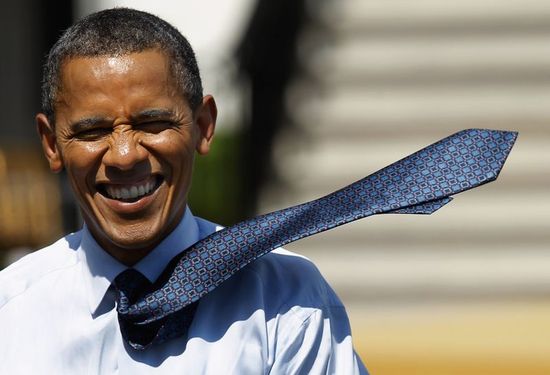
(Photo: Chip Somodevilla/Getty)

The Evolution Of Cool

Ilan Dar-Nimrod, lead author of the study "Coolness: An Empirical Investigation," measures it:

"James Dean is no longer the epitome of cool," Dar-Nimrod said. "The much darker version of what coolness is still there, but it is not the main focus. The main thing is: Do I like this person? Is this person nice to people, attractive, confident and successful? That’s cool today, at least among young mainstream individuals." …

"I got my first sunglasses when I was about 13," said Dar-Nimrod. "There wasn’t a cooler kid on the block for the next few days. I was looking cool because I was distant from people. My emotions were not something they could read. I put a filter between me and everyone else. That, in my mind, made me cool. Today, that doesn’t seem to be supported. If anything, sociability is considered to be cool, being nice is considered to be cool. And in an oxymoron, being passionate is considered to be cool—at least, it is part of the dominant perception of what coolness is. How can you combine the idea of cool—emotionally controlled and distant—with passionate?"

Will Democrats Extend The Bush Tax Cuts In Full?

Bernstein ponders the party's mixed messaging:

The Democrats have been oddly defensive about the tax issue ever since they ran on it in 2008. They failed to act when they had the votes in 2009, and they failed to find a way to use it as a campaign issue in 2010; now, it looks as if they may mangle it again in 2012. It’s a mistake, and if the Democrats can’t manage to get their act together, they deserve to lose on this one again.

Sweatshops And The Status Quo

Matt Zwolinski's qualified defense of sweatshops:

Roderick Long opposes sweatshops:

I agree that if protests and boycotts take as their aim simply the closing of sweatshops (or, worse yet, regulations such as minimum-wage laws that force out sweatshops), then they’re a mistake. But what the people protesting sweatshops are demanding is not that the employers fire all their employees and close down the shops; rather, they’re demanding higher wages and better conditions. If a company responds to a boycott, not by improving its sweatshops but by closing them, and the boycotters respond by ending the boycott, then the boycott is being done in a counterproductive way; but that’s a reason for condemning stupid anti-sweatshop boycotts, not for condemning anti-sweatshop boycotts per se.

Zwolinski counters:

[N]o one really comes out and advocates that we just take those jobs away full stop. But they do advocate policies that have the effect of taking those jobs away. And as libertarians, this kind of unintended consequence should hardly be a surprise to us.

Look at what happened to Masango’s friend as a result of minimum wage laws in the video. Or look at some of the studies that Powell and I cite in our paper. Sweatshops, or the MNEs that contract with them, might be able to afford higher wages or better working conditions. (Though I have yet to see any critic of sweatshops produce hard data about the profit margins in sweatshop-employing companies compared with profit-margins elsewhere in the industry). But what they can afford to do is less important than what they will do. And very often, sweatshops and the MNEs that contract with them respond to consumer pressure by shutting down, automating production, or moving elsewhere. And that hurts people who can ill-afford to be hurt.

How Much Can Earth Endure?

Nils at Small Precautions traces the exponential loss of animal species to a time well before modern trade and industrialization:

[T]he processes we've become acutely conscious of over the past couple of decades and which usually gets labelled "climate change" didn't actually begin with industrial revolution 250 years ago, but rather 40,000 years ago, when humans arrived in Australia, which began the process of mass mega-fauna extinction. This continued with the arrival of humans in the Americas, about 15K years ago, which also resulted in the loss of many of the continents' large beasts. What's happened since then forms a single continuous process of progressive human "commandeering" of the planet's resources.

Dave Roberts fears that the planet is nearing a dangerous tipping point.