Haggling For Cable

After calling Comcast and getting his bill lowered on a regular basis, Timothy Lee wonders why it works:

Comcast is taking advantage of the fact that most consumers expect an apparently reputable company like Comcast to offer the same deal to all similarly-situated customers. Indeed, I suspect the scheme is profitable only because it’s flouting a norm that’s observed by virtually all reputable firms. Because I think the no-haggling norm is good for society, I think firms that defect from it deserve to be stigmatized.

Alex Tabarrok disagreed:

Price discrimination is really the only way to pay for big fixed costs like laying cable.

On a related note, this week saw a passionate fan campaign for web subscriptions to HBO called "Take My Money, HBO!" with users tweeting the amount they would pay for monthly web access. Even though the average person would pay $12 a month, or about $145 a year, Ryan Lawler explains why it won't be happening any time soon:

What would happen if HBO no longer had the pay TV industry’s marketing team propping it up all the time? The results would be disastrous, and there’s no way that HBO could make up in online volume the number of subscribers it would lose from cable. Which is why, even though some users would actually pay more for access to HBO GO without all the other cable channels, you won’t see it show up as a standalone service anytime soon.

HBO agreed on Twitter: "Love the love for HBO. Keep it up. For now, @RyanLawler @TechCrunch has it right: http://itsh.bo/JLtSFE ?#takemymoneyHBO." Brian Stelter looks on the bright side:

Of course, HBO’s message included the words "for now" — a reminder that as the economics of television change, so too could HBO’s calculations about its relationships. For now, Web-only television viewers will have to keep swapping HBO GO passwords, it seems.
The Uncertainty That Counts

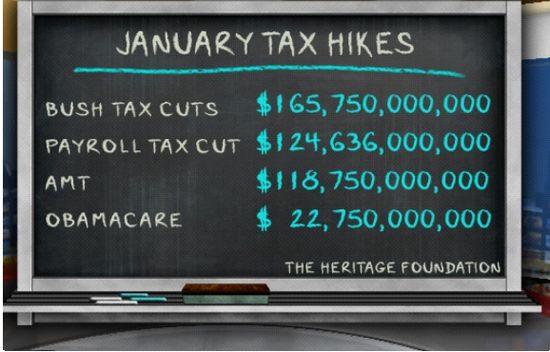
TAXGEDDON2

Jared Bernstein worries that uncertainty about the economic future is holding growth back:

Reading Fed speeches this week, looking at the upcoming fiscal slope and debt ceiling fights, watching Europe bumble along, and just trying to read the economic tea leaves—“uncertainty” is a pretty good word to describe the way a lot of people are probably thinking and feeling about the current economy right now. Picture a defense contractor whose short-term future rests on the outcome of the automatic spending cuts, half of which come from defense spending.  Or exporters who sell stuff to Europe.  Or retailers who don’t know whether middle-class paychecks will take a hit on Jan 1 when the payroll tax break ends and middle-class taxes increase (which could show up in wage withholding tables right away).

Drum distinguishes between "regulatory" and "economic" uncertainty:

Conservatives complain about the former regularly, but there's simply no evidence that regulatory uncertainty is, or ever has been, a significant issue for American businesses. In fact, all the evidence says exactly the opposite. Economic uncertainty is a whole different thing, and there's really nothing here to come around on. That's been holding back investment and hiring for a long time, and it's always been one of the strongest arguments in favor of further fiscal and monetary stimulus.

(Illustration from Heritage.)

The End Of The Paul Insurgency? Ctd

Philip Giraldi fumes at Rand Paul's endorsement of Romney:

Rand is basically conceding that it is most important to elect a Republican — any Republican — as president and is willing to do whatever it takes to accomplish that end. The senator’s endorsement cited his discovery of considerable common ground with Romney, something his father never managed to achieve. 

Daniel McCarthy, by contrast, endorses it, contrasting Rand's "integrationist" strategy for changing the GOP with Ron's "party-within-a-party" approach:

It’s possible that the integration strategy will backfire, that by lending support to Romney it will lend support to the neocons eager to occupy his administration and who already fill the ranks of his foreign-policy advisers. But the attempt to build a third party has comprehensively failed, as the sorry annals of the Libertarian, Constitution, and Reform parties show, and the attempt to build a party-within-a-party showed no signs this year of having a chance. If the integration strategy fails — and giving up one’s principles would be the greatest failure of all, yet so far Rand’s Senate record is pretty good, and [Pat Buchanan] never surrendered his realism or economic nationalism for the sake of Bush or Dole — then the liberty movement will have to try something else. There’s no a priori path to succeeding in politics in order to change policy in this country; like many things, political strategy is a matter of trial and error.

Obama’s High-Risk High-Reward Two-Term Strategy

145975361

Scott Galupo hypothesizes

Let’s assume that the Supreme Court overturns the Affordable Care Act in full; there would go Obama’s signature domestic achievement. He achieved no significant fiscal reforms. He extended the Bush tax cuts… Obama has perhaps accelerated America’s exit from the quagmires of Iraq and Afghanistan. His rhetoric sounds different than his predecessor’s. … In the big picture, we’re left with a stimulus whose impact on the economy, whatever it was, has washed out completely; the tepid Dodd-Frank reforms of Wall Street; and a public affirmation of same-sex marriage.

Yes. As I've noted, few first-term presidents have achieved so much so tenuously. But all of this is a function of two things: first, the crushing burden of grappling with an economy in a tailspin and two wars in which victory was not easily defined (but getting the hell out of Iraq and killing much of al Qaeda and bin Laden is about as good as anyone would have forecast); and second, the long-game strategy for lasting change. Obama cannot really leave his mark until this December when much of his fiscal strategizing against the GOP since 2010 will reach a moment of truth. Ditto Iran – also reaching a critical tipping point; and the actual implementation of universal healthcare – if it survives SCOTUS. And if you think Dodd-Frank was tepid, wait till the Romney-Ryan era and Wall Street will be back to the casino in no time.

There's a painful irony in all this: Obama's legacy, more than most presidents, will be measured by his second term, because so many of his first-term initiatives depend on a second. Without a second term, it could all be washed away – to Romney's enormous benefit

Romney is on track, if elected, to enter the Oval Office with a stronger wind at his back than many of its previous occupants, including Obama. And that, more than anything else, may be what’s at stake in this election, at least for the combatants themselves. Like him or not, Obama has already done a lot of the hardest, dirtiest jobs on America’s 2009 to-do list. If he’s reelected in November, he gets the chance to preserve (and, finally, enjoy) the fruits of his labors: an improving economy, a universal health-care system, a safer war on terror, perhaps even that elusive deficit deal. Meanwhile, if Romney wins, he gets to build his presidency on ground his predecessor has very conveniently cleared for him—and Obama’s achievements go unrealized or uncredited. 

Obama's long game was always a high-risk high-reward strategy. And this is when the nail-biting starts in earnest.

(Photo: Chip Somodevilla/Getty.)

The Balls To Act Like Republicans

Sanford Levinson wonders if the Democrats will grow them:

I fully expect a Republican majority in the Senate, should Mitt Romney be elected, [to modify the filibuster rule by reducing the number of votes required to bring a measure to the floor when the Senate next convenes]. The Republican Party is determined to make its mark and will brook no opposition from 49, let alone 41, Democrats. What if the next Senate is evenly split? Then we will have the opportunity see one of the more bizarre features of the Constitution in action: If Obama and Biden lose the election, Biden will remain president of the Senate when it convenes, as required by the Twentieth Amendment, for the first time on January 3, 2013 (among other things, in order to count the electoral votes and declare the winners). This means that he would get to break a presumptive tie between filibuster-abolishing Republicans and now-filibuster-friendly Democrats. If Biden voted to maintain the filibuster, that would presumably settle the issue for the entire session and therefore guarantee that Democrats could block radical Republican measures, at least.

The question, of course, is what if—unexpectedly, but not impossibly—not only are Obama and Biden reelected, but the Democrats retain the Senate and even gain back the House? Will they have the political will to do what I predict the Republicans would do were they a majority?

Quote For The Day

"Perhaps the only thing more intensely held than a person’s religious beliefs, be they strong or strongly disinterested, is a guy’s thoughts about his pecker. It is just about all we think about, though thankfully for one and all, the manifestations do vary. Given this, how completely and bizarrely ridiculous it is that men, millions and millions of men, that brutal tribe that spends all day thinking about it, worrying about it, protecting it, comparing it, agree to give up their foreskin and even that of their sons to the cold blade. That’s the point though—it is the ultimate leap of faith," – Kent Sepkowitz, an infectious-disease specialist, on the story of two children who died of herpes because a mohel with herpes sucked the blood off the the infant boys' dicks after mutilating them.

The Dish covered a similar case earlier this year.

They Have Learned Nothing

Top neocon John Bolton pens an op-ed on Syria. I hope you're sitting down:

It would have been one thing to work with the Syrian diaspora to remove Assad and the Baath party when we had a massive military presence in Iraq, right on Syria’s border. In the days just after Saddam’s ouster in 2003, conditions were optimal (if nonetheless imperfect) for overthrowing Assad and replacing his regime with something compatible with American interests. We would not have needed to use U.S. ground forces. Our mere presence in Iraq could have precluded Iran — or, what we see today, an Iraq under Iran’s influence — from trying to protect Assad.

But the dream of a permanent occupation of Iraq and the ousting of Assad is just the start:

Significantly, U.S. intervention could not be confined to Syria and would inevitably entail confronting Iran and possibly Russia. This the Obama administration is unwilling to do, although it should.

Remember what Romney said about Bolton:

John’s wisdom, clarity and courage are qualities that should typify our foreign policy.

Just ponder that for a moment. Are you terrified because Romney believes that? Or because he'll say anything to get elected?

America’s Trust Deficit, Ctd

Joe Klein recently mourned the loss of trust in America. Samuel Goldman labels this "liberal nostalgia":

[Klein] makes the basic error of all liberal nostalgists. In short: the consensus around a highly-regulated, highly-taxed, middle-class society that lasted from about 1945-1965 is thoroughly exceptional in American history. It came into being through the sequence of the Great Depression and World War II, which was by no means predetermined. And it eroded as those experiences slipped into the past, in addition to changes in the international economy and the restoration of mass immigration, among other reasons. The postwar moment cannot be restored by any policies or programs.

I fear he is right. I also feel the gulf is deeper than even Joe, in his splendid missives from the road, acknowledges. I grew up on political theory and learned how polities in the past were united by universally acknowledged or at least widely accepted commonalities. Shared moralities, experiences, religions and cultures were part of past cultures where elites imposed moral and cultural order, often buttressed by the church. Modernity ended that – splintering us into a million little subcultures, bound together now solely by the joint pursuit of material wealth. And when that wealth dries up, or disappears for a while, when the system fails to guarantee its constant economic growth, you see more plainly the gulfs that separate us. Which is where we are now.

I saw a poll the other day that is still in my head. Here it is:

Screen shot 2012-06-11 at 11.32.17 AM

We can over-analyze single poll results, but absorbing this chart is a useful tonic to anyone feeling optimistic about bringing the country together. A clear plurality of Americans believe in something empirically untrue: that human beings in our current form were created 10,000 years ago. More interestingly, that number has jumped in the last couple of years, while a more moderate fusion of science and religion – "humans evolved but with God guiding" – is at its lowest level ever, and may soon be joining the slowly growing ranks of the Darwinians.

I'm not sure how many of the 46 percent actually believe the story of 10,000 years ago. Surely some of them know it's less empirically supported than Bigfoot. My fear is that some of that 46 percent are giving that answer not as an empirical response, but as a cultural signifier. That means that some are more prepared to cling to untruth than concede a thing to libruls or atheists or blue America, or whatever the "other" is at any given point in time. I simply do not know how you construct a civil discourse indispensable to a functioning democracy with this vast a gulf between citizens in their basic understanding of the world.