A glimmer of light in a growing darkness? It will be the Republican parents of gay kids who will do it. Unlike those who simply use their gay kids as political shields, like Cheney.
Month: June 2012
Obama And The Future
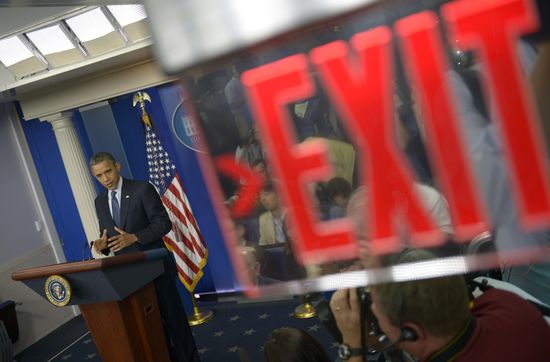
The good news of the terrible news of the last couple of weeks is that there's a lot more realism about the forces at work in this election. Incumbent presidents always have a tricky re-election campaign, because they have to balance a defense of their record with a set of proposals for the next term. Often, the mandate is vague – and you won't find a better summary of the risks and opportunities involved than Ryan Lizza's superb new piece in The New Yorker.
What the Obama campaign has to do is relatively simple: stop being defensive about their record, connect the politics of the past two years to the GOP's fierce resistance to change and then ask for help in completing it. I made a brief case along these lines last Friday. Tomasky piths it up:
The story, in a nutshell, is this: we inherited a total disaster, things are getting better, and Romney will bring us back to disaster.
The problem is that the GOP looks likely to remain a powerful force in the second term, barring some miracle in November. In fact, I'd argue Romney's best case is that with a Republican Congress, he will be able to end the gridlock and move the country forward. The trouble with this, of course, is that a total GOP government would be a toxic brew of Paul Ryan's economics with Dick Cheney's diplomacy and Bryan Fischer's open mind. But if you're a low-information swing voter and associate gridlock with recession, you can see the appeal of at least some movement somewhere.
So what Obama has to do – what he can only do – is focus on the specifics of what must happen before the end of the year. He should remind us that without some compromise, we will have what's been called Taxmageddon: all the Bush tax cuts will be sunsetted, unemployment benefits for 3 million Americans will end, payroll taxes will rise two percent for employees, and sequestration will start being enforced. Even Romney has said that that combination would plunge us and the world back into recession, so he won't go there. So if both candidates say this is unacceptable, the most obvious choice we currently face in this election is: which solution to this looming crisis is the most effective?
This where Obama has the edge in the arguments, it seems to me: he says that the Bush tax cuts should only be sunsetted for those earning over $250,000, unemployment benefits should continue, the payroll tax should be kept where it is (to prevent a slide into a double dip), but sequestration should proceed. But he should also say he'd throw all this up in the air if the GOP were willing to raise serious new revenues via elimination of tax deductions, along with further cuts in defense, in return for real entitlement reform. In other words, he must put front and center his view of debt reduction: entitlement cuts, defense cuts and revenue increases via tax reform. Essentially a more Democratic version of Bowles-Simpson. Then he has to just call Romney out on refusing to raise any taxes on the very wealthy. If it's framed this way, Obama wins.When you're grappling with debt and one sides insists on only tackling spending and not revenues, it's being perverse.
Running simply against austerity, as if the debt did not exist, is not, I think, a realistic option. Obama should run rather on the most equitable way to cut the long-term debt, and then insist on some short-term easing on the imminent austerity. And he has to combine this with one signature and clear second-term commitment.
My view is that it should be immigration reform, along Bush's lines (as Lizza discusses). This is something even the most recalcitrant Republicans would be leery of demonizing, especially if  Romney lost the election because of the Latino vote. Those whites who are incensed by illegal immigration are voting for Romney anyway. More to the point, the sane people left in the Congressional GOP know that it splits their party and opposition to it could kill their future. If Obama invokes the legacy of Bush for the reform, it could be brutal for them.
Tomasky's critique of this is that the Republicans will be just as crazy after the election as now, and so all of this is academic. I don't agree. We live in a polity where one party has essentially stopped treating the other party as in any way legitimate representatives of the American people. There is no willingness to compromise. The question is not whether this fever will break; the question is how does a country function unless it breaks? One soft spot where it could be tackled is immigration. It's one area where the GOP is rightly alarmed about its own future. If it is front and center in this election campaign, alongside a balanced approach to long-term debt and short-term stimulus, you can begin to see why many would want to back Obama.
So far, the Obama campaign has seemed to me overly negative and tactical, as opposed to positive and strategic. I'm not saying the Bain ads should be pulled; they're legit and they appear to be working. I'm not saying that Romney's extreme wealth and privilege should not be highlighted. But I am saying that Obama's core strength must stay what it was last time: sane, centrist, profound reform. He can say in his first two years, he made a massive downpayment but has been stymied ever since. This election is about empowering him to finish what he began. And to have voted for him in 2008 and not vote for him now makes no sense at all.
We all knew there would be brutal resistance to real change. So are we really going to bail when resistance makes its strongest counter-attack? Or will we push the president to keep his promises while mobilizing to ensure he can recapitalize in this election and finish the job? I know where I am on this. Do you?
(Photos: Mandel Ngan, Brendan Smialowski/Getty)
Racists And Obama
Check it out this graph. Basically, the author tries to figure out whether racism really did suppress Obama's vote in 2008. No one admits to it in polling; other issues completely drown it out in noise; and there were plenty of non-racist reasons people might have voted for McCain or vote for Romney. But Google is an amazing thing:
I performed the somewhat unpleasant task of ranking states and media markets in the United States based on the proportion of their Google searches that included the word “nigger(s).” This word was included in roughly the same number of Google searches as terms like “Lakers,” “Daily Show,” “migraine” and “economist.” …
The state with the highest racially charged search rate in the country was West Virginia. Other areas with high percentages included western Pennsylvania, eastern Ohio, upstate New York and southern Mississippi. Once I figured out which parts of the country had the highest racially charged search rates, I could test whether Mr. Obama underperformed in these areas. I predicted how many votes Mr. Obama should have received based on how many votes John Kerry received in 2004 plus the average gain achieved by other 2008 Democratic Congressional candidates.
And guess what?
Add up the totals throughout the country, and racial animus cost Mr. Obama three to five percentage points of the popular vote.
I'd say that is likely to occur in higher numbers this time. But imagine a scenario in which Obama's majority of the popular vote had not been 53 percent but 56. And if McCain had won 43 percent. Given the way the GOP has reacted to Obama, I wouldn't go so far as to say they would have behaved differently in the face of such a landslide. But just a few votes for the stimulus would have changed the dynamic of the past four years of total obstructionism. Too late now, at least. But it's good to be completely realistic about the uphill struggle the president is now in.
It's steep. Without the kind of engagement and enthusiasm he garnered last time, it's close to vertical.
Studying Silence
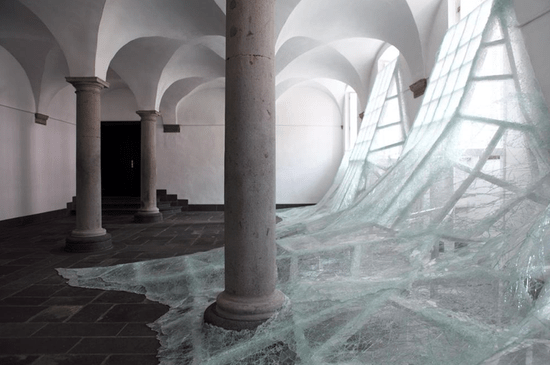
Jeremy Mesiano-Crookston exchanged emails with Trappist monks, the only Western order to practice a "vow" of silence (the "vow" isn't truly a vow and the monks do speak when neccessary). Mesiano-Crookston asked one monk whether he considered his near complete silence a sacrifice. His answer:
The silence which is my natural habitat is not created by forcibly sacrificing anything. When a man and woman meet and fall in love they begin to talk. They talk and talk and talk all day long and can't wait to meet again to talk some more. They talk for hours together, and never tire of talking and so talk late into the night, until they become intimate—and then they don't talk anymore. Neither would describe intimacy as “the sacrifice of words” and a monk is not inclined to speak about his intimacy with God in this way.
Is silence beneficial for all people? I would say the cultivation of silence is indispensable to being human. People sometimes talk as if they were “looking for silence,” as if silence had gone away or they had misplaced it somewhere. But it is hardly something they could have misplaced. Silence is the infinite horizon against which is set every word they have ever spoken, and they can't find it? Not to worry—it will find them.
Earlier coverage of the Trappist monks, inspiration for the film Of Gods And Men, here.
(Image: Aerial, an installation by Baptiste Debombourg at an old Benedictine monastery which he describes as "The mind is everything. The material is the servant of spiritual," via Colossal)
Sleep On It
How rest can lead to insight:
[R]esearchers gave a group of students a tedious task that involved transforming a long list of number strings into a new set of number strings. Wagner and Born designed the task so that there was an elegant shortcut, but it could only be uncovered if the subject had an insight about the problem. When people were left to their own devices, less than twenty per cent of them found the shortcut, even when given several hours to mull over the task. The act of dreaming, however, changed everything: after people were allowed to lapse into R.E.M. sleep, nearly sixty per cent of them discovered the secret pattern. Kierkegaard was right: sleeping is the height of genius.
Hunting for Nouns
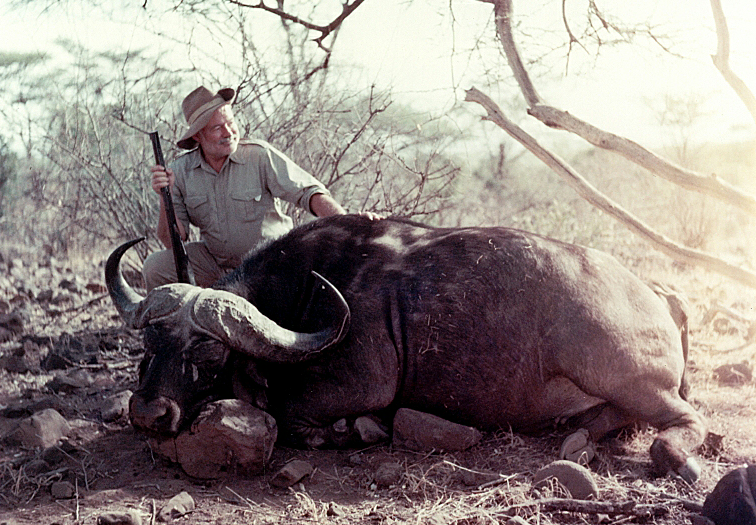
Andrew O'Hagan takes issue with Hemingway's style:
Good reporters go hunting for nouns. They want the odd verb too, but the main thing is the nouns, especially the proper ones, the who, what and where. The thing British schoolchildren call a ‘naming word’ was, for Hemingway, a chance to reveal what he knew, an opportunity to be experienced, to discriminate, and his style depends on engorged nouns, not absent adjectives. But at times it strikes you that the cult of specificity in Hemingway is a drug you take in a cheap arcade: lights flash on the old machines and a piano plinks overhead. One evening it came to me as a small revelation that he takes too much pride in the nouns. (And pride ruined him.) He never takes nouns for granted. He invests his whole personality in them, because nouns are the part of speech where a person gets to show off. Papa gets busted on the nouns because he can’t place them on the page without ego. Too often they are there to attract attention. To cause a sensation. To make a blaze. Hemingway will never say someone had a drink when he can say they had a vermouth.
(Photo: Ernest Hemingway poses with a water buffalo while on safari in Africa, 1953-1954. Photograph in the Ernest Hemingway Photograph Collection, John F. Kennedy Presidential Library, Boston.)
Poverty Is Relative
A useful reminder:
The tenants of modern trailer parks live in more luxury than early Sumerian aristocrats, whose mansions were reed huts with dirt floors. The motor scooters of unemployed college students travel faster than the horses of medieval lords. Civil War generals communicated by courier, but now every private has a mobile phone. Progress impoverishes the past. Complaints feel childish when you think of your ancestors. I grumble when my air conditioning breaks in summer, but in ancient Egypt even Pharaohs had to sweat.
Mental Health Break
Manhattan gets timelapsed:
The Politicization Of Death
Jill Lepore laments it:
It’s not that matters of life and death weren’t the subject of fierce political debate before [the 1960s and '70s], but in those years, the two-party system re-aligned itself around these issues, which is horrible, because, while there are only two parties, matters of life and death don’t generally have only two sides. Making these matters partisan makes them impossible to resolve, or even to talk about in any humane way.
Over the last four or five decades, a great deal of political discourse has been reduced to a ham-fisted rhetoric of freedom and murder. It’s as if there are only two possible issues and only two possible positions: Either abortion is freedom and guns are murder, or guns are freedom and abortion is murder. None of these issues and positions existed, in exactly this form, before 1968. I find that strangely comforting. Because something that has a beginning has also got an end.
Church Sign Fail
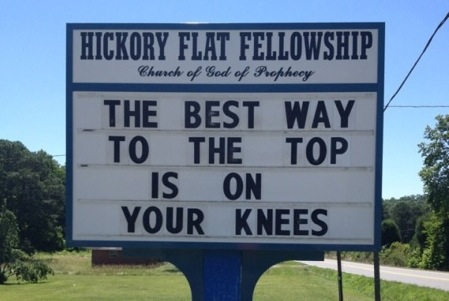
Fred Clark snickers:
Jesus told his disciples to be wise as serpents and innocent as doves. Some of the folks in charge of these signs, God bless ‘em, have got the innocent as doves part down. What they need is some kind-hearted, filthy-minded neighbor who’d be willing to supply a bit of serpently wisdom — somebody who can look over the copy for next week’s sign before it goes public.
They need someone who could warn them ahead of time that “Behold, I come quickly” is likely to inspire too many giggles from passersby, never mind why. Or who could gently inform the Christian Outreach Church to reword the name of their C.O.C. Block Party. Or who could say, “Psalm 16:11 is a lovely verse, but you don’t want to put ‘In your right hand are pleasures for evermore’ on your sign.” (All real-life examples.)
(Image via Matthew Paul Turner's collection)
 The Dish