Am I wrong in recollecting that President Obama, months ago, pushed and/or encouraged a decision by the Supreme Court on the Affordable Care Act? I seem to remember thinking at the time that it was a crazy thing to do prior to the 2012 election. But maybe not so much?
Another adds:
He's weak. He yields too much. He gets rolled. He's a lightweight. He's inexperienced.
He wins.
Always.
In the end. And the next election will be the real proof of principle, won't it?
Uninsured Americans are sick and getting sicker. Atul Gawande calls some doctors:
Another friend, an oncologist in Marietta, Ohio, told me about three women in their forties and fifties he was treating for advanced cervical cancer. A pap smear would have caught their cancers far sooner. But since they didn’t have insurance, their cancers were only recognized when they caused profuse bleeding. Now they required radiation and chemotherapy if they were to have a chance of surviving.
A colleague practicing family medicine in Las Vegas told me about his clinic’s cleaning lady, who came to him in desperation about her uninsured husband. He had a painful rectal fistula—a chronically draining infection. Surgery could cure the condition, but hospitals required him to pay for the procedure in advance, and, as unskilled laborers, the couple didn’t remotely have the money. He’d lived in misery for nine months so far. The couple had nowhere to turn. Neither did the doctor.
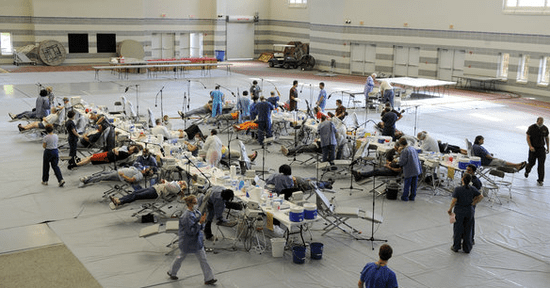
(Photo by Jim Myers/AP/KHN as part of a slideshow of the poor and the sick in Tennessee you can watch here. Dish coverage of the clinic for the poor – and my own evolution on this subject – here. )
"Let's talk about [US Supreme Court Chief Justice John] Roberts. I'm going to tell you something that you're not going to hear anywhere else, that you must pay attention to. It's well known that Roberts, unfortunately for him, has suffered from epileptic seizures. Therefore he has been on medication. Therefore neurologists will tell you that medication used for seizure disorders, such as epilepsy, can introduce mental slowing, forgetfulness and other cognitive problems. And if you look at Roberts' writings you can see the cognitive disassociation in what he is saying," – radio host Michael Savage.
[Re-posted from earlier today. Extensive coverage after the jump.]
1.12 pm. Normal blogging will resume shortly. My take on this morning's drama: for millions of people, this will mean one thing. They will have an opportunity to purchase healthcare that would otherwise be denied them because of a pre-existing condition or simply lack of means to buy it. This has been done through the private health insurance sector along lines many Republicans were proud of until very recently. And this is a good thing.
The fact that there is no constitutional issue in doing this federally, as opposed to by the states, also removes Mitt Romney's only argument in defense of his own almost identical law in Massachusetts. And so the GOP candidate will be running against his own record in his own state on no rational grounds whatever. And against a Chief Justice appointed by George W. Bush.
But that matters less to me than that someone in America who once had to suffer in silence may now get some help to tackle her health issues. For me, that's a moral principle. Much more needs to be done, specifically in restraining healthcare costs and reforming Medicare. But the core beginning of this process will be getting everyone in the same boat. That now seems unstoppable. So Obama's first term remains historic. And his re-election to cement this change essential.
1.11 pm. NRO's commenters on Romney's pledge to repeal the law one Day One are priceless.
1.07 pm. Take a bow, Will Wilkinson, who wrote this yesterday:
Roberts, writing for the majority, will offer a hyper-casuistical decision that discovers in standing commerce clause precedent principled grounds for ruling in an insurance mandate while ruling out congress' power to mandate purchase of any goods and services that don't begin with an "i" and end with an "e", and aren't ice or iodine. To brighten the dashed hopes of conservatives, the "Why there can never be a broccoli mandate" section of Roberts' decision will on the whole narrow Congress' commerce-clause regulatory powers. However, in their very great relief, and schadenfreude over bitter conservative disappointment, liberals will largely miss the minor revolution contained in Roberts' sly scholasticism.
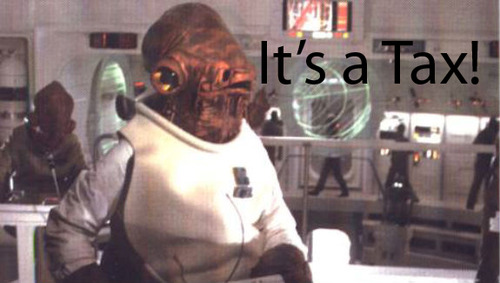
ObamaCare was a gigantic tax increase! The Supreme Court says so! I just heard Marco Rubio on Fox, and he managed to use the word “tax” about four times in every sentence.
The individual mandate is constitutional because despite the name because it’s not really a mandate. Congress called it a mandate, to be sure, but in practice it’s really just a small tax. And the enforcement mechanism is pretty light. So you really don’t have to get health insurance: You just have to pay the smallish penalty if you decide you don’t want it. So Congress lacks the power to say that you go to jail if you don’t buy health insurance.
But Congress does have the power to encourage you to get health insurance by imposing a tax if you don’t, as long as the tax isn’t so coercive that it’s really more than just a tax… willful failure to pay the tax (that is, knowing you have to but intentionally refusing to pay your tax bill) can be a crime. But you can pay the tax and not get health insurance if that’s what you want. So the “mandate” is just a tax, and it is therefore constitutional.
“Fucking humiliating. We had a chance to cover it right. And some people in here don’t get what a big deal getting it wrong is. Morons.
12.50 pm. This strikes me as a sober and judicious assessment:
It’s questionable to me, formally, whether the mandate survived as a mandate. It’s not exactly a mandate, any more than a tax on cigarettes is a mandate to cease purchasing cigarettes. Effectively, however, the function the mandate was meant to serve did survive. The “mandate” was intended to fund coverage for those who would be a net loss on the health care system. If you are a young and healthy individual who does not particularly need health insurance, you can fund the system either by signing up for health insurance or by paying the tax that helps to fund the system.
12.46 pm. Will this revive the Tea Party? Tobin hopes so (as does Fred Barnes). This will be a talking point going forward, it seems to me:
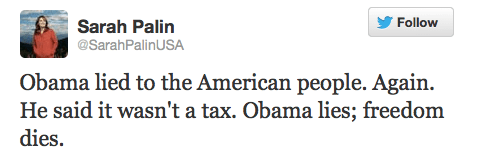
Mitt Romney and the rest of the Republicans can argue that while the Court ruled it constitutional, its passage was the result of a deception, and the net result is a tax hike for the entire country as well as granting the government an unprecedented expansion of power. The health care debate now switches from speculation about what the Court would do to one about whether the voters are prepared to re-elect a president who has snuck through a massive tax on the middle class on a technicality.
My italics.
12.42 pm. Good one, Nancy (who's wearing the same purple pumps today that she wore when Obamacare passed):
Pelosi: What a great victory!
Congressman George Miller: You bet your ass [it is].
12.35 pm. More radical in its implications than we might have thought? Lawrence Solum:
There is an alternative gestalt concerning the New Deal Settlement. For many years, some legal scholars had advanced an alternative reading of the key cases uphold New Deal legislation. On this alternative reading, the New Deal decisions were seen as representing the high water mark of federal power. Although the New Deal represented a massive expansion of the role of the federal government, it actually left a huge amount of legislative power to the states. On the alternative gestalt, the power of the federal government is limited to the enumerated powers in Section Eight of Article One, plus the New Deal additions. These are huge, but not plenary and unlimited.
Today, it became clear that four of the Supreme Court's nine justices reject the academic consensus… And because Justice Roberts believes that the mandate is not a valid exercise of the commerce clause (but is valid if interpreted as a tax), he has left open the possibility that there is a fifth justice who endorses the alternative gestalt.
12.26 pm. A round-up of reader reax from the in-tray. A lawyer writes:
Actually, broccoli doesn't win. As I’m sure other readers are pointing out, Justice Roberts’ opinion argues that if the Commerce Clause meant what the government argued it did, then “Congress could…[order] everyone to buy vegetables…That is not the country the Framers of our Constitution envisioned.” (See page 23 of the opinion.) Sorry, broccoli.
Another lawyer:
It is remarkable that, at the end of the day, the 5-4 vote upholding the ACA turned on a simple, well established rule of statutory construction, the “constitutional avoidance” doctrine. When a court is faced with a statute that is fairly susceptible of more than one meaning, and one interpretation renders the law unconstitutional while the other interpretation affirms its constitutionality, a judge is required to adopt the later interpretation. That’s what Chief Justice Roberts did. He said that the individual mandate could be read as a tax, even though that was not the most obvious interpretation. Thus, because Congress has the authority to impose a tax, the invalidity of the mandate under the Commerce Clause was not determinative.
Another:
What I think a lot of people are missing in this case is its connection to that foundational Supreme Court case, Marbury v. Madison (to which the Chief Justice cites several times). Marbury is an interesting study; essentially it was a political battle between Jefferson and the Federalists. John Marshall, presiding Chief Justice, most definitely held with the latter. In deciding the case, Marshall pulled an impressive feat of judicial jujitsu; he found for Jefferson's side, but announced the principal of Judicial Review, something with which Jefferson would have disagreed. But Jefferson could hardly caterwaul about a case he had 'won.' Jefferson won in the short term, Marshall, arguably, in the long term. Thence to Roberts' opinion.
He did uphold the mandate as a tax, but specifically said it was beyond the Commerce Clause power. Much of the opinion is dedicated to explicating why this is so (and adopting the anti-ACA arguments for such). I think Roberts has taken a lesson from his famed predecessor. By upholding the mandate as a tax, but deciding the Commerce Clause issue against what would seem to be the weight of precedent, he may be hoping to hand conservatives the long-term win.
If Wickard v. Fillburn (generally seen as the broadest Commerce Clause case) is one day overturned, as seems likely, much of the language will be taken from the Chief Justice's opinion.
Another:
A prediction: public opinion will swing toward a favorable view of Obamacare because of today's ruling. Remember, most Americans have no idea what this does; they've just been told it's either a terrible, awful, horrible scheme to allow the government to form death panels to kill them or it's a terrible, awful, horrible illegal power grab by that socialist/Communist/Kenyan anti-colonalist in the White House. Well, the second part turns out to be false. And it's hard to build a suitable conspiracy theory to explain away today's ruling when John Roberts is the decider on this.
Another:
You wrote: " We may see attempted nullification of the law by Tea Party types refusing to get insurance in order to destabilize the system." Tea Party types already have health insurance. They are overwhelmingly white and middle class, and the retiree set amongst them already has government healthcare. I cannot see the system being destablized by the abstention of the five or so Tea Partiers who aren't already covered.
Roberts peered into the abyss of a world in which he and his colleagues are little more than Senators with lifetime appointments, and he recoiled. The long-term war over the shape of the state goes on, but the crisis of legitimacy has been averted. I have rarely felt so relieved.
12.22 pm. Yglesias Award nominee – Jeff Toobin live on CNN:
"This is a day for Don Verrilli to take an enormous amount of credit, and for me to eat a bit of crow – because he won, and everyone should know that that argument was a winning argument, whatever you thought on it."
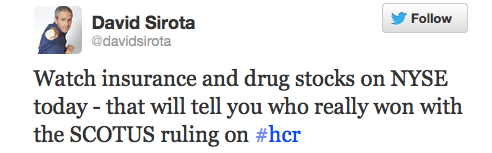
Stocks are reacting very much as analysts predicted in the event that the law was upheld. Hospital stocks such as HCA (up 8%) and LifePoint (up 4%) are rising because the law is likely to result in increases in volume for their businesses without added costs. Insurers such as Wellpoint and Cigna (down 4% and 5% respectively) are dropping because the law is likely to crimp their profit margins.
12.15 pm. Tweet of the hour:
12.14 pm. Yglesias also ponders the implications of the Medicaid issue:
Chief Justice Roberts joined with the other conservatives on the court to argue that this penalty—withdrawing of existing federal money unless states kicked in new money of their own—overstepped the constitutional bounds of the spending power. So now states have the carrot to expand Medicaid but not the stick.
Since your state's citizens have to pay taxes to the federal government one way or the other, you'd have to be pretty crazy to refuse the carrot if you ask me. But ideological zeal may well lead some states to turn it down. In that case, substantially more people than the law's authors expected might find themselves eligible for either hardship waivers from the mandate or subsidies to buy insurance on exchanges. How much of each of those things happened will depend on exactly what states do, and figuring out the budgetary implications of the whole thing is going to require some hard work by the little modeling gnomes at the Congressional Budget Office.
The Court’s decision on the constitutionality of the Medicaid expansion is divided and complicated. The bottom line is that: (1) Congress acted constitutionally in offering states funds to expand coverage to millions of new individuals; (2) So states can agree to expand coverage in exchange for those new funds; (3) If the state accepts the expansion funds, it must obey by the new rules and expand coverage; (4) but a state can refuse to participate in the expansion without losing all of its Medicaid funds; instead the state will have the option of continue the its current, unexpanded plan as is.
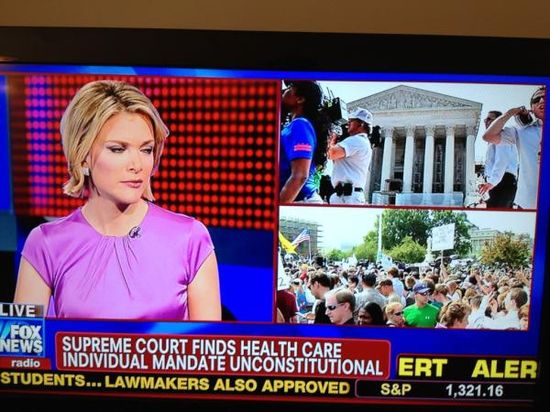
12.11 pm. Cable News FAIL:
This embed is invalid
12.06 pm. An interesting piece of speculation from David Bernstein:
Scalia’s dissent, at least on first quick perusal, reads like it was originally written as a majority opinion. Back in May, there were rumors floating around relevant legal circles that a key vote was taking place, and that Roberts was feeling tremendous pressure from unidentified circles to vote to uphold the mandate. Did Roberts originally vote to invalidate the mandate on commerce clause grounds, and to invalidate the Medicaid expansion, and then decide later to accept the tax argument and essentially rewrite the Medicaid expansion (which, as I noted, citing Jonathan Cohn, was the sleeper issue in this case) to preserve it?
If so, was he responding to the heat from President Obama and others, preemptively threatening to delegitimize the Court if it invalidated the ACA? The dissent, along with the surprising way that Roberts chose to uphold both the mandate and the Medicaid expansion, will inevitably feed the rumor mill.
12.04 pm. Echoing Dish readers' concerns below, Jon Adler writes:
Holding that it would be unconstitutional to terminate existing Medicaid funds to states that refuse to go along with the Medicaid expansion is quite significant, particularly as seven justices joined this result. While the holding here may not go beyond the limits articulated in South Dakota v. Dole, the Supreme Court has not limited the exercise of the spending power to impose conditions on states since the New Deal and, again, seven justices endorsed this result. Going forward, I expect this portion of the opinion to have the greatest practical impact. In fact, I can think of some federal laws, including portions of the Clean Air Act, that are likely to be challenged on these grounds.
11.59 am. Now the chatter begins to turn to the challenges of this ruling for Obama. Some liberal readers are nervous. One writes:
This decision is a massive political problem for Obama. For starters it will rally conservatives and allow Romney to further consolidate his base. A loss for Obamacare would have done the same for Obama's base which would have been helpful in November. Second, and more importantly, SCOTUS' finding that this is a "tax" opens Obama to an entire new line of attack. Not only has he "raised taxes" on "hard-working middle class people" but he has done it in a non-transparent, nefarious way. It feeds directly into the Right's existing themes on Obama. Obama is going to have to come out swinging and, I think, finally defend the merits of Obamacare (i.e. explain to people what they are getting for this "tax").
Well, we'll see soon enough. Another:
I think Jeffrey Toobin was more right than wrong. Ok, I can't actually justify that by what he said but I do think this ruling was a disaster for the left. Advocates of federal power lost everything except the headline. This looks like a stealth overturning of Wickard v. Filburn. The commerce clause expansion that has fueled everything from the New Deal to federal highways to the Great Society to the War on Drugs just took a huge hit.
Furthermore, Congress's power to attach new strings to existing pipelines of federal money just got clipped. This power is used so pervasively that I can't even describe it. Here are a few examples of strings tied to federal buckets of money that were enacted long after the original funding: Title IX (education funds), national drinking age (highway funds), and same sex partner hospital visitation rights (Medicare funds).
11.54 am. It seems to me that Romney is stuck with a call to repeal the entire law, and will probably now tout it as a big tax increase. Ed Morrissey advises fortitude:
So what now? Mitt Romney and Republicans can now run on repeal as a big issue in the campaign. They should emphasize the tax argument when they do, because this tax hits everyone. The ruling may alleviate some of the bad polling the ACA has received, but probably not by much. It’s going to remain deeply unpopular for the next few months.
That may be, but now the law is deemed constitutional by John Roberts, it will be harder to portray it as the end of America, or whatever today's unhinged right believe. And since there's no actual "replace" in Romney's proposals, Obama can and should talk about Romney's attempt to strip those with pre-existing conditions of protection, throw twentysomethings off their parents' policy, etc etc. Obama is gonna speak at 12.15 pm, apparently. We'll keep live-blogging.
11.51 am. It's important to remember what, beneath all the legal wrangling and political posturing, this decision will mean for millions of Americans. Ezra weighs in:
The individual mandate, by bringing healthy people into the insurance market and lowering premiums, means health insurance for between 12.5 million and 24 million more Americans than if the mandate was struck down. And as Kennedy said in his dissent that the conservatives on the Court believed the entire law should have been invalidated, it means health insurance for 33 million more Americans than if Kennedy and the conservatives had their way.
[W]e may learn that President Obama sacrificed his presidency to push through this piece of legislation — the Dems already lost Congress over it. But presidencies are for doing important things not just for getting elected to second terms in office. And I strongly suspect that even if Mitt Romney wins and gets a Republican Congress, they still won’t be able to get rid of this law.
That counts. That matters.
11.49 am. Tweet of the hour:
11.46 am. An angle that looks at the ruling from a woman's perspective:
Women are big financial winners in this decision … The first is the elimination of gender rating, or charging women more because they’re women, pure and simple. The National Women’s Law Center recently found that in states that haven’t banned the practice, over 90% of the best selling plans charge women more than men, even though only 3% of them cover maternity services. In fact, even when maternity care is excluded, almost a third of plans charge women at least 30% more than men for the same coverage. One plan even charges 25-year-old women 85% more than men. All told, the practice costs women about $1 billion a year.
That will now become illegal in 2014, after the ACA is fully implemented.
11.43 am. Cable news needs to shut itself down. They failed high school newspaper tests this morning. There's no excuse whatsoever. They really ought to be ashamed. Covering live events is all they're really good for any more, if you are not partial to screeching propaganda or pure CNN tedium. And they even fuck that up – in a way many pajama-clad amateurs didn't.
11.40 am. To me, the most fascinating part of this is that John Roberts has revealed himself as an institutional conservative rather than a radical reactionary (as his party has now become). Matt Cooper notes:
He saved the individual mandate, choosing to see it as a tax hike and not a mandate, and thus legal. It's like that moment in the Cuban Missile Crisis when President Kennedy got two letters from the Soviets, one accommodating and one bellicose. He chose the one he wanted. Sure, we don't know how John Roberts will evolve in the years ahead. Justices change. But he's shown a deference to federal authority in this case — and in the Arizona case — an aversion to being like the "nine old men" who tortured Franklin Roosevelt, throwing out key elements of the New Deal. As a former DOJ lawyer, as well as longtime veteran of the firm Hogan & Hartson, he seemed to have a deference to arguments and not ideology.
It's good to see conservatism survive somewhere.
11.35 am. Is this the "best public relations news Obamacare has ever gotten?" From Peter Spiliakos in First Things:
The argument against Obamacare from constitutional norms has been fatally wounded to the extent of winning over persuadables… It also damages Romney in other ways. He can no longer distinguish Romneycare from Obamacare on the grounds that one is a legitimate use of state power and the other is is an unconstitutional use of federal power. Thanks to the Supreme Court, both Romneycare and Obamacare are now constitutional schemes of coverage mandates + individual purchase mandates + guaranteed issue + community rating. Romney can try to explain why what he thinks is good for Massachusetts isn’t good for America. Not impossible, but not easy, and I would guess probably beyond Romney’s power.
Yep. This was a triumph for a federal version of Romneycare. Which puts Mitt in the excruciating position of declaring John Roberts a leftist and explaining why Obamacare raises constitutional issues that Romneycare doesn't.
11.31 am. My view on the politics if this is that it will sharpen the debate this fall – and probably rally the GOP base. We may see attempted nullification of the law by Tea Party types refusing to get insurance in order to destabilize the system. But the interpretation of the mandate as a form of taxation is giving Erick Erickson other ideas:
The President and Democrats did, according to the Court, impose a tax increase. Because it is a taxation issue, the GOP now, should it take back the Senate, have even more grounds to deal with the matter under reconciliation, bypassing the 60 vote filibuster threshold.
My view: not gonna happen. But this will take time to shake out.
In issuing this ruling, the Court has not only validated the Affordable Care Act. It has also validated its own reputation. The vast majority of legal experts have said, all along, that the law is constitutional under any reasonable reading of past decisions. The only way to overturn the law would have been to rewrite decades of constitutional law, if not more—and to overturn in economic regulatory legislation in a way the Court has not done in nearly a century. Instead, five justices demonstrated that judges should act with caution and humility, overturning major federal legislation only in cases where such legislation represents clear violations of the Constitution. The Affordable Care Act does not qualify, the justices said.
Liberals for judicial restraint!
11.26 am. When all else fails, read the ruling (PDF). Legal reader comments particularly welcome.
“The president’s health care law is hurting our economy by driving up health costs and making it harder for small businesses to hire. Today’s ruling underscores the urgency of repealing this harmful law in its entirety. What Americans want is a common-sense, step-by-step approach to health care reform that will protect Americans’ access to the care they need, from the doctor they choose, at a lower cost. Republicans stand ready to work with a president who will listen to the people and will not repeat the mistakes that gave our country ObamaCare.”
“I got a call from Speaker Boehner last Friday,” said Rush Limbaugh on his radio show Wednesday. “He called a lot of people and he was telling us what the Republican plan is. And it was repeal, repeal, repeal. Regardless of what happens. … He made it clear that repeal — and not repeal and replace, but repeal — was going to be the focal point for the House Republicans.”
11.16 am. Maybe the president owes the Supreme Court Chief Justice an apology:
I want to take Judge Roberts at his word that he doesn't like bullies and he sees the law and the court as a means of evening the playing field between the strong and the weak. But given the gravity of the position to which he will undoubtedly ascend and the gravity of the decisions in which he will undoubtedly participate during his tenure on the court, I ultimately have to give more weight to his deeds and the overarching political philosophy that he appears to have shared with those in power than to the assuring words that he provided me in our meeting. The bottom line is this: I will be voting against John Roberts' nomination.
11.14 am. I apologize for running all this deranged hysteria from the far right (which is now the center of the GOP), but it's revealing of how loony the right now is:
11.12 am. And now for a comment from some obscure reality show nutcase:
11.03 am. Why do some people hate America? From NRO:
I honestly cannot believe this many Americans are retarded and think this way. As if one law will make premiums go through the roof. God damn I'm ashamed to say I'm American. Selfish assholes, all of you.
In July of 1798, Congress passed – and President John Adams signed – “An Act for the Relief of Sick and Disabled Seamen.” The law authorized the creation of a government operated marine hospital service and mandated that privately employed sailors be required to purchase health care insurance.
10.58 am. Today marks the end of cable news as news, don't you think? I mean, bloggers did much better than the MSM.
10.56 am. An immediate favorite to win the year's Malkin Award nomination – and it's only June:
Nah. No exaggeration at all. Upholding slavery vs giving more people basic healthcare – no contest for the moral enormity of our current moment.
"This was a train wreck for the Obama administration. This law looks like it’s going to be struck down. I’m telling you, all of the predictions including mine that the justices would not have a problem with this law were wrong… if I had to bet today I would bet that this court is going to strike down the individual mandate."
10.50 am. Romney backs the decision with enthusiasm because it reflects the "ultimate conservatism" of the individual mandate:
Oh, wait, that was in 2007. Sometimes, it's hard to keep up with a human weathervane.
10.48 am. Remind me why we're surprised again:
10. 45 am. The movement right is just getting its dander up. Ross Kaminsky at the American Spectator understates:
This is nothing short of a disaster for the nation, and a huge black mark on John Roberts' legacy. In speaking with others, I noted that Roberts was the Court member who worried me most; more than Kennedy. Still, I am fairly stunned by this outcome and can't help but feel that the soul of our nation has just been lost.
Yes, America's soul is lost because many more poor people will be able to get basic healthcare. Do these people hear themselves? Do they have any idea what it is to have a pre-existing condition? Or to live without any healthcare at all?
In Plain English: The Affordable Care Act, including its individual mandate that virtually all Americans buy health insurance, is constitutional. There were not five votes to uphold it on the ground that Congress could use its power to regulate commerce between the states to require everyone to buy health insurance. However, five Justices agreed that the penalty that someone must pay if he refuses to buy insurance is a kind of tax that Congress can impose using its taxing power. That is all that matters.
Because the mandate survives, the Court did not need to decide what other parts of the statute were constitutional, except for a provision that required states to comply with new eligibility requirements for Medicaid or risk losing their funding. On that question, the Court held that the provision is constitutional as long as states would only lose new funds if they didn't comply with the new requirements, rather than all of their funding.
10.40 am. By the way, the Dish basically called this one back in March. Money quote:
In an American Bar Association survey of legal experts, 69% determined that the most likely conservative to uphold the ACA is not Anthony Kennedy, but Chief Justice John Roberts … Conn Carroll … expects that Republicans will never forgive Bush if his appointee joins the liberal majority:
If Roberts does end up being the fifth and deciding vote to uphold Obamacare, Bush's Supreme Court legacy will be regarded as a failure too. His reputation among conservatives will never recover.
10.38 am. Now that the court has defined the mandate as a tax, this video is making the rounds:
But in a weird way, this brings Obama back to his position in the primaries, when he opposed a mandate and Clinton supported one.
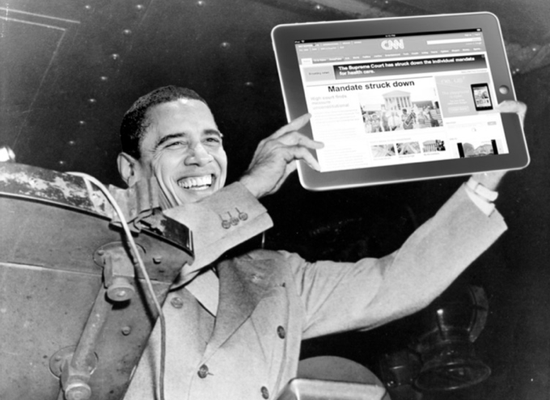
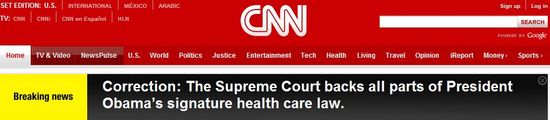
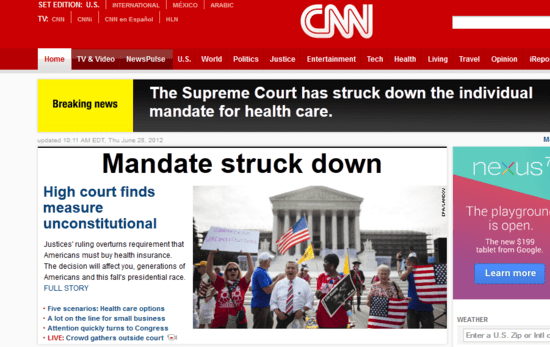
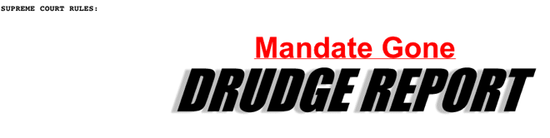
10.36 am. One wonders who at CNN authorized the excruciatingly premature headline below. This is now the correction of the year:
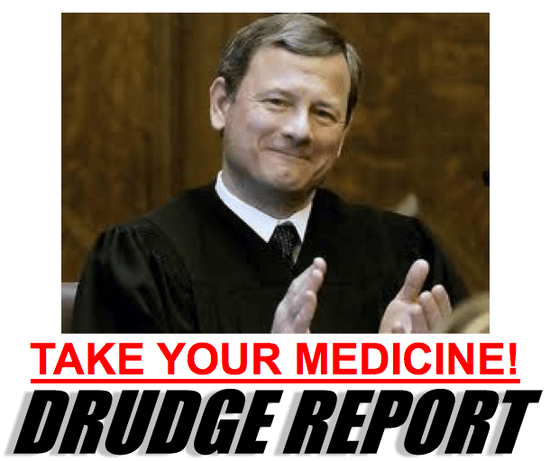
Drudge did not run a correction.
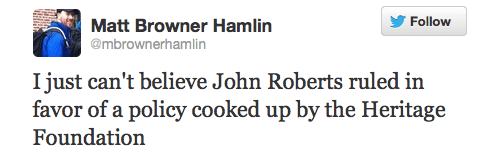
10.32 am. Tweets of the day:
10.29 am. Some confusion in the media:
CNN has now refreshed the page to read:
The Supreme Court backs all parts of President Obama's signature health care law.
Roberts is going to turn out to be another in the long list of GWB mistakes. Complete squish.
Another beaut:
This is what happens when conservatives ignore liberty principles (which they often do) and put someone like Roberts on the Court? He has been deferential to government power in many areas of the law. He is a conservative, not a libertarian. Deference to tradition and we've had a 100 years of tradition in the law that is deferential to government power.
10.25 am. Premature ejaculation:
10.19 am. Tom at ScotusBlog:
The bottom line: the entire ACA is upheld, with the exception that the federal government's power to terminate states' Medicaid funds is narrowly read.
That's a huge victory for Obama, it seems to me. His core domestic achievement was salvaged by … John Roberts.
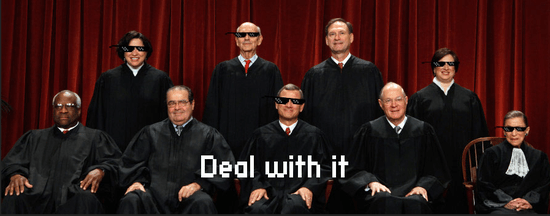
10.16 am. Roberts defends Obamacare. And a thousand pundits swoon.
10.15 am. The mandate survives! As a tax, apparently. But: "It's very complicated, so we're still figuring it out."
(Broccoli photo by "Fir0002/Flagstaffotos" via Wiki)
Since this morning's ruling, the Romney campaign and RNC have issued calls for "full repeal" while the DCCC took an extended victory lap. There's more to come: not even an hour after the ruling, the Koch-funded Americans for Prosperity announced it was putting together a $9 million ad buy targeting Obamacare in 12 key states. Meanwhile, Obama's Super PAC continues to hammer Romney's record at Bain with a new spot running in CO, FL, OH, PA and VA:
In a preview of their somehow tentative response to the Bain onslaught, the Romney campaign posted – and then quietly deleted – a video of GST's former vice president offering a different perspective on the "vampire story":
We posted a bunch of emails during our live-blogging but here's another big batch:
As much as the right tries to push the "SCOTUS called it a tax" argument, I think Obama has a pretty good comeback with "SCOTUS ruled 8-1 that it's not a tax." Only Roberts said it was a tax. Four justices said it's not a tax and thus unconstitutional; four said it's not a tax but still constitutional. So what if one justice said the mandate is a tax?
A lawyer outlines his reaction to the ruling:
(1) I am absolutely overjoyed that the Court has upheld the Affordable Care Act, and that the vision of universal coverage is closer today than it was yesterday.
(2) As a long term legal matter, Chief Justice Roberts: (a) now has himself a previously non-existent limit on Congress's Commerce clause power, and (b) a perviously unrecognized limit on Congress's Spending Clause power. He will have these limits at his disposal over his next 20+ years as leader of the Roberts Court.
(3) As political matter, his maneuvering was absolutely genius. He has (a) protected the institution of the Court; (b) forced Obama and the Democrats in Congress to acknowledge that the mandate is a tax and, thus, they have raised taxes on earners under $250,000; and (c) ensured that, as a tax, the mandate can be repealed by reconciliation – i.e., a bare majority of both Houses and the signature of a Republican President.
Roberts got his limitation on federal power and got to ingeniously play the political game without receiving any fault for doing so. And, most importantly, the uninsured will now get insurance.
Another lawyer writes:
From my quick glance at who signed on to what in whose opinion, it seems like the four dissenters – Scalia, Alito, Kennedy, and Thomas – did not sign on even to the part of the opinion in which Roberts says the ACA would not pass Constitutional muster under the Commerce Clause. This is unusual, as dissenters usually will join those parts of the majority decision with which they agree unless they have a completely novel reason for their determination – which in this case, from my brief perusal of the opinions, they do not.
Bottom line: the Kennedy-led branch seems to have intentionally distanced themselves from Roberts ruling in toto, even where they agree. Also, based on a quick word search, they do not even mention the majority opinion regarding the parts on which they agree. Thomas, as he often does, both joins the dissent and writes his own, and he does acknowledge Roberts' proper reading of the Commerce Clause though he say he would go even further.
Another reader:
During oral argument of the Affordable Care Act, Solicitor General Donald Verrilli allegedly engaged in a "slip of the tongue" in calling the individual mandate just a "tax" rather than a "tax penalty" – the term that the US generally used to describe the penalty. At the time, I never believed it was a mistake. Verrilli is to smart, experienced, and careful in his word choices to make such an amatuer mistake. Is it impossible to imagine – or perhaps to cynical – that he did it intentionally, serving as a kind of subliminal message to the Court, particularly its most conservative members who – it turns out – latched onto that argument to save the Act?
Another:
So, now that the Affordable Care Act has a mandate from the Supreme Court, do you think maybe it's time for Obama to put his communication skills to use and explain what the law is, why it makes sense, and how it helps people? This seems like a moment when they can start to win the PR war on ACA that they've so badly blundered in the past, and do so in a way that shows how unhinged the Republicans have become.
Another:
I do not understand why Democrats don't embrace the newly defined "tax", saying: you bet we raised taxes, but not on the hard-working, responsible middle class. This is a tax on those deadbeats who don't pay for their own insurance but still expect care when they show up at emergency rooms. It's a tax, all right, and I think we should agree to raise it even higher so they have more of an incentive to buy their own damned insurance and leave the rest of us alone. Let the Republicans protect the rights of deadbeats; Democrats are fighting for people who play by the rules.
And another:
I think Romney and the GOP probably will try to pivot by claiming that "Obama raised taxes on hard working Americans," this talking point is transparently stupid and easy to parry. The "tax" at issue here is one that no one is intended to pay. If you get health insurance (which most voters have already and the rest want), you don't have to pay the "tax." And the ACA has a number of mechanisms for helping people get insurance. The idea that there are actual people out there who don't want health insurance is an absurd product of the wingnut imagination. If Obama and the Democrats can't parry that argument, they deserve to lose. Moreover, let's not forget that Romney himself passed a mandate in Massachusetts. If it's a tax, he raised taxes too.
Another:
Here's an April 2010 video of Romney claiming that RomneyCare did not raise taxes when it had a tax penalty for mandate non-compliance:
Another:
As you know, Obama's key challenge now is beating the ObamaCare-as-tax-increase charge. Obama can say this: "For years, Americans who were lucky enough to have health insurance were paying higher-than-necessary premiums to cover those Americans who weren't lucky enough to have insurance but who needed healthcare. Now, the penalty that passed as part of ObamaCare, which some Republicans are calling a tax, and which is the same exact penalty my opponent passed when he was Governor of Massachusetts, will be levied on those same uninsured people unless they decide to purchase insurance. So if you have insurance, not only will you never face the penalty, but your premiums will be lower than they otherwise would have been because you won't be subsidizing the uninsured like you once were."
Or he can simply say this: "I agree with Mitt Romney circa 2007 that it's not a tax, but a penalty. And if you're lucky enough to have health insurance already, it's a penalty you won't have to pay, and it's a penalty that will reduce your health insurance premiums." Full stop.
The latter is less honest, sure, but it's what a Republican would say if he were in Obama's shoes. And it's certainly closer to the truth than anything Mitt Romney will end up saying. And the uninsured who will in fact have to buy health insurance or pay a penalty either know that already or aren't paying attention anyhow. If necessary, he could throw in this bit: "And if you're already struggling and uninsured, we'll help you pay for insurance so you don't have to pay the penalty." Simple stuff.
Yet another:
Just imagine if Romney had originally stood by his Massachusetts health care mandate when he began his run for 2012 president. Today's SCOTUS decision could have been Romney's big win – the triumph of a health care plan conceived by conservative leaders that Romney himself successfully implemented in Massachusetts. He could have proclaimed himself as a national visionary of conservative health care, while painting Obama as a pale Romney-imitator. But such are the perils of pandering to today's conservative base: Forswear your prior political successes instead of building upon them, then let your opponent reap the rewards of favorable SCOTUS decisions that you could have claimed.
Another reacts to previous readers:
"This decision is a major political problem for Obama"? And this: "…this ruling was a disaster for the left"?? Are these people fucking kidding me? They remind me of that scene in Hannah and Her Sisters where Woody Allen's character learns he doesn't have a brain tumor. He comes running out of his doctor's office, dancing down the street, before suddenly realizing that life is still horrible and meaningless. He then turns around goes shuffling down the street in the other direction. The American Left: even when they're winning, they think they're losing.
Let's take this for what it was: A huge political victory for Obama. But more importantly, a huge victory for all Americans who have suffered and are suffering because of a lack of health insurance. We haven't won the war yet, but we just won a major battle.
[B]ecause the law was written assuming that the uninsured poor would be covered by Medicaid, subsidies to purchase health insurance in the exchanges don’t kick in until higher income levels. The poor won’t have to pay the tax penalty formerly known as the mandate because of a hardship exemption in the law, but neither will they get the subsidy until their incomes go up enough. It’s a very weird reversal of the usual means-test for government benefits. Typically, as your income rises you become ineligible for benefits. Here, you become eligible.
I agree with Bernstein and Aaron and Kevin Drum (all posts worth reading) that it is unlikely many states will actually refuse the money that comes with Medicaid expansion due to the pressure they’re likely to receive from providers. But it is possible some may try, and in particular they may do so to extract concessions from regulators. “Hey, let that waiver through and we’re on board.” It’d be an ugly game, threatening the affordability of coverage of low-income individuals, but that doesn’t mean some states won’t play it.
Judy Soloman thinks the Medicaid funds are a very good deal for the states. Pelosi unsurprisingly agrees:
Pelosi argued that it will be extremely difficult for conservative states to opt out once their residents see how other states are benefitting from the Medicaid expansion. “Once this bill is rolling and people experience benefits of it, it’s very hard for a state to say [no],” she said. States will also receive full federal funding for the first three years of the expansion before they have to take up more the expense, which Pelosi described as a major incentive to get them to participate.
Suderman, on the other hand, thinks the Medicaid ruling could allow states to effectively opt-out of Obamacare:
Overall, this dramatically expands the choices for state governments. Already they had the option to decline to set up health insurance exchanges as called for the by the law. In theory, the federal government would then step in to create an exchange, but it’s not at all clear that the federal government has the necessary funding or authority to get funding. If a state opts out of both exchange creation and the law’s Medicaid expansion, it will be able to avoid many of the law’s costs and consequences, and position itself largely beyond the reach of the law. Which may leave us with a fractured, quasi-federalist health care overhaul in which some states have exchanges and a beefed up, federally managed Medicaid program and other states avoid participation almost entirely.
Avik Roy argues that the Medicaid decision could explode the deficit:
[N]ow that states can opt out of the law’s Medicaid expansion, states that currently cover people above 100 percent of FPL with Medicaid now have a significant financial incentive to shrink Medicaid eligibility down to 100 percent of FPL, and let the federal government (read: taxpayers in other states) pay for the rest. This, again, will lead to substantially higher costs for the federal government, because exchange subsidies are much more generous than Medicaid is.
Douthat believes that Roberts' decision was political:
[T]o my admittedly non-expert eyes, Roberts’s attempt at a “reasonable construction” looks more like a re-construction, and his ruling reads as a decision made much, much more out of deference to the legislative and executive branches than out of a straightforward application of the Chief Justice’s views of the Constitution to the plain language of the statute.
He goes on to argue that "such deference is a defensible way for a restraint-minded Supreme Court Justice to approach his role in our republic." Will Wilkinson is mostly on the same page:
Mr Roberts genuinely thinks continuity, stability, public approval, and a posture of deference to the legislature are crucial to the healthy functioning of the judicial branch. The members of the court have more room to move, more freedom to interpret the constitution by their independent lights, when they are not the subject of an angry, divisive public debate that loudly calls into question the independence and legitimacy of their institution. Mr Roberts observed the livid reaction to Citizens United, as well as the liberal freak-out over the mere possibility of a ruling striking down Obamacare, and determined that prudent custodianship of the court called for a light, conciliatory touch. Indeed, my hunch (and none shall doubt my amazing intuition!) is that Mr Roberts may well have chosen to join his conservative colleagues had the court not lost so much public goodwill following the Citizens United decision
Fallows, while defending his coup remark, makes related points:
In making a majority to sustain the mandate / "tax," the Chief Justice gave his first substantial demonstration of loyalty-to-institution outweighing loyalty-to-cause. I am willing to believe that this has been his real intention all along; that he was increasingly concerned that his legacy might be a Court whose legitimacy ebbed as its partisan predictability rose; and that he finally found the way to express his true "institutionalist" nature. To gauge the importance of this move by the Chief Justice, consider the political and legal world we would know today if he had joined the other side to make a 5-4 majority for totally overthrowing the law, perhaps accompanied by a hyperpoliticized Scalia concurrence. I stand by my previous (much objected-to) contention that this would have aggravated a genuine legitimacy crisis for the Supreme Court.
And Randy Barnett, who spearheaded the argument against the mandate, claims partial victory:
From then until today, most law professors have taught that the power of Congress to regulate the "national economy" is limited only by Congressional restraint, which means that the power is unlimited. … Today, the Supreme Court definitively rejected this position by holding that mandating economic activity is not the same as regulating it, and that some means Congress chooses to regulate commerce can be improper. Today, the Court reaffirmed the traditional view that there must be a judicially-enforceable limit on the powers of Congress. From now on, Congress will need to take the limits of its own power seriously, because it can be assured that the Court will be looking over its shoulder.
A month ago, the Dish assessed the news that the investment bank had lost $2 billion on a bad bet. Turns out that news was off by about 450%. Yves Smith demands accountability:
So again, what did [JP Morgan boss Jamie] Dimon know when? Under the hot lights at the House Financial Services Committee, he repeatedly brushed off the losses on the failed Chief Investment Office trades as no biggie. Let us remind readers that the size of the CIO’s balance sheet would make it the 8th largest bank in the US and it was running half of JPM’s total risk exposures, so it’s hard to see the failure of oversight as something to be waived off. And now it turns out the losses are going to clock in at a much higher number than the $2 billion that Dimon kept repeating in the hearings.
Yglesias wonders what the government can do if this happens again, only worse:
If JP Morgan finds a way to lose $90 billion in a crazy trade, do we have the tools in place to unwind the firm or are taxpayers going to end up writing Jamie Dimon a check for $90 billion?



 The Dish
