Mister Rogers finally gets his auto-tune:
Month: June 2012
Where Is The Netflix Of Porn?
Janko Roettgers investigates:
Netflix and others in the mainstream video space owe a huge part of their success to word-of-mouth, with people recommending the services to friends and Facebook followers. You’re much less likely to do that with adult content, argued Wantedlist (site not safe for work) co-founder Danny Ting when I talked to him a few days ago. "It’s a very private matter for most people," he said.
Wantedlist started in the late 1990s by taking lots of cues from Netflix. The service initially just rented DVDs to mail to its customers and then eventually expanded to online streaming as well. It now offers an online-only all-you-can-eat subscription that largely consists of catalog titles, and also still maintains its DVD business. Sounds like Netflix all over again — except that the rapid transition to online subscriptions never happened.
"We thought we would be full-on streaming," remembered Ting. But to this day, DVDs are the biggest part of Wantedlist’s business. “We didn’t become as big as we wanted to,” he admitted. Ting also sees piracy as part of the problem, but still thinks the real issue is privacy. “People don’t really share that consumption with anyone else,” he explained. And as companies like Hulu and Spotify are flocking to Facebook to share their members media consumption, the adult Netflix wanna-be’s are increasingly left behind. Said Ting: “We are not part of the viral marketing revolution."
Who Should Govern Egypt?
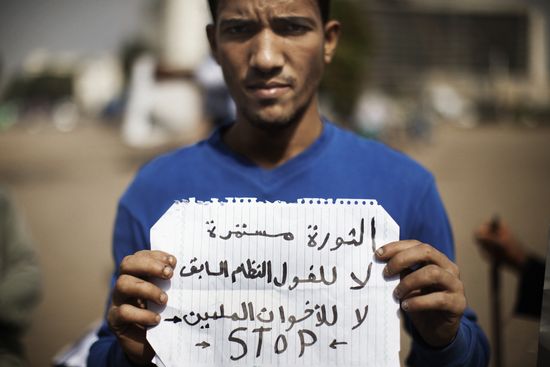
Daniel Serwer comes out in support of the ex-regime candidate in Egypt's presidential election over the Muslim Brotherhood's champion:
The Egyptian revolution would have done better with a more charismatic, less compromised, more principled leader like Nelson Mandela. But that is not what the tortuous path of its politics over the last year and a half has produced. Better a divided government under Shafiq than a deeply Islamist government under Morsi.
Hassan Malik makes the case for the Brotherhood's candidate:
[A] Morsi administration, which looks increasingly likely, may not be a bad outcome after all; it may even be the best option from the perspective of financial markets. The Brotherhood draws significant support from property-owning professionals and businessmen, and is sensitive to their needs. Indeed, the group’s first-choice candidate, Khairat el-Shater, is a multimillionaire businessman who was disqualified at the last minute on a legal technicality, and the party has also taken on internationally respected development economist Hernando de Soto as an adviser on economic reforms. All of this suggests that the Brotherhood is more interested in Turkish-style pious capitalism along the lines promoted by the AK Party than in the Muslim theocracy peddled by the Taliban.
(Photo: An Egyptian man holds an Arabic sign while demonstrating in Cairo's Tahrir square on May 29, 2012. Writing reads: 'The revolution continues… No to candidates from the old regime…No to the Muslim Brotherhood….STOP'. By Marco Longari/AFP/Getty Images.)
The “Unethical Stench” Of Mitt
PM Carpenter provoked me into a little tirade. I feel better now.
Dissent Of The Day
A reader writes:
The recent posts a la "The Death Knell For Football" are really starting to get on my nerves. The point at which you started comparing football to Big Tobacco (which I think is an enormous stretch) finally pushed me to respond.
The risks of potential injury (and even injuries that could persist for years after a player had stopped playing the game) have been highly publicized for years. Even absent the concussion issue, players enter into the league knowing that is a brutal, dangerous, highly risky activity. Further, football players are individuals that have self selected for a dangerous profession — and have been offered significant monetary compensation to do so. How exactly are players victims? How are they any different from any other employee that has opted to work in a dangerous profession? It's not like they were rounded up and forced to play football.
If your point is that the NFL knew about the longterm dangers of concussions, but did nothing to protect their players, I would argue that the league has for years maintained positions in favor of safety that players themselves have pushed back against.
For years, the league and its teams have made efforts to suggest the equipment and pads that players wear during games and practices, but players have pushed back because as an example, they prefer the helmet brand/style they wore in college or they don't want to wear pads because they inhibit their movement/quickness. Even now, as the league moves to make the wearing of mouthpieces (something that is know to mitigate the risk and/or limit the severity of concussions), many players have stated that they are against this as it inhibits their ability to communicate on the field of play. How is the safety of the players solely the league's responsibility?
I guess though my biggest gripe with this series of posts is that it singles out American professional football, despite the fact that the rates of concussions in many other professional sports (e.g. hockey, soccer, rugby, lacrosse) are not that dissimilar from football. Seriously, Google "rates of concussions in sports", and you'll find numerous peer reviewed research on concussion rates in every major sport. Why then is professional football such an evil entity, making money "off their bludgeoned human cattle", while other professional leagues get a free pass?
Our discussion of NFL violence actually did spawn a long thread on pro hockey and its unique "enforcer" problem – here, here, here, here and here. Read the whole "Big Football" thread here, here, here, here, here and here.
The Reality Of Military Rape
A new film exposes it:
Ali Gharib provides background on the issue:
The victims of these rampant sexual assaults have little recourse outside their own chain-of-command, where commanding officers often personally know the assailant. That’s why Ziering stressed in her comments that commanders need to be held accountable, holding up the example of the Catholic church, where action against child abuse only came after bishops’ responsibility became an area of focus. Defense Secretary Leon Panetta viewed “The Invisible War” in April and two days later shifted the discretion for pursuing investigations higher up the chain-of-command in order to distance those determinations from the immediate commanders of accusers and accused alike. (Other steps have since been taken, too.)
Our Cyber-War Defenses
Steve Coll worries about them:
Iran is one of two-dozen-plus countries believed to possess an explicit cyber-warfare capability, akin to America’s Cyber Command. Russia is highly effective; China is active and capable. Specialists do not rate the United States as especially dominant on offense, but the country looks strikingly weak on defense.
"Because of its greater dependence on cyber-controlled systems and its inability thus far to create national cyber defenses, the United States is currently far more vulnerable to cyber war than Russia or China," write Richard A. Clarke and Robert K. Knake in their book, "Cyber War: The Next Threat to National Security and What to Do About It."
The Politicization Of Catholicism, Ctd
A reader writes:
You wrote: “Where will it end?” It ends when their tax exemption gets threatened. And if they’re engaging in openly political activity it should get threatened. When a priest says – from the pulpit (!) that you can’t be a Catholic and vote Democrat, well, it’s a political organization isn’t it?
I used to work for the church (25 yrs ago) and believe me, the possibility of their finances being looked over puts the fear of God in them.
I think that when a priest attends and blesses an announcement that a politician is switching parties, the tax exemption is null and void.
The Franciscans Come To The Nuns’ Defense, Ctd

A reader writes:
One thing to mention about the letter is that the Franciscans are a Mendicant Order: they survive on charity donations. They aren't tied into the massive wealth and prestige of the Catholic Church's "business/political" arm. Take away the power and wealth of the Catholic's cardinals and pope, and the political games that come with that power and wealth, and you might get … Christianity?
Well, there's a reason I turned to Saint Francis in my own attempt to explain Christianity's essence. Another adds:
The friars are not coming to the nuns' "rescue." They are not helpless damsels, and painting them as such plays right into the line of thinking that the Vatican wants people to perpetuate. "Defense" is fine and appropriate. "Rescue" is demeaning and counter to your good work on this issue thus far.
Point taken (see headline). Another writes:
Like you, I was heartened by the Franciscans' letter. But my eyebrows went up at this line (in italics):
"Finally, when there appears to be honest disagreement on the application of moral principles to public policy, it is not equivalent to questioning the authority of the Church’s magisterium. Although the Catholic moral tradition speaks of agreement regarding moral principles, it also – from the Middle Ages through today – speaks of appropriate disagreement regarding specific application of these principles. Unfortunately, the public communications media in the U.S. may not recognize this distinction."
The good friars should know, as well as anyone, that the issue isn't the "public communications media" not recognizing the distinction; it's the Vatican, and a 'Rome Has Spoken' policy that dates back to the start of John Paul II's pontificate.
As this excellent National Catholic Reporter article points out, the nuns are being condemned over two areas.
One is a speech given in 2007 by Sr. Laurie Brink, a Dominican, who made the statement during a presentation on different models of religious life that "the God of Jesus might well be the God of Moses and the God of Mohammed" for some religious women. That statement, as America magazine noted, was used to describe choices the religious face — in this case "sojourning to a land unknown" — choices that included letting congregations die or engaging in total obedience to the Church.
Brink said her preference was for a fourth model of "reconciliation" with the Church, in which religious women and bishops understand the choices before them and move together in the common purpose of their mission. It is not, as the Congregation for the Defense of the Faith alleged, "a challenge . . . to core Catholic beliefs," because she wasn't advocating nuns adopt Judaic or Islamic conceptions of God; Brink said it was one of many options religious women face as they grow closer in their relationship to God.
But that nuance doesn't seem to matter to the Vatican.
The second instance, according to the CDF, is that certain leaders of the religious orders (not stated in the letter) have written letters "protesting the Holy See's actions" in relation to the ordination of women and ministry to homosexuals. "The terms of the letters," the CDF statement says, "suggest that these sisters collectively take a position not in agreement with the Church's teaching on human sexuality. It is a serious matter when these Leadership Teams are not providing effective leadership and example to their communities, but place themselves outside the Church's teaching."
Got that? The mere act of writing a letter in protest — the act of disagreement — constitutes a break with the Church. There is no evidence the nuns have declared they can administer the Eucharist or bless a union of a loving gay couple; discussion alone brings the wrath of Rome. The letter goes on to say:
"Some speakers claim that dissent from the doctrine of the Church is justified as an exercise of the prophetic office. But this is based upon a mistaken understanding of the dynamic of prophecy in the Church: it justifies dissent by positing the possibility of divergence between the Church’s magisterium and a “legitimate” theological intuition of some of the faithful. “Prophecy,” as a methodological principle, is here directed at the Magisterium and the Church’s pastors, whereas true prophecy is a grace which accompanies the exercise of the responsibilities of the Christian life and ministries within the Church, regulated and verified by the Church’s faith and teaching office. Some of the addresses at LCWR-sponsored events perpetuate a distorted ecclesiological vision, and have scant regard for the role of the Magisterium as the guarantor of the authentic interpretation of the Church’s faith."
In other words: God speaks to us bishops. Your vision, formed from prayer and real-world experience? Just a hunch.
If the Catholic Church's leadership well and truly recognizes the value of appropriate disagreement, it has a narrow understanding of what disagreement entails. To them, it's reserved for bishops behind closed doors, and not a matter for those who go out into the world to fulfill the charge of Christ.
(Painting: St Francis In The Desert, by Giovanni Bellini, 1480. A wonderful appreciation of the masterpiece can be read here.)
As Syria Burns
We are hurtling through deserted towns on our way to Damascus. The driver is scared. When we entered some areas he puts his foot down #Syria
— Paul Danahar (@pdanahar) June 8, 2012
Julien Barnes-Dacey reports from Damascus on the regime's increasing unpopularity:
This hollowing-out of regime support in the capital, which is increasingly visible to visitors and residents alike, suggests the potential dawn of a new phase in Syria's long struggle. The decision by Damascene merchants to go on an unprecedented strike over recent days — locking their stores shut or sitting outside and refusing to do business in response to the Houla killings — marked an important escalation of local defiance. Previous calls for strikes, by contrast, had withered out unsuccessfully.
Barbara Walter explains why Assad continues to laughably deny responsibility for the massacres his forces are committing:
[T]he countries that are most likely to intervene are also democracies, and politicians in democracies cannot ignore public opinion. The more pressure the public places on their democratically elected leaders to “do something,” the more likely these leaders are to respond with action. Especially if those cries come in the months leading up to a contentious election. This is where Assad’s denial comes in. Average citizens in the United States, France and Britain are far less informed about who actually did the killing than the villagers in Houla or any politician. This uncertainty creates an opening for Assad to exploit. By denying any involvement, Assad is planting a seed of doubt that he wasn’t involved. And a seed of doubt might be all he needs to convince voters he isn’t a monster and that outside intervention isn’t necessary.
Robert Satloff worries about the escalating conflict's implications for America, particularly with respect to Syria's chemical weapons. Barry Rubin compares the situation to the Spanish Civil War.
 The Dish