Are Large Sugary Drinks Food?

Mark Bittman issues a ringing endorsement of the soda ban: 

They are not food. Added sugar, as will be obvious when we look back in 20 or 50 years, is the tobacco of the 21st century. (The time frame will depend on how many decent public health officials we manage to put in office, and how hard we’re willing to fight Big Food.) And if you believe that limiting our "right" to purchase soda is a slippery slope, one that will lead to defining which foods are nutritious and which aren’t — and which ones government funds should be used to subsidize and which they shouldn’t — you’re right. It’s the beginning of better public health policy, policy that is good for the health of our citizenry.

Shani Hilton doubts the ban will change much:

Obviously what should be happening here is a federal move to end sugar subsidies. If Bittman wants to argue against added sugar in food—which he does effectively—then it's silly to neglect the point that sugar is cheap because the government makes it cheap. Make it expensive and people will consume less.

Earlier Dish on Bloomberg's misguided paternalism here, here, here, and here

Should Unions Give Up On Democrats?

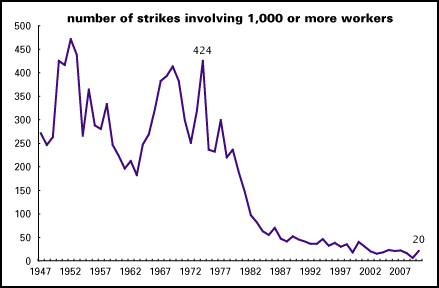
Strikes

Doug Henwood makes the case:

Since 2000, unions have given over $700 million to Democrats—$45 million of it this year alone (Labor: Long-Term Contribution Trends). What do they have to show for it? Imagine if they’d spent that sort of money, say, lobbying for single-payer day-in, day-out, everywhere.

Scott Lemieux strikes back:

[W]e wouldn’t be any closer to single payer than we are now. Even if we generously assume that this lobbying campaign would increase public support for single-payer, a lack of public support for single payer is not the crucial barrier. You need, in concrete terms, to explain how this campaign would get a majority for single-payer in the House and a supermajority in the Senate. Under current conditions, no lobbying campaign is going to get single-payer the slightest consideration in the House. 

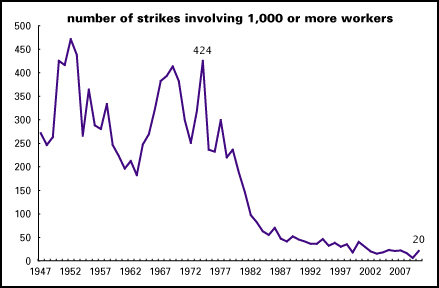
(Chart by Henwood)

The Franciscans Come To The Nuns’ Rescue

This is becoming a major revolt against the Vatican's attempt to police and control the nuns who don't adhere to Benedict's diktats. It's strongly worded and its message is clear: the Vatican's intrusion is "excessive". Here's the full text released yesterday morning. It is, as James Martin puts it, "fathers and brothers coming to the defense of their sisters. " It's a nuanced and respectful defense of core Catholicism, asserting that the current Vatican's insistence on total control over all issues, even those where there can and should be "courageous discernment", is actually against Catholic teaching, as expressed in the Second Vatican Council. And it gives me hope:

May 31, 2012

Open Letter to the United States Catholic Sisters

We, the Leadership of the Friars Minor of the United States, write today as your brothers in the vowed religious life who, like you, have great love for our Church and for the people whom we are privileged to serve.  We write at a time of heightened polarization and even animosity in our nation and Church, with deep concern that the recent Vatican Doctrinal Assessment of the Leadership Conference of Women Religious (LCWR) may inadvertently fuel the current climate of division and confusion.  We write, too, as a public sign of our solidarity with you as you endure this very difficult moment.  We are privileged to share with you the journey of religious life.  Like you, we strive in all that we do to build up the People of God.

As religious brothers in the Franciscan tradition, we are rooted in a stance of gratitude that flows from awareness of the myriad ways that God is disclosed and made manifest in the world.  For us, there can be no dispute that God has been and continues to be revealed through the faithful (and often unsung) witness of religious women in the United States.  Thus we note with appreciation that the Congregation for the Defense of the Faith (CDF) “acknowledges with gratitude the great contributions of women Religious to the Church of the United States as seen particularly in the many schools, hospitals, and institutions of support for the poor which have been founded and staffed by Religious over the years.”  We certainly know how much our service has been enriched by the many gifts you bring to these ministries.

However, your gift to the Church is not only one of service, but also one of courageous discernment.  The late 20th century and the beginning of this century have been times of great social, political and cultural upheaval and change.  Such contextual changes require us, as faithful members of the Church, to pose questions that at first may appear to be controversial or even unfaithful, but in fact are asked precisely so that we might live authentically the charisms we have received, even as we respond to the “signs of the times.”  This is the charge that we as religious have received through the “Decree on the Renewal of Religious Life” from the Second Vatican Council and subsequent statements of the Church on religious life.  We believe that your willingness to reflect on many of the questions faced by contemporary society is an expression of your determination to be faithful to the Gospel, the Church, the invitation from Vatican II and your own religious charisms.  We remain thankful for and edified by your courage to engage in such reflection despite the ever-present risk of misunderstanding.

Moreover, we are concerned that the tone and direction set forth in the Doctrinal Assessment of LCWR are excessive, given the evidence raised.  The efforts of LCWR to facilitate honest and faithful dialogue on critical issues of our times must not result in a level of ecclesial oversight that could, in effect, quash all further discernment.  Further, questioning your adherence to Church teaching by your “remaining silent” on certain ethical issues seems to us a charge that could be leveled against many groups in the Church, and fails to appreciate both the larger cultural context and the particular parameters of expertise within which we all operate. 

Finally, when there appears to be honest disagreement on the application of moral principles to public policy, it is not equivalent to questioning the authority of the Church’s magisterium.  Although the Catholic moral tradition speaks of agreement regarding moral principles, it also – from the Middle Ages through today – speaks of appropriate disagreement regarding specific application of these principles.  Unfortunately, the public communications media in the U.S. may not recognize this distinction.  Rather than excessive oversight of LCWR, perhaps a better service to the people of God might be a renewed effort to articulate the nuances of our complex moral tradition.   This can be a teaching moment rather than a moment of regulation — an opportunity to bring our faith to bear on the complexity of public policy particularly in the midst of our quadrennial elections.

Finally, we realize and appreciate, as we are sure do you, the proper and right role of the bishops as it is set out in Mutuae Relationes to provide leadership and guidance to religious institutions.[i]  However, the same document clearly states:

since it is of utmost importance that the council of major superiors collaborate diligently and in a spirit of trust with episcopal conferences, ‘it is desirable that questions having reference to both bishops and religious should be dealt with by mixed commissions consisting of bishops and major religious superiors, men or women. …Such a mixed commission should be structured in such a way that even if the right of ultimate decision making is to be always left to councils or conferences, according to the respective competencies, it can, as an organism of mutual counsel, liaison, communication, study and reflection, achieve its purpose.  (#63)

We trust that CDF was attempting to follow their counsel from Mutuae Relationes; however, we fear that in today’s public media world their action easily could be misunderstood.  We hope that our bishops will take particular care to see that the way they take action is as important as the actions themselves in serving the People of God.  Otherwise, their efforts will surely be misunderstood and polarizing.

Lastly, we appreciate the approach that you at LCWR have taken to enter into a time of discernment, rather than immediately making public statements that could be construed as “opposing the bishops” after the release of the Doctrinal Assessment.  The rancor and incivility of public conversation in the United States at this time make the possibility of productive dialogue more difficult to achieve.  We pray that the future conversation between LCWR and CDF might provide an example to the larger world of respectful, civil dialog.  Such dialog will require a degree of mutuality, trust and honesty that is absent from much of our world.  We trust that you will continue your efforts to live out this principle, and we trust and pray that our bishops will do the same.

Please be assured of our on-going support, prayers, respect, and gratitude for your living example of the following of Christ in our times.

Fraternally,

Leadership of Franciscan (O.F.M.) Provinces of the United States

Is It Legal To Rent Out Your Home?

Yglesias is unsure:

Airbnb came to Washington to promote the idea that it’s facilitating a peer-to-peer "sharing economy," not empowering a new breed of cold-blooded hospitality entrepreneurs. They emphasized that Airbnb is in many ways not directly competitive with existing hotels, simply adding to the frequency of trips and giving tourists access to neighborhoods that aren’t currently served by major chains. That’s may be true, but one reason those neighborhoods don’t have hotel beds is that in most cities you can’t just slap up a hotel in a residential neighborhood or turn an existing residential property into one. Big cities draw a fairly firm distinction between a house and a hotel, but Airbnb’s entire business is based on obscuring that line.

He hopes the laws will change:

More visitors is good for almost any town. It’s time for cities to take note of what’s happening on the ground and start making changes to ensure that it’s legal.

Landlords can also pose problems.

The Money Game

A new poll shows Romney slightly ahead in Michigan, where pro-Republican groups have spent $3.4 million to Obama's none. Chait worries about the GOP's fundraising advantage in this context: 

One of the things a party can do with a financial advantage like this is force the other party to spend money it doesn't want to spend. Obama doesn't need to match Romney's spending to win Michigan, but if he gets outspent, say, 10 million to nothing, he could lose the state. Republicans have the money to dump into safe Democratic states and force Obama to defend them. If it works in Michigan, it could work in other blue states, too. The point isn't to win those states. The point is to drain Obama's resources for the states he really does need to compete in, like Virginia, Ohio, Colorado, and so on.

 Kornacki, on the other hand, downplays Romney's cash advantage. 

Ad War Update

After a disappointing May jobs report, the Obama campaign addresses Big Lie III - and runs against Congress: 

Greg Sargent has more

Romney is operating from the calculation that swing voters will hold Obama solely responsible for the state of the economy, and won’t factor in the basic history of the last three years into their decisionmaking, leaving Romney free to claim whatever he wants about what’s been happening. There’s plenty of evidence that he may be right in this calculation — particularly with the anemic jobs numbers we’ve been seeing. This new ad doesn’t directly name Republicans for blocking Obama’s jobs plan, only faulting “Congress” for failing to act on it. Perhaps the campaign is trying a new tack — reminding voters that Obama does in fact have a jobs plan, without tainting it with an overtly partisan message.

Alex Burns looks ahead

If unemployment keeps ticking upward over the course of the summer, it's difficult to see how any political message or ad campaign could fully blunt the negative impact for Obama. But if he can somehow convince the public that he's doing his best over the stonewalling of his opponents, it's conceivable that could mitigate the damage, and that appears to be what this ad is aimed at. It's also a contrast with the Obama campaign's ads blasting Mitt Romney's record in Massachusetts and arguing that the Republican doesn't know how to generate jobs through government.

Previous Ad War Updates: June 6June 5June 4June 1May 31May 30May 29May 24May 23May 22May 21May 18May 17May 16May 15May 14May 10May 9May 8,  May 7May 3May 2May 1Apr 30Apr 27Apr 26Apr 25Apr 24Apr 23Apr 18Apr 17Apr 16Apr 13Apr 11Apr 10Apr 9Apr 5Apr 4Apr 3Apr 2Mar 30Mar 27Mar 26Mar 23Mar 22Mar 21Mar 20Mar 19Mar 16Mar 15Mar 14Mar 13Mar 12Mar 9Mar 8Mar 7Mar 6Mar 5Mar 2Mar 1Feb 29Feb 28Feb 27Feb 23Feb 22Feb 21, Feb 17, Feb 16, Feb 15, Feb 14, Feb 13, Feb 9, Feb 8, Feb 7, Feb 6, Feb 3, Feb 2, Feb 1, Jan 30, Jan 29, Jan 27, Jan 26, Jan 25, Jan 24, Jan 22, Jan 20, Jan 19, Jan 18, Jan 17, Jan 16 and Jan 12.

Yglesias Award Nominee

"Here are two of the smartest men on the economic right, one [Phil Gramm] a former chairman of the Senate banking committee, the other [Glenn Hubbard] a former chair of the Council of Economic Advisers. Yet they insist on treating today's economic crisis as a repeat of 1979-81—and Europe's agony as a debt crisis (which it isn't), not a currency crisis (which it is). Why? Well you will consider only one policy solution—cut taxes and regulations—then you must insist that there can be only one policy problem.

Yet in almost every way, today's economic problems are exactly the opposite of those of 30 years ago. Then we had inflation, today we are struggling against deflation. Then we had weak corporate profits, today corporations are more profitable than ever. Then we had slow productivity growth, today it is high. Then the to-individual income-tax rate was 70%. Today it is 36%. Then energy regulations produced energy shortages. Today the removal of banking regulations has produced an abundance of debt," – David Frum.

The Daily Wrap

6a00d83451c45669e201761520336b970c-550wi

Today on the Dish, Andrew called Romney out on the Big Lie that Obama slowed the economy on purpose (follow-up here), noticed a fifth Big Lie about supermajorities (its follow-up here), called attention to Romney's "vigilance against non-comformance," wondered whether supporting pot legalization could help Obama, and responded to a critique of his position on Wisconsin. We checked on Nate Silver's new election model (60% odds Obama comes out on top), bet on Romney appointing hard-right judges, figured money didn't decide Wisconsin, and ridiculed the idea that Obama told a blowjob joke. Everyone still remembered Bush, the Cabinet mattered little, DOMA moved one step closer to the edge, readers debated Bloomberg nannyism here and here, and unions declined just as libertarians learned to embrace them. Ad War Update here.

Andrew also confessed his difficulties during recent battles with HIV and testosterone, gave a pro-life argument for legal abortion, sounded a death knell for Big Football, reupped the call to Ask Scott Horton Anything, told a story about poop, and chuckled at a bear headline. We wrapped our brains around the grim logic of massacre in Syria, called the notion that Libya was a failed state "a myth," and gaped at parliamentary craziness in Greece. A statistic on healthcare misled (sort of), connected the overdiagnosis problem to broader issues with US health care, and put the spotlight on face transplants. Marriage equality debates continued, marijauna arrests were (arguably) not racist, and humans are DESTROYING THE PLANET. Long copyrights saved business money, tech firm bosses had some strange minds, daily newspapers weakened, and Americans moved everywhere. Humans hated being cut in line, Tarantino muddled race politics, and beards proliferated. Ask Bruce Bartlett Anything here, Quotes for the Day here and here, Chart of the Day here, VFYW here, MHB here, and FOTD here.

Z.B.