The Results Of Obama’s “Socialism”

Screen shot 2012-06-07 at 9.38.27 PM

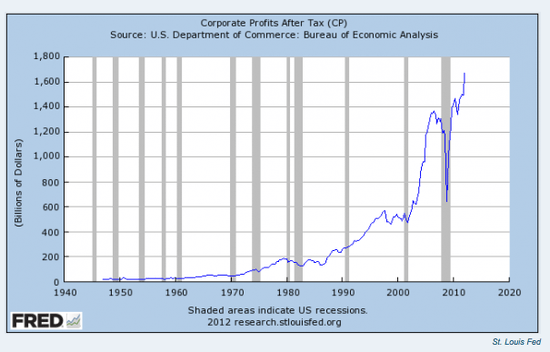
This is the picture (via Blodgett) for corporate after-tax profits. Now listen to what Romney said today:

One must ask whether we will still be a free enterprise nation and whether we will still have economic freedom. America is on the cusp of having a government-run economy. President Obama is transforming America into something very different than the land of the free and the land of opportunity.

So why are private sector profits at historic records?

The Decline Of Unions

Union_membership_decline

Richard Yeselson mourns it:

The problem isn’t that most people hate unions. The problem for unions is that most people don’t care about them, or think about them, at all. …  Sixty years ago, the UAW or the Mineworkers or the Steelworkers, not only deeply affected crucial sectors of an industrial economy, they also demanded respect from broader society—demands made manifest in the "political strikes" they organized, whether legally or not, to protest the issues of the day. Millions supported these strikes, millions despised them—but nobody could ignore them. 

Felix Salmon wonders if unions will ever regain their footing:

One of the biggest secular forces in the decline of labor has surely been the glut of skilled and unskilled workers coming onto the international labor force in recent decades, particularly in China. As a result, I suspect that any truly important next-generation social movement will be profoundly international in nature, and will have to make big strides in China before it has any real effect in the US. Laborers in Chinese factories aren’t just competing with US workers for jobs: they’re also, in a weird way, the best hope those US workers have for real improvements in how they’re treated and paid.

Will Wilkinson makes a distinction between public sector unions (which he opposes) and private sector unions (which he supports):

Competitive globalized markets for labor and capital make the worst excesses of unions infeasible. That outsourcing and capital flight would prevent a reinvigorated American private-sector labor movement from becoming as a powerful force for a more social-democratic politics is a fact progressives have a hard time accepting, but for me that fact is more feature than bug.  …  It's pretty clear that global market forces function worldwide to keep unions' worst anti-competitive instincts in check.

(Chart from Mark Perry)

Bloomberg’s Health Hypocrisy, Ctd

Many readers keep the debate going:

Your reader with the degree in public health makes a very good point and then misapplies it. No one is trying to "restrict a person's right to a salty meal or a Super Big Gulp." This idea that Bloomberg's ban has anything to do with individual's rights is nonsense; the law is nothing more than a regulation of business practice.

Your reader recommends warning people not to buy big drinks, but I don't see how that is any different. If the government can require a warning label on a dangerous product, that "infringes" my "liberty" to consume it without having to feel guilty about it. Warning labels and cup size restrictions are both merely inconveniences to the consumer in an attempt to make them more aware of what they are consuming, thereby promoting public health.

If you still want a salty meal, go out of your way to order extra fries or add more salt. If you need to drink more soda, buy two sodas. Right now my government prevents me entirely from consuming a harmless substance, marijuana; that is a real invasion of my liberty. I'll be happy to see the day when were debating whether or not the government can restrict how many joints come in one pack.

Another writes:

I've loved reading the Dish on Bloomberg and soda, but I think that you're neglecting the science behind his decision. The science shows that sugar is bad enough to warrant action, even that which seems nannyish. Sugar is a poison.

As your posts on nicotine pointed out, anything can be poisonous at certain levels. What's the threshold for sugar? In the 1980s, the Department of Agriculture estimated it to be 40 pounds per person per year. Americans now consume over 90 pounds per year.

What are the consequences of this? Gary Taubes had an article in the Times Magazine last year in which he provided evidence that the increased consumption of sugar is responsible not only for the rise in obesity and diabetes, but also "heart disease, hypertension and many common cancers."

Bloomberg's is a tiny, cheap measure that may get people to limit the amount of dangerous poison they consume. That sort of limitation isn't ridiculous when it comes to sugar, because nobody's eating those 90 pounds in one sitting. And everyone you've quoted seems to think that the goal of the "ban" is to save from themselves adults who have chosen to drink soda despite its health risks. Nobody has brought up how this measure may affect lifetime eating habits in children.

Another:

I am amazed that nobody in the soda-ban debate is addressing the core issue. It's not "freedom" vs. "government interference." It's what to do about the government interference WE ALREADY HAVE. For decades already, the US government has been promoting corn (high fructose corn syrup, animal feed) and cane sugar with direct subsidies and import tariffs. (See Michael Pollan's excellent book, The Omnivore's Dilemma.)

Another proposes the alternative:

I'm amazed at the capacity of such highly educated people, as your readers, to miss the simplest solution to this problem. Obesity is a negative externality. Governments have a legitimate role in addressing such externalities. Tax high-fructose corn syrup and sugar, the offending inputs, and let people choose a large water at 1/3 the price, if they are thirsty. Size of sodas will then regulate themselves. Any government in the US could use the revenue, as well.

Another:

Your reader wrote, "You can hardly find a 12oz soda anywhere these days, and that was the standard soda size for most of the 20th century." Not even. Until the 1950s, the only size you could get a bottled coke was 6.5 ounces, half the size of a 12-ounce can, a third of a 20 ounce bottle and tenth of a half-liter. The largest size you could get in the '50s was 26 ounces, but this was seen as a family size – an alternative to bringing home a six-pack of the little bottles. Now, with 20, 24 and 33 (half litre) bottles of soda, it's about a single serving.

I think an underlying problem is that the profit margins go up for larger sizes. The cost for the syrup is negligible; even for big bottles it's pennies. For a couple extra pennies for a bigger bottle (if that) Coke can charge 50¢ more. And for fountain drinks, where they don't have to distribute the end product (there aren't really economies of scale hauling around bigger bottles) the extra cost for a Big Gulp is almost negligible, which is why prices are often only a few cents higher – the few cents are all profit.

Another sees change in the other direction:

I haven’t seen this covered yet: the soda companies are currently experimenting with Coca-cola-coke-cans-90-calorie425wy101509-1255627949smaller size containers. I love my Diet Dr. Pepper, but 20 oz. a pop is really a bit too much in terms of caffeine and fizz-bloat. Lately, I’ve been seeing 16 oz and even 12 oz plastic bottles at select locations in my neighborhood convenience stores. I’m so happy about it I will just walk out of a store if they don’t have anything smaller than the giant 20 oz bottles. And if I get the chance I will tell the clerk why I left, doing my best to express the market demand for smaller serving size.
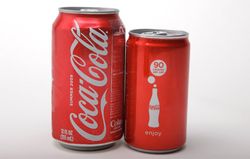
But unlike political structures, there’s no check or balance on the demand by the public for bigger soda sizes. It may be that a lower price point on a 16 oz soda will popularize the smaller size. I hope so. Because I think I’m very much in the minority on this issue. I am the 12% (body fat, that is).
Why Syria Is Escalating

Two more massacres like the one in Houla have taken place recently. Juan Cole explains the logic:

Why is the Syrian Baath Party committing crimes against humanity? Because it has not succeeded in putting down the 14-month-old rebellion against one-party dictatorship by other means. They began by putting snipers on buildings above city squares and just shooting 10 demonstrators in each population center every day. The point was to raise the cost of protesting, to make people wonder if this would be their last demonstration. When the brave protesters nevertheless insisted on continuing to come out, and when the regime lost control of some city quarters to armed defectors from its own military, the regime actually sent in tanks and artillery to pound the rebellious quarters (as with Baba Amr in Homs), despite the inevitable loss of civilian life.

But that use of armor against city quarters did not succeed in quelling the rebellion, either. So the regime has gone to the next step. It is using shabiha death squads to simply kill the unarmed protesters, including women and children, and giving the death squads cover with artillery and tanks. The death squad technique is typically the death rattle of a regime.

Face Of The Day

GT_PAKISTAN-BOMB_120607

A Pakistani man helps an elderly injured blast victim outside a Sunni Muslim seminary on the outskirts of Quetta on June 7, 2012. A bomb attack killed at least eight people and wounded more than 20 others outside a Pakistani madrassa in the troubled southwestern city of Quetta, police said. The bomb was detonated outside the gates of the Sunni Muslim seminary as a degree ceremony for students was being held inside. By Banaras Khan/AFP/Getty Images.

The Big Lies of Mitt Romney V: Obama Had A Super-Majority In Congress For Two Years, Ctd

A reader writes:

Good catch by your readers about Obama's seven-week supermajority.  But there's another thing that irked me about this – what did Obama do during those seven weeks?  He tried to get bipartisan consensus.  This was the time of the "Gang of 6" and the courting of Chuck Grassley.  He possibly could have tried to "ram things through", but to the obvious frustration of lefties chose to continue to seek bipartisan agreement.  For Romney and the Republicans to fault Obama for not being more partisan… I feel like this is a "Annals of Chutzpah" moment.

It is. There are various scenarios to do with Kennedy's and Byrd's health, along with the Kirk replacement, that could be argued with. And you can find small periods in which Obama had a fleeting supermajority in the Senate – but still sought bipartisan support. Just remember that Romney claimed a supermajority in both houses for two years. Just untrue. And he clearly doesn't care.

Are Marijuana Arrests Racist?

Heather MacDonald insists they are not:

The reason that marijuana arrests are higher in high-crime neighborhoods is that their law-abiding residents ask for heavier police presence and for enforcement of all the laws—including drug laws.

The anti-cop advocates love to point out that the 50,000 marijuana-possession arrests in 2011 were more than all such arrests in the 19 years leading up to 1996, when marijuana arrests began rising under the mayoral administration of Rudolph Giuliani. Recall what those 19 years were like: “Twenty years ago you couldn’t walk through here,” a 58-year-old former junkie told me at an East Harlem anti-stop rally several weeks ago. “There’s no crime here anymore.” From 1977 to 1996, those allegedly halcyon days without marijuana enforcement, 12.4 million felonies were committed in the city; from 1997 to 2006, there were only 2.6 million. And it was minority neighborhoods in those pre-Giuliani decades that were most lethally overrun by both crime and the drug trade. Police enforce low-level drug offenses in high-crime areas because they are trying to establish norms of lawful conduct. Ideally, parents would be the ones enforcing those norms, but when they fail to, as the predation in minority neighborhoods shows has happened, the police will step in in their stead.

The Gift Of A New Face

A year-old video tells the story of America's first face transplant recipient:

Katie Drummond reports that the military is investing heavily in more research:

The procedure carries lifelong implications. Patients require years of rehabilitative therapy to finesse facial movements like chewing and swallowing, along with immuno-suppressing drugs to prevent rejection of the foreign tissue. Then there are the psychological considerations: Patients need to adjust to a new set of facial characteristics — often a hybrid of their former face and their donor’s — which is inevitably a weighty toll.