Is An Abortion Ban Actually Pro-Life?

19FETUSBLeonNeal:Getty

Amanda Marcotte argues it isn't, practically speaking:

The rate of abortion is actually higher in countries where it's banned, suggesting that if you're "pro-life", the last thing you want is an abortion ban. The black markets that are handling those abortions are—duh—unsafe. There's no "if" here, no future date when all this is suddenly resolved. We actually know right now what each side's policy gets. If we get our way, abortion rates are lower and exponentially fewer women die or are disfigured by abortions. (In fact, if done properly, it's one of the safest surgical procedures that exists, and far safer than childbirth.) If antis get their way, the abortion rate goes up, as does the rate of women dying or being injured by unsafe abortion.

I don't think this is easy to argue against. I am pro-life, in as much as I find abortion deeply morally troubling. But I am also a conservative, which requires me to see what is actually practicable in a diverse and free society, where government does not, mercifully, have the power to control what happens inside our bodies. And so I favor the boring but essentially conservative position that most European countries have and that Roe deprived America of: legal, safe and rare abortion, with increasing restrictions past the first trimester (while allowing for late-term medical necessities for child and mother). Unsatisfying? Yes. Is any other compromise truly possible in a free society where views differ so greatly? Not without ripping the society apart.

Republicans favor the latter. Real conservatives don't.

Romney’s Vigilance Against Nonconformity

I have to say that most of my sympathy in this hilarious and petty piece in the NYT "Home" section is with the Romneys. But if you think he is a live-and-let-live fellow, you should remember his compulsion for order in his Cranbrook days. People don't change that much:

Mr. Romney and his wife take regular walks around La Jolla, exchanging pleasantries with fellow strollers and occasionally enforcing the law. A young man in town recalled that Mr. Romney confronted him as he smoked marijuana and drank on the beach last summer, demanding that he stop.

The issue appears to be a recurring nuisance for the Romneys. Mr. Quint, who lives on the waterfront near Mr. Romney, said that a police officer had asked him, on a weekend when the candidate was in town, to report any pot smoking on the beach. The officer explained to him that "your neighbors have complained,” Mr. Quint recalled. “He was pretty clear that it was the Romneys."

Wisconsin – And The Rest Of Us, Ctd

I wrote that Wisconsin's recall election was "a case study in the complete breakdown of our political system, and of public trust." Will Wilkinson calls this "badly overwrought":

America's states are undergoing a fiscal reckoning. At the same time, the American electorate is polarising along partisan lines. Repairing a busted state budget is by its nature a fraught exercise in distributive politics, bound to generate bad feeling. Some constituencies are going to take a hit and there's no way around it. Polarisation means that inevitably bitter fights over the distribution of the burdens of fiscal retrenchment are getting bitterer and more divisive. I think we see all this at work in Wisconsin's fight over the power and costs of public-sector unions. We've seen protests in the capital, state senators fleeing into Illinois, and an acrimonious recall election. It's all very messy and exciting, but it is by no means a breakdown. The voters of Wisconsin elected Scott Walker twice, he and the state legislature enacted reforms, and those reforms stand, for now. Wisconsin's democracy may be ugly, but it's working.

In the grand scheme of things, Will has a point. What worries me is the zero-sum dynamics of the political game. The goal of democratic politics should always, in my view, be non-zero-sum: a collective weighing of various interests and an attempt to find a compromise to balance them. With the Manichean rhetoric and ideology of the two factions in Wisconsin – sadly echoing the national divide – decisions may be reached, as Will notes. But the cost to civil society is deep, especially if a tit-for-tat partisan war overwhelms everything else.

Ask Scott Horton Anything

Ask Scott Horton Anything

[Re-posted from yesterday with added questions from readers. Please vote on them if you have 30 seconds to spare.]

Scott Horton is a contributing editor of Harper's who blogs about civil liberties at No Comment. If you haven't yet read his award-winning piece "The Guantánamo 'Suicides'", you should definitely do so. Here is my long take on the report. I also wrote about it in my Sunday Times column (pay-walled):

What really happened? I do not know. But it seems to me that these credible witnesses should have at least been interviewed by the NCIS; that the official story has gaping holes of logic; that the autopsies are beyond bizarre; and that the slightest possibility that something is amiss requires further investigation. If there is any chance that these prisoners were accidentally tortured to death and their deaths then covered up as suicide, this is the biggest story in the grim annals of the Bush-Cheney era since Abu Ghraib. And yet, other than to carry a brief synopsis from Associated Press, no main US newspaper has delved into the Harper’s cover-story.

To submit a question for Scott, simply enter it into the field at the top of the Urtak poll (ignore the "YES or NO question" aspect and simply enter any open-ended question). We primed the poll with questions you can vote on right away – click "Yes" if you are interested in seeing Scott answer the question or "No" if you don't particularly care. We will air his responses soon.

The Psychology Of Pooping, Ctd

Reddit had a thread on epic dumps recently. One for starters:

I just spent 8 minutes sweating, rocking back and forth and hyperventilating while shitting. I thought it was death. At 36 I have never experienced anything like it. It kept getting worse and worse until finally my ass let loose with the fury of a thousand suns. Then, aside from a burning asshole, it has subsided. I am still sitting here waiting for something more. I think it's done.

Dish fave:

I'll see your vicodin shit and raise you a heroin shit.

My dead friend, Patrick, was obsessed with what he called his Morgenscheisse. He once went to the loo and came out all excited. "It's a water-breaker!" he proudly proclaimed. One of four boys, he was scatologically evolved. A "water-breaker" is a single long log that touches the bottom of the toilet bowl and continues out above the surface water. I'm not sure how many Courics that is.

Chart Of The Day

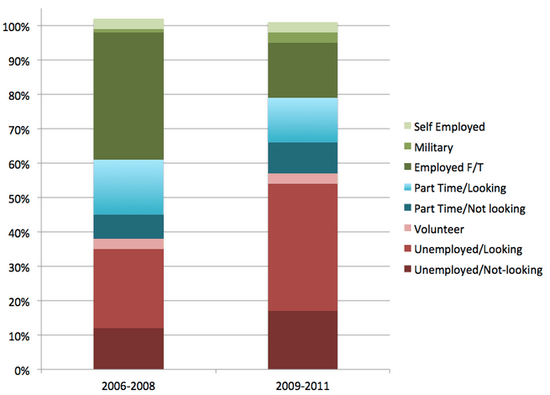
High school graduates entering the workforce are having major trouble finding work:

High_School_Grads

Kevin Drum captions:

Back in 2006-08, about 60% found work of some kind right after graduating. Since 2009, only about 40% have found work. This is a staggering waste of human potential, and almost certainly a lifelong burden for these workers, since abundant evidence suggests that starting out your working career either unemployed or in a low-paying job leads to lower pay throughout your entire life.

The Birthplace Of Democracy

What the utopian dreams of the European Union have helped bring about:

Update from a reader:

I don't think the EU is responsible for Ilias Kasidiaris' assholery on live Greek TV. It has more to do with the fact that he's in a party (Golden Dawn) that makes use of confrontational assholery to make a name for itself and to further its agenda. They'd be doing this even if the EU didn't exist (which I wish it never did.) I realize confrontational violence in Greek politics isn't unusual, but the Golden Dawn fascists have made it an integral part of their organizing.

Bloomberg’s Health Hypocrisy, Ctd

A reader writes:

Saletan fumed: "You can have it one way or the other, Mr. Mayor. You can preach moderation or the right to stuff yourself. But you can’t do both." Why not?  I don't support the soda ban, but there's no contradiction between regulating ordinary people's lives while allowing (or even promoting) a once-a-year public spectacle involving trained performers.  It's like calling laws against keeping tigers as pets hypocritical because Ringling Brothers comes to town every year, or arguing that street drag racing needs to be legalized in Florida because of the Daytona 500. 

Another continues the "nanny state" thread from last week:

I'm a lifelong New Yorker and have a bit of a social libertarian streak in me.  With that in mind, I'm OK with Bloomie's Ban. Here's my issue: People are fat. 

People have no – and I mean NO – self control when it comes to this stuff (soda).  People are going to buy soda; it's that simple.  The only way to keep them from becoming morbidly obese – which has negative impact on others, not in the same way smoking in public does, but through health care costs – is to limit the exploding portions of the past 30 years.  I do understand the reservations of the "paternalistic" legislation, but sometimes, just sometimes, we need protection from ouselves.

Another:

What I haven't seen in the soda defense is this: these enormous soda sizes are a very recent phenomenon, and they weren't driven by consumer demand; they were driven by soda companies wanting more money. You can hardly find a 12oz soda anywhere these days, and that was the standard soda size for most of the 20th century. Buying a giant coke at a movie theater barely even qualifies as a conscious choice. I'd really like to hear a reasoned stance on why someone truly requires a 30oz Coke, because, like popcorn, most of it gets thrown out anyway. And what did they do at the movies in the decades before the giant cup's invention? Was their thirst so unquenched that they went back for more? Somehow I doubt it.

If this were the banning of substance, I'd have fear for my liberties. But it's not a ban on soda, just a ban on a particular type of convenience in certain places.

The Dish is with this reader:

This discussion really hits home. I have a degree in Public Health and have worked in the field for years, but I'm also a fervent believer in an individual's right to sin, even if it drives up our insurance premiums. Obesity, along with smoking, drinking, and sex are all big risk factors for things like diabetes, lung cancer, liver cirrosis, HIV, and a whole lot of fun.

I sometimes get the feeling from some of my public health colleagues that they'd pass laws and run public service announcements against dancing and swearing if they could. Public health is filled with the same stock as the prohibitionists of an earlier era – generally upper-crust, well-meaning, hyperrational, and utterly uninterested in everyone else's right to a good time. 

Still, I'm a true believer in the importance of positive public health outcomes. Reducing obesity reduces suffering. It saves everyone a ton of money too. It's the means to the end that piss me off, and the smug ethic behind them. I just can't abide by laws that restrict a person's right to a salty meal or a Super Big Gulp. I don't think it's especially effective public policy, and more importantly, it reeks of a patrician morality that goes against my every fiber as a free-thinking individual.

Instead of banning soft drinks, how about simply warning people of the real risks behind a 44 oz Sprite? How about a few celebrities getting on TV telling people that ordering a small is sexy? Or working on school curricula? Or a little guerrilla marketing? How about coming up with a clever pitch and putting it on a few billboards? There are any number of effective (even fun) alternatives to a blanket ban on big drinks.

Public health is mostly about behavior change, but the law is the crudest instrument for changing people's minds. If New York wants to reduce obesity they should forget about City Hall and turn to Madison Avenue – the real behavior-change professionals.