Yet another ruling from a federal court striking down DOMA – this time on a "rational basis" test, the most basic there is.
Month: June 2012
How Much Does Medical Care Matter?
Less than our spending on it would suggest, according to an infographic from the the Bipartisan Policy Center:
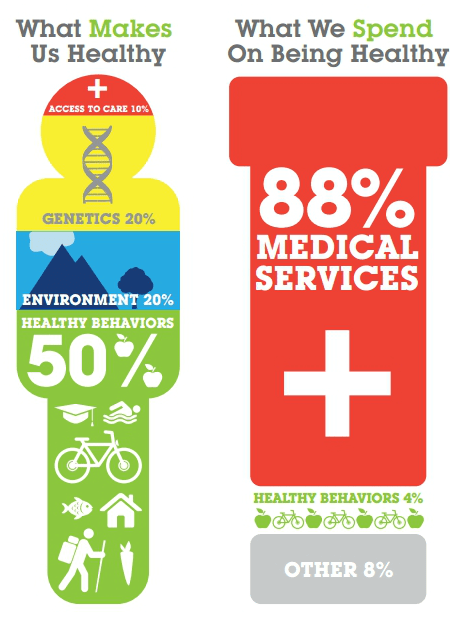
Austin Frakt disbelieves the numbers:
David Cutler and others suggest that health care is responsible for 50% of the gains in longevity over the past half century. Now, I have not read the underlying literature on this. … Still, it seems to me there is no good reason to accept the 10% figure at the top of the left-hand side of the infographic. I’d like to know more how it got there. I’d like to hear the best argument as to why it’s correct.
Ezra Klein explains why our health dollars aren't spent more wisely:
In 2009, I argued that one of the biggest impediments to spending money on programs that make people healthier — such as, oddly enough, early childhood education — is that we’re spending so much money taking care of people when they’re sick. The piece holds up pretty well, I think.
Yglesias looks at the issue from another angle:
The rural/metro health care gap is … a pretty good case study in the limited relevance of health care services to health outcomes. Residents of the extremely low density northern plains states have some of the highest life expectancies in America especially when you consider their relatively low incomes and low levels of educational attainment. That's not because the best doctors in the world are found in Montana or that North Dakota is a good place to find a specialist.
Why Does Copyright Last So Long?
Julian Sanchez has a theory:
Insanely long copyright terms are how the culture industries avoid competing with their own back catalogs.
Imagine that we still had a copyright term that maxed out at 28 years, the regime the first Americans lived under. The shorter term wouldn’t in itself have much effect on output or incentives to create. But it would mean that, today, every book, song, image, and movie produced before 1984 was freely available to anyone with an Internet connection. Under those conditions, would we be anywhere near as willing to pay a premium for the latest release? In some cases, no doubt. But when the baseline is that we already have free, completely legal access to every great album, film, or novel produced before the mid-80s—more than any human being could realistically watch, read, or listen to in a lifetime—I wouldn’t be surprised if our consumption patterns became a good deal less neophilic, or at the very least, prices on new releases had to drop substantially to remain competitive.
Beardage Update
Now, even buildings are growing one. And someone has a severe case of James Harden envy. Me too.
The Market For Unusual Minds
The Economist notices that neurologically atypical workers often cluster and thrive in tech firms:
Speaking of internet firms founded in the past decade, Peter Thiel, an early Facebook investor, told the New Yorker that: “The people who run them are sort of autistic.” Yishan Wong, an ex-Facebooker, wrote that Mark Zuckerberg, the founder, has “a touch of Asperger’s”, in that “he does not provide much active feedback or confirmation that he is listening to you.” Craig Newmark, the founder of Craigslist, says he finds the symptoms of Asperger’s “uncomfortably familiar” when he hears them listed.
The Myth Of Libya’s Failure?

Juan Cole pens a dispatch from Libya blasting the "black legend" that "it has become a failed state":
I was struck at the air of normality everywhere I went, and by the obvious comfort people had in circulating, selling and going about their lives. There are no bombings, there is no civil war, there is no serious secessionism. One man told me that the biggest change is that people are no longer afraid. They had been captive of the revolutionary committees and the secret police. And that end of political fear, the Libyans I talked to insisted, made the uncertainties of this transitional period all worthwhile.
Nicholas Pelham is less sanguine about the problems created by the thuwwar (militia), but he concludes on a high note:
[S]o far the electoral process has proceeded remarkably smoothly.
The Electoral Commission has registered over 70 percent of an estimated 3.4 million eligible voters in three weeks, exceeding UN and government targets. In contrast to Iraq, which was ruled by America in the aftermath of dictatorship, Libyans – thuwwar included — have one great advantage: a sense of ownership of their country’s destiny and the responsibility that comes with it. Amid no small amount of xenophobia — befitting a country with vast wealth, a small population and oversized fear of predatory scavengers — external players have sensibly stayed out of sight. For all the hand wringing and post-civil war bloodletting, Libya might just pull through.
(Photo: A Libyan walks through the destroyed compound of fomer Libyan leader Moamer Kadhafi, in Tripoli's Bab al-Aziziya on June 2, 2012. In June, Libyans are due to vote for a constituent assembly which will replace the ruling National Transitional Council (NTC). By Gianluigi Guercia/AFP/Getty Images.)
The End Of Daily Newspapers
Shafer fears it's coming:
Newspaper owners may be running out of time to beat the liquidation clock if the prediction (pdf) made in January by the USC Annenberg Center for the Digital Future proves accurate. Because the current generation of print newspaper readers aren’t being replaced, most major U.S. print dailies will be dead in five years, the report concluded. Very small newspapers might endure as dailies, as well as the large national newspapers – the New York Times, the Wall Street Journal, and USA Today – and the local Washington Post. For other newspapers to beat the reaper, said the Annenberg report, they must downsize from daily to once- or twice-a-week publication.
Ad War Update
The RNC basks in Scott Walker's victory in Wisconsin:
On the other side, the Obama camp focuses on Latino voters:
Previous Ad War Updates: June 5, June 4, June 1, May 31, May 30, May 29, May 24, May 23, May 22, May 21, May 18, May 17, May 16, May 15, May 14, May 10, May 9, May 8, May 7, May 3, May 2, May 1, Apr 30, Apr 27, Apr 26, Apr 25, Apr 24, Apr 23, Apr 18, Apr 17, Apr 16, Apr 13, Apr 11, Apr 10, Apr 9, Apr 5, Apr 4, Apr 3, Apr 2, Mar 30, Mar 27, Mar 26, Mar 23, Mar 22, Mar 21, Mar 20, Mar 19, Mar 16, Mar 15, Mar 14, Mar 13, Mar 12, Mar 9, Mar 8, Mar 7, Mar 6, Mar 5, Mar 2, Mar 1, Feb 29, Feb 28, Feb 27, Feb 23, Feb 22, Feb 21, Feb 17, Feb 16, Feb 15, Feb 14, Feb 13, Feb 9, Feb 8, Feb 7, Feb 6, Feb 3, Feb 2, Feb 1, Jan 30, Jan 29, Jan 27, Jan 26, Jan 25, Jan 24, Jan 22, Jan 20, Jan 19, Jan 18, Jan 17, Jan 16 and Jan 12.
Too Soon? Ctd
Bill Gardner argues that the overdiagnosis problem is yet another symptom of a broken healthcare system:
What we need is long term surveillance studies of cohorts of patients who have been screened and diagnosed, including random samples of those who screened negative and were diagnosed negative as well as the positives. This is currently infeasible in the US. It's infeasible because following patients over time is too expensive, because the US lacks a coherent national electronic health record system. Things are, unfortunately, not too much better in most Canadian provinces. What should be happening is that these data ought to be accumulated as an automatic by-product of good clinical care. What's needed for that is a rational health information technology infrastructure — see here. For better and too often for worse, all of our problems are connected.
The Daily Wrap

Today on the Dish, Andrew mulled over the damage done to democracy by the Scott Walker fight (follow-up here), called out another Romney Big Lie, and marvelled at Obama's success in counterterrorism. We grabbed reax to the Wisconsin election, gave one explanation for Walker's victory, flagged a Romney official's post-victory overreach, Obama's lead widened, his marriage equality evolution helped the cause, Colorado's pot initiative challenged the candidates, and Texas shaped the country. Edmund Burke weighed in on Bloomberg's soda ban and the Mayor was (hot dog!) a hypocrite. Ad War Update here.
Andrew also predicted more would come of Peter Beinart's book than what we now see and gaped at GOP support for Netanyahu. Readers defended the Qu'ran against Sam Harris, Obameron battled Merkel, "leadership" wasn't a Eurozone silver bullet, the European crisis made the 1930s comprehensible, China essentially censored American films, and more work went in to understanding sovereign territory sales.
Finally, Andrew highlighted one of our most entertaining correspondents, implored you to Ask Scott Horton Anything, and shared beagle happiness. We watched the HuffPo descend into self-parody territory, worried about the male invention of the internet, and blasted the vertical video epidemic. A talent for "rescue" marked good hospitals, readers sounded off on the pscyhology of poop (follow-up here), others distinguished nicotine from poison, drugs didn't explain the rash of crazy zombie incidents (on one view), socially constructed racial categories altered your biology, and breastfeeding lowered obesity rates. Luck determined success, a theocon tipped his hand, the private sectory failed to provide subways, and Ray Bradbury lived an extraordinary life. Ask Eli Lake Anything here, Quotes for the Day here and here, Cool Ad here, VFYW Contest follow-up here, VFYW here, MHB here, and FOTD here.
– Z.B.
(Photo: A sign supporting Wisconsin Governor Scott Walker stands outside a home June 4, 2012 in Clinton, Wisconsin. By Scott Olson/Getty Images.)
 The Dish