Quote For The Day IV

GT_BRADBURY-120606

"I don’t believe in optimism. I believe in optimal behavior. That's a different thing … Action is hope. At the end of each day, when you’ve done your work, you lie there and think, Well, I’ll be damned, I did this today. It doesn’t matter how good it is, or how bad – you did it. At the end of the week you’ll have a certain amount of accumulation. At the end of a year, you look back and say, I'll be damned, it's been a good year," – Ray Bradbury, RIP. More notable quotes here.

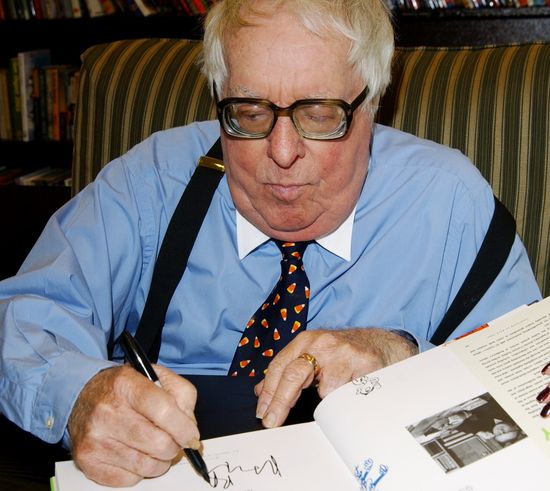
(Photo: Author Ray Bradbury signs his new book 'Bradbury: An Illustrated Life' at Barnes & Noble on October 19, 2002 in Los Angeles, California. By Jon Kopaloff/Getty Images)

How Powerful Is Texas?

Gail Collins, who has a new book on Texas, contends that the state has "taken a starring role in the 21st-century national political discussion":

The state has a remarkable ability to be two contradictory things at once. It’s a fast-growing, increasingly urban place whose citizens have nevertheless managed to maintain the conviction that they’re living in the wide open spaces. And its politicians are skilled at bragging about the wonderful Texas economy and lifestyle while wailing and rending their garments over their helplessness in the hands of the federal Death Star in Washington. You need that sense of victimhood because it creates energy and unity. You can’t build a Tea Party on good news.

James Henson thinks Collins oversimplifies:

Though you’d never know it from As Texas Goes, Obama got more votes than McCain in Harris and Bexar counties in 2008, and there are a growing number of competitive legislative districts in the demographically dynamic suburbs. Significant groups—African Americans, Latinos, and white voters in urban and suburban areas with relatively cosmopolitan views—have little interest in the orthodoxy Collins describes. Much to the Democratic party’s frustration, the Texans who take the trouble to vote are much more conservative than the overall population of eligible voters. But just because the opposition keeps losing doesn’t mean there isn’t one. The current battle over redistricting is an indication of how terrifying the Republican leadership finds these shifts.

Erica Grieder agrees that Collins misreads Texas:

I think she slightly exaggerates Texas's capacity to mess with America. Yes, of course, it's a big, influential, state, but if Texas is leading the way on policy issues, it's because other states are following its lead, as it is, of course, their right to do. 

Collins also critiques Texas's abstinence sex-ed program.
Bloomberg’s Health Hypocrisy

Will Saletan fumes:

To Bloomberg, it’s all in good fun. Shoving fat, salt, and white bread down your throat is a circus act, to be gawked at and celebrated on TV. But soda? That’s a health threat requiring government-enforced portion control. You can have it one way or the other, Mr. Mayor. You can preach moderation or the right to stuff yourself. But you can’t do both. The next orgy is four weeks away. We’ll be watching you.

Why Don’t We Buy And Sell Territory Anymore? Ctd

Joshua Keating investigates Joseph Blocher's question:

[S]ome commentators have half-seriously suggested Greece sell off some its islands to settle its debts. Paul Romer's charter cities concept involves a Hong Kong-esque lease of territory for commercial development purchases — creating a little piece of Canada in Honduras for example. Low-lying island nations like Maldives and Kiribati have openly discussed the possibility of buying land in other countries as their territory is threatened by sea-level rise. It is also tempting to wonder whether there are any economic solutions to current territorial disputes. Is there a scenario in which China could simply pay the Philippines to give up the Spratlys? What would be a fair price?

Blocher follows up by focusing on sales between states in the US:

[S]ince selling sovereign territory would change the relevant residences of voters residing in the territory, it would also potentially change the makeup of the House of Representatives and the voting rights of people in the transacting states. One-person one-vote problems seem likely. If nothing else, the impacts of inter-state land sales on political structures and voting rights demonstrate the relevance of the “political” concerns that many [readers] raised last week, and which I’ll try to address in my next post.

Face Of The Day

GT_VENUS_120606

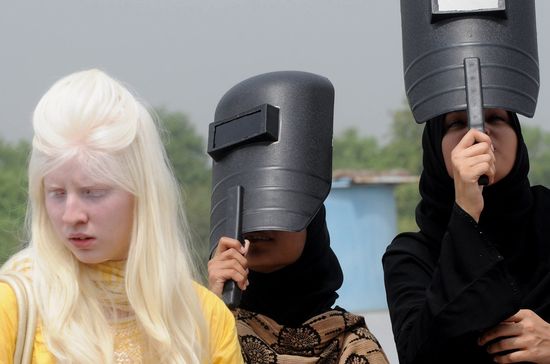
Pakistani students watch the Venus transit using welder's masks for eye protection in Lahore on June 6, 2012. Astronomers around the world trained their telescopes on the skies to watch Venus pass in front of the Sun, a once-in-a-lifetime event that will not be seen for another 105 years. By Arif Ali/AFP/Getty Images. Vivid photos of the transit here.

What Censorship Looks Like

Sonny Bunch asks why there is little outrage about Chinese censorship of American films:

Few of our pop culture mavens seem to think that it’s a particularly big deal that movie studios are clawing each other’s eyes out—and cutting anything the Chinese deem unacceptable—to get one of the limited licenses to show their films in China. None of our nation’s prominent cultural bloggers seem particularly upset that a nation committed to censoring cultural products it proclaims unfit for consumption is forming the world’s largest chain of theaters.

Instead of getting worked up about The Weinstein Company taking a minor economic hit because one of their documentaries is rated R instead of PG-13, wouldn’t it make more sense to get worked up about a growing superpower committed to telling our film studios what they can and cannot show?

Quote For The Day III

"We are like tenant farmers chopping down the fence around our house for fuel when we should be using Nature's inexhaustible sources of energy — sun, wind and tide. … I'd put my money on the sun and solar energy. What a source of power! I hope we don't have to wait until oil and coal run out before we tackle that," – Thomas Edison.

Yes, It Really Is About Sex

A theocon bishop commits a classic gaffe. Money quote (in conversation with theocon-on-chief, Robert P. George):

BP. CORDILEONE: I want to refer to what one of the questioners this morning pointed out…when he mentioned the two commonalities in all of this legislation, the first one that he mentioned was that they all have to do with sexual ethics, basically, advocating sexual license. And that I think is a common thread in all of these three foundational issues of life, marriage and religious liberty. So really the division, I think, gets down to what is the purpose of our sexual difference and the purpose of sex which gets into what is the purpose of marriage.

GEORGE: So the fat was in the fire with the sexual revolution, to divide the culture…

BP. CORDILEONE: Oh absolutely, absolutely, absolutely.