The Psychology Of Pooping, Ctd

How did we miss this from W.H. Auden? Money quote:

Lifted off the potty,
Infants from their mothers
Hear their first impartial
Words of worldly praise:
Hence, to start the morning
With a satisfactory
Dump is a good omen
All our adult days.

Revelation came to
Luther in a privy
(Crosswords have been solved there)
Rodin was no fool
When he cast his Thinker,
Cogitating deeply,
Crouched in the position
Of a man at stool.

The Big Lies of Mitt Romney III: Obama Has No Jobs Plan

BOBBLEMITTAlexWong:Getty

A classic of total disingenuous crap:

"[W]ith America in crisis, with 23 million people out of work or stopped looking for work, he hasn’t put forth a plan to get us working again. Now I know we’re getting close to an election so he’ll come out with one soon, but three and a half years later, we’re waiting."

Funny, but I remember the stimulus and the auto-bailout and continuation of TARP. And then I recall Obama coming out storming in January with a State of the Union address that demanded quick passage of his American Jobs Act. This is presumably what Romney is referring to later in the same mass of lies:

"[H]e blames Congress, he goes after Congress, but we remember the president’s own party had a super majority in both houses for his first two years, so you can hardly blame Congress for the faults that he’s put in place himself, and so he’s casting about looking for someone to blame and just hasn’t been able to find anybody — whether it’s the ATM machines or the tsunami or Europe."

But Obama has blamed Congress for not acting on his jobs bill, as Jed Lewison notes. There is a perfect symmetry here for Romney: he attacks Obama's successful jobs program then claims it doesn't exist. I guess he's counted on a full-bore amnesiac scenario in which the US economy was fine and its budget balanced until Obama came along and meretriciously added on a pile of more debt and spending for some reason – with no results on employment. That is the universe his political psyche now lives in – and it is a total untruth. Sargent summarizes:

Romney’s calculation: Voters will not care if Obama had a job plan that was blocked by the opposition; voters only care about results; not being able to get your plan passed despite determined opposition is tantamount to not having a plan or not acting at all; it’s time to elect someone who will be able to get something done.

And you know what? Romney may be right.

I think this is a core goal of the total obstructionists in the GOP: to prevent Obama from doing anything past his first two years to alleviate the sluggish recovery, so they can then blame the subsequent sluggishness on him, and then cover the whole cake in surreal, deceptive, cynical Rovian icing. It may work. Which is why we need to do what we can to expose the lies as insistently as we can.

Big Lie I here. Big Lie II here.

(Photo: Alex Wong/Getty)
Drugs Don’t Make You Eat Other People’s Faces, Ctd

Jacob Sullum weighs in on the panic over bath salts:

Stories about psychoactive substances that transform people into irrationally violent monsters with superhuman strength have been tied to various chemical agents over the years, including cocaine, PCP, methamphetamine, and even marijuana. They always prove to be grossly exaggerated, if not utterly fictitious. 

A 1989 analysis of "crack-related homicides" in New York City, for example, found that the vast majority of the violence stemmed from black-market disputes, as opposed to the drug's psychoactive effects. After finding only three documented cases in which people under the influence of PCP alone had committed acts of violence, the authors of a 1988 literature review concluded that  "PCP does not live up to its reputation as a violence-inducing drug."

Wisconsin – And The Rest Of Us, Ctd

There is, of course, this:

Through April, Walker’s top three donors combined gave more than challenger Barrett’s campaign had raised overall. Four of Walker’s top seven donors are out-of-state billionaires, including former AmWay CEO and former Michigan gubernatorial candidate Dick DeVos, and casino magnate Adelson, who each gave $250,000.

Citizens United is doing what it was supposed to do: empower the already-powerful, or a democracy whose choices are determined by completely unaccountable billionaires.

Burke And Bloomberg, Sitting In A Tree?

Frum recently invoked the conservative giant's skepticism of human reason in defense of his, er, support for Bloomberg's soda-tax nannyism. Daniel Foster counters:

Burke’s greatest criticism of the French Revolution was that it sought to replace the “wisdom of nations, and of ages” with the vogue of few radical dilettantes. He reserved his greatest scorn for “sophisters, economists, and calculators” who sought to govern — to coerce — according to the latest intellectual fad or table of numbers. In other words, Burke would have hated Mike Bloomberg’s guts.

Yuval Levin steps back to make a broader point:

It is precisely when we make too much of the power of our reason that we also overemphasize man’s animality—coming to see ourselves merely as the only animal that knows it is merely an animal. Burke’s alternative was to emphasize the other not-simply-rational element of human nature, the sentimental intelligence that allows us to be the animal that is not merely an animal.

This kind of intelligence expresses itself not in explicit principles of government but in ways of living that have served human happiness for generations even if what justifies them cannot be fully articulated, and that is why Burke thought we could learn something (though not everything) from the forms and structures of our society’s life that we could not hope to learn from geometrical reasoning about politics alone. This is the “general bank and capital of nations, and of ages,” and it’s hard to see where in that bank we would find support for the notion that people’s access to sugary beverages beyond a certain size should be limited by their city’s mayor. On the contrary, the forms and structures of our society’s life suggest that a significant measure of personal liberty—even when it amounts to the freedom to harm oneself to some extent—is essential to our happiness.

The View From Your Window Contest, Ctd

IMG_0040

A reader writes:

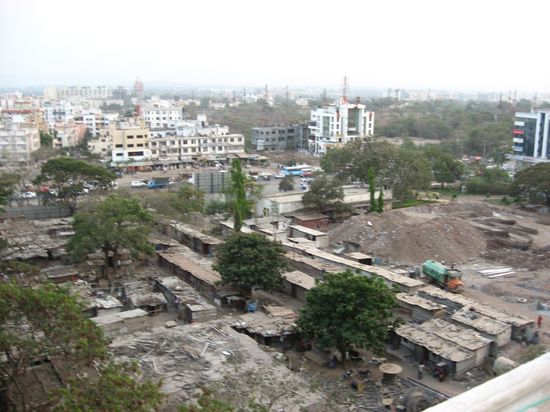
A couple of days ago Frum had a story about the slowing India economy. Your latest contest made me think that slowdown may be premature. I too looked at your contest photo and thought instantly it was India. But about 10 seconds later I discounted that when I saw the construction crane at the top left.  I did a stint over there setting up a call center in 2007 and took the attached photo from my office there. I watched every bit of steel and cement carried up 8 floors by hand by an army of workers who lived on site with their families in those shacks.  The photo was taken about 11 miles due east of contest's, in Viman Nagar, on the other side of Pune. Nowhere I travelled in India that year did I see a crane on any high rise development.

Another writes:

Oh. My. Goodness. I am kicking myself. I have spent almost my entire life in Pune before coming to the US and I'm a rabid VFYW fan.

Previously, I used to spend many hours trying to figure out window contests and even wrote an explicative-filled rant on how futile it is to spend hours searching for the window location (which you posted). I stopped cold turkey many, many months ago when I realised I was plain awful at guessing, and not well traveled at all. Since then, I have only observed the results and have not spent any time working on guessing the locations. 

This week's contest OFCOURSE screamed 154_5412Pune – the dry, dusty landscape, the thorny trees, small maruti cars, the buildings and specially the hills in the background. I smiled nostalgically and thought "Ya right, Pune. Ha ha. It's probably in Africa like the Dar es Salaam window which looked like Pune". Recently, I even missed the Atlanta window, where I now live.  Sigh.

On a trip home to Bombay-Pune during Christmas, I was off the Dish for six weeks, but was reminded of it here, there and everywhere. I laughed out loud when I realised my backpack was called "Trig". Funny videos were always filed away as mental health breaks, and I was clicking views from my window where ever I went. Tons of them.

Above is one such photo we found in the Dish archives, labeled "Marietta, Georgia, 10.47 am, May 11, 2008". We didn't post it back then because we have a strict policy against views featuring animals, especially non-dogs. But consider this a consolation prize, dear reader.

Can Race Restructure Your Biology?

Anne-Fausto Sterling reads three new books for evidence:

These days large numbers of medical research dollars are devoted to finding genetic differences between races that might explain health disparities. But many students of biology and race, and at least some of our bar mates, think that is a bad idea. They are not against medical research per se but against bad research. Instead of looking for genes that cause race and attending health outcomes (the standard approach) they point to evidence strongly suggesting that everyday events alter our bodies, making them sicker or more resistant to disease—events that the political economy ensures are more or less common depending on which racial categories one is assigned to. Indeed, it may be that biology doesn’t create race but that racial marking creates new biological states.

The Psychology Of Pooping, Ctd

First, a moment of Zen:

This is one of the great mysteries of life.  All I know is when I take a gigantic, um, trip to the bathroom, I feel empty, yet, somehow, fulfilled.

Another reader:

Thought you might be interested in a classic story that explored that very topic, from the perspective of athletes. It's a terrific read, and I'm not just saying that because I work at the magazine that published it. Nut graph: "We can exhaustively ­explore every aspect of athletic life — victory, defeat, violence, racism, drugs, brain damage, paralysis, death — but nothing reveals as much about the physiology, psychology and sociology of sport as the excretory experience of athletes."

Another shifts gears:

I am not a psychologist but rather a pediatric urologist at Wake Forest University, and as someone who deals with poop every day, all day, I can tell you that the psychology of pooping is indeed worthy of serious study.

I treat countless children for bladder problems – bedwetting, accidents, urinary frequency, among others – that are directly related to the chronic holding of poop. Masses of poop build up in the rectum, pressing against the bladder and irritating the bladder nerves. One of my patients was the Arlington, Virginia girl who was kicked out of preschool for having "too many" accidents. Her doctor and her pediatric urology clinic failed to detect the Nerf-basketball-sized mass of stool lodged in her rectum. I see this type of case daily.

As I explained in recent posts for the New York Times and the Huffington Post, poop-holding has become epidemic among children in our culture, and kids are suffering for it in ways that even most pediatricians do not recognize. Why are kids holding it? Three reasons: 1.) the terrible diet we feed our kids, 2.) toilet training them too early (a two-year-old does not have the wisdom to understand the importance of emptying one's bowels in a timely manner), and 3.) the horrific bathroom conditions in the vast majority of our kids' schools.

We make it very difficult for our kids to feel comfortable pooping. And then we mock people who are trying to do something about it. (After my Times piece was posted, Gawker promptly belittled it here.) If anyone is interested in the connection between constipation and bladder problems, the research – my own and that of others – is here.