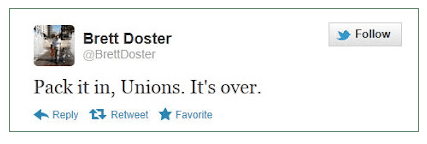
Doster is the chair of Romney's campaign in Florida. Hat tip: JMG.
Month: June 2012
Quote For The Day
"'Feck them all, the English government and the Royal Family—they raped and desolated us,' my Irish grandmother, a woman of stoutly Fenian views, would say whenever she saw the Queen appear on the television. 'But, oh she’s nice. Let me see her,'" – John Cassidy on the strangely resilient "anachronism" called the British monarchy.
Here are the lyrics to "God Save The Queen," seen above. Money quote:
When there's no future
How can there be sin
We're the flowers in the dustbin
We're the poison in your human machine
We're the future, your futureGod save the queen
We mean it man
We love our queen
And we still do.
Ask Eli Anything: How Powerful Is AIPAC?
Self-Parody Alert
Meet the HuffPo's newest "news" section: Sideboob.
Wisconsin – And The Rest Of Us
Readers know the Dish hasn't exactly been fixated on the epic partisan struggle in Wisconsin over public sector union rights. The reason? I'm not that interested in raw purely partisan mudfights, and while I don't see the harm in allowing public sector unions to retain some collective bargaining rights, especially in an era when unions can be seen as institutions putting a break on soaring economic inequality, I also believe there's a difference between public sector and private sector unions, and that curtailing the massive collective costs that public union benefits place on the public is a perfectly legitimate way to cut spending. It may be vital if we are to regain some fiscal balance. But when all is said and done, my bottom line is that I believe in democratic elections, and granting legitimacy to your opponents when they win.
Leaving aside the issues being fought over, Scott Walker won an election, and absent some grotesque abuse of power, he deserved to serve his term out. I don't think turning out to be even more radical than the platform you ran on is a grotesque abuse of power. It is precisely the kind of over-reach that is best left to the voters at the next election, rather than creating a massive, disruptive, premature political storm that can only deepen partisan deadlock and mistrust. What Wisconsin means in microcosm is not so much a portent of the future November election (though it may be that), or a decisive turn toward fiscal retrenchment (thought it certainly seems that way), but a case study in the complete breakdown of our political system, and of public trust.
The Democrats refused to allow Walker to serve his full term and then seek the judgment of the voters. They acted throughout as if he were somehow illegitimate. They refused the give-and-take of democratic politics, using emergency measures for non-emergency reasons. And in this, they are, it seems to me, a state-based mirror-image of the GOP in Washington. Just as Walker was quite clearly a far right candidate and implemented an agenda that was predictable from the spirit if not the letter of his campaign, so Obama ran precisely on what he has done in office, despite the crushing emergency he was handed on becoming president. His healthcare reform was not suddenly revealed in a bait-and-switch operation. It was exhaustively debated in the primaries and the fall campaign; ditto the stimulus, a no-brainer for any president looking into a deflationary abyss; ditto ending the war in Iraq; and focusing on al Qaeda in counter-terrorism, rather than social engineering of quixotic proportions in counter-insurgency.
He has done what he said he'd do. And yet he has been treated as illegitimate and utterly unworthy of any cooperation or compromise by the congressional and media GOP. I worry that Ross's prediction of zero-sum scorched earth politics in an era of spiraling austerity is accurate. I worry that the polarization that Obama tried to overcome has now been innoculated by the virus of victory.
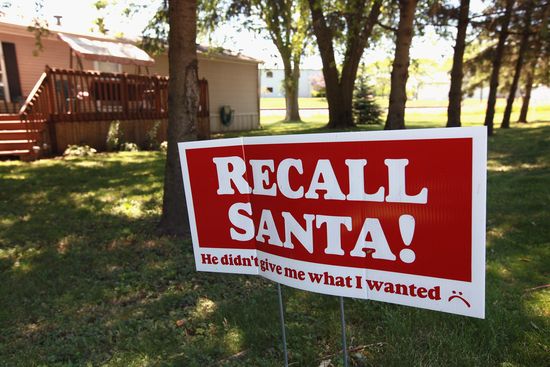
(Photo: A sign supporting Wisconsin Governor Scott Walker stands outside a home June 4, 2012 in Clinton, Wisconsin. By Scott Olson/Getty Images.)
Wisconsin Reax: Unions Lose Big
First, a moment of hathos:
My own reflections soon. Meanwhile, Josh Marshall sees the result in Wisconsin as a sign of things to come:
Walker went big to destroy the public-sector unions in his state. And the labor movement went all out to take him down and lost. Wisconsin’s a pretty progressive, fairly blue-ish state. This result in this state has to embolden Republican governors across the country to think you can go for game-changing attacks on key Democratic constituencies like labor and not pay a price at the polls. Public employees unions across the country have feel like they have crosshairs on their backs. And they do.
Chait agrees:
Walker’s win will certainly provide a blueprint for fellow Republicans. When they gain a majority, they can quickly move to not just wrest concessions from public sector unions but completely destroy them, which in turn eliminates one of the strongest sources of political organization for the Democratic Party. And whatever backlash develops, it’s probably not enough to outweigh the political benefit. Walker has pioneered a tactic that will likely become a staple of Republican governance. Fortune favors the bold.
Douthat puts the failed recall in perspective:
To understand the broader trends at work, a useful place to turn is Jay Cost’s essay on "The Politics of Loss" in the latest issue of National Affairs. … Between our slowing growth and our unsustainable spending commitments, "the days when lawmakers could give to some Americans without shortchanging others are over; the politics of deciding who loses what, and when and how, is upon us." In this era, debates will be increasingly zero-sum, bipartisan compromise will be increasingly difficult, and "the rules and norms of our politics that several generations have taken for granted" will fade away into irrelevance.
Ezra Klein considers political fundraising:
[T]wo things are happening simultaneously among the key interest groups in American politics. Labor is getting weaker. And corporations, in part due to Citizens United, are getting much stronger. The electoral effect of that is obvious: It favors Republicans. But the legislative effect is, perhaps, more significant: It favors corporate interests in Congress, as Democrats will have to be that much more solicitous of business demands in order to keep from being spent into oblivion.
Frum zooms out:
Wisconsin has definitively exposed the failure of the American left to build an effective populist movement despite the worst economic crisis since the 1930s. The Wisconsin recall vote was a battle at a time and place of the unions' own choosing. They still lost, and in one of the bluest states of non-coastal America. Who'll fear them now? Say what you will about the Tea Party, it collected scalps. The unions plus Occupy plus the remnants of the '08 Obama campaign have not. Perhaps that will change if a Republican wins the White House – but until and unless the left loses that fight too, we won't know.
Mark Blumenthal points out that Walker won 17 percent of Obama voters. Tomasky predicts that Obama will nevertheless win Wisconsin in November:
Yesterday, about 2.5 million people voted. In 2010, it was 2.15 million. In 2008, it was 2.93 million. Assume a turnout in November of around 2.7 million, maybe 2.8. In general, higher turnout favors Democrats, as we know. So the plus six or 11 or whatever Obama advantage from yesterday is probably, if anything, a tad low.
How “Good” Is The Koran?
Scores of readers are countering Sam Harris' criticism of the Islamic holy book:
I too, have read the Qur'an a number of times, in both English and Arabic, and have a couple of counters to that rather offensive and bigoted quote. First, the Qur'an, unlike
the Bible, is not a narrative expected to promote morality through example. It is considered the living, breathing, actual word of God, dictated and preserved to inspire and educate through spirit and meaning. If you approach it with the typical 21st century American (Judaeo-) Christian idea of biblical narrative, then yes, you will come away disappointed, puzzled, and probably very misinformed. If you approach it as you would the ecstatic poetry of say, Julian of Norwich, or Hildegard of Bingen, you may see things differently.
Second, it's pretty clear that poetic meaning is lost on Mr. Harris, if he thinks that chapters like The Spider (al-Ankabut, su.29), or The Light (al-Nur, su.24), or The Women (al-Nisa', su.4), The Dawn (al-Fajr, su.89), or The Clot (al-Alaq, su.96) are without value. Finally, if the Qur'an is any worse than the Holy Bible as a moral compass, I'll eat my shorts.
Another suggests:
How about Surah 2 verse 256? "Let there be no compulsion in religion."
Another:
A simple Google search for peaceful quotations from the Quran turns up plenty of positive wisdom, such as: "Whoever recommends and helps a good cause becomes a partner therein, and whoever recommends and helps an evil cause shares in its burdens" Qur’an:4:85
Another:
I won't say that the Quran is a particularly "wise" book, but the idea that everything but a few lines about patience and generosity is "just vilification of the infidel" is patently unfair. Sura 2 (the Cow), verse 62, in the Yusuf Ali translation: "Those who believe (in the Qur'an) and those who follow the Jewish (scriptures), and the Christians and the Sabians, – any who believe in Allah and the Last Day, and work righteousness, shall have their reward with the Lord; on them shall be no fear, nor shall they grieve." 1,400 years ago, the Qur'an was preaching salvation of followers of other faiths, an idea which only became widespread among Christians less than a century ago. A shame so many Muslims don't bother to pay attention to this verse.
Another:
Why is the Koran a good book? I'll give two examples why.
Historical context seems to be a concept entirely alien to Mr. Harris, seeing as he can find nothing "good" in the Koran. I ask him: what about the rights it granted women in 7th century Arabia? Rights to property, divorce, alimony, child support, etc., are all granted explicitly in the Koran. This is remarkably progressive given the fact that women in the West were only granted similar rights less than 200 years ago.
Another reason why the Koran seems a good book is its commitment to education and knowledge-seeking (see Surah 20.114 for an example of this). This Quranic emphasis on learning was the genesis of the Islamic intelectual tradition – the very tradition that preserved math, science, and philosophy throughout the dark ages in Europe. As a scientific man himself, Mr. Harris must surely see the value in that.
Another:
I'm Muslim in name only; agnostic; long time reader that does not enjoy your "god babble" on Sundays. Harris seems to find offense with the Quran for lacking a spiritual and moral map; but you don't clarify that Muslims don't look to the Quran for these things.
In brief, Islam has two sources: the Quran and the Sunnah (the practices of Muhammad). Muslims look to the Quran for affirmation of divinity; they look to the Sunnah for their moral and ethical map (all those proverbs and maxims like, love for your neighbor what you love for yourself; be nice to people even if they throw trash on you; give water to a thirsty dog even if you should have to send your own shoe down a well). It is the Quran itself which has various verses that affirm the necessity and importance of the Sunnah.
You'd have to be silly to read the Quran for a map on daily behavior. It is too epic for that. The Quran is obsessed with affirming the sovereignty, majesty, grandeur of the divine. And its primary vehicle for doing so is the stories of the ancient Prophets, Joseph, Jacob, Moses, and the ilk. The Quran's longest chapter, The Cow, is all about what happens to you when you abandon God (you become debauched idol worshippers). Even the Quran's earliest revelations (the short chapters that are ironically at the end of the compiled book) only mostly affirm god – as creator, master, unifier – with a few exhortations towards being nice to orphans.
But this does not mean that Islam's moral and spiritual map, as found in the Sunnah, is small. Quite the contrary. It is perhaps bigger than the combined maps of Judaism and Christianity, and on top of that, extremely hard to wade through.
What's perhaps throwing people like Sam Harris and others off about the Sunnah is that he doesn't know where to find it. Without getting into a massive lecture about the various definitions of Sunnah (which I would be too bored to give), let me just say that the question of "What is the Sunnah?" is a fraught one in Islam. It is actually the single biggest fight between Muslims. You should consider getting some kind of Islamic expert on your "Ask Anything" video series to break it down.
Yet another:
I'm an incoming graduate student starting study at the School of Oriental and African Studies in Middle East Politics, and hopefully a second year degree in Islamic Studies. I'm Christian, not Muslim; I speak Arabic, but not fluently. And I'm not sure which Qur'an Harris is looking at, but there are a couple reasons why he might not be impressed.
First, Harris is likely reading an English Qur'an, which is not really a Qur'an at all. One of the Qur'an's biggest claims to fame is its transmission from the time of the Prophet, if not thirty years afterward when it was finally codified and written down, in Arabic, unchanging. My senior undergraduate thesis was on the history of Qur'anic recitation. Those who claim that there are different versions of the Qur'an, relying on various sayings of the Prophet (hadith) that discuss such things, generally make arguments that don't hold water. Thus, the Qur'an's unchanging nature and preservation of the Arabic language are two things that make it great.
Second, I doubt Harris has ever taken any time to listen to Qur'anic recitation:
The Qur'an's primarily oral, not written nature, and its setting in poetry, not prose, lends itself to oral expression in a way other texts do not. Stories abound of listeners to recitation from Islam's beginning to today stopping in their steps, entranced, and later converting. There is something magical and fascinating in the Word of God beautifully and artfully and reverently ornamented.
Third, as for Harris's claim that the Qur'an is really only a couple platitudes and invective against the infidel, again, I'm not sure which Qur'an Harris is reading, but it's likely one without tafsir, or explanation. Certainly, the Qur'an has its share of lines against kafirs, or infidels. But it also has its share of stories pulled from the Judeo-Christian tradition, commandments of religious law, and moral teachings. The book Jesus and Mohammed: The Parallel Sayings page after page puts the moral teachings of the Qur'an and the hadith side by side with the teachings of the Bible and the words of Jesus. The document "A Common Word," signed by such Muslim leaders as Shaykh Salim Falahat, the director-general of the Muslim Brotherhood of Jordan, Ali Juma'a, the mufti of Egypt, and 136 other leading Muslim leaders, point to teachings of the Qur'an mirroring the two great commandments of Jesus.
The Qur'an is filled with moral teachings, like the Bible. It is much more than a letter of invective against unbelievers. Moreover, Harris fails to make the differentiation, unimportant to him but surely important to 2 billion Christians, 1.5 billion Muslims and 14 million Jews, of "people of the Book" and "infidels." I'm a Christian who's studied in Jordan and is returning there in a few weeks for more study. The Qur'an draws me again and again back to the mysteries and wonders of Islam. I have gotten much more wisdom out of it than a "random book in Barnes and Noble". It's a shame Harris can't appreciate it as so many millions do.
(Photo: Yusuf, 70, recites from the Koran at a graveyard in Kabul on April 25, 2012. Yusuf earns 100 Afghani (2 USD) for reciting prayers over graves being visited by relatives and loved ones. By Bay Ismoyo/AFP/Getty Images)
“A Shout Out To Netanyahu: Don’t Trust Obama”
Hugh Hewitt, alongside Don Rumsfeld, sides with a foreign prime minister in distrust of his own president's commitment to the alliance: essentially siding with a foreign government over his own. This is now so familiar a trope it doesn't even register. But for those like Hewitt, Israel under Netanyahu deserves more loyalty and support than America under Obama. That's how low they've sunk.
Why “Global Leadership” Can’t Save The Euro
Drezner delivers a reality check:
I think there is a desire for one leader to knock some global skulls together and get Germany to start consuming more and the ECB to print more money and China to stop saving and any other action that would jumpstart the global economy. Again, fine, but in the history of the global economy there has only been one instance in which one country had sufficient economic power to exercise this kind of leadership—the United States of the late 1940s. Truman’s leadership was important—but the U.S. being responsible for close to half of the world’s economic output was even more important. Even if Barack Obama had an iron grip over all of America’s policy levers, he couldn’t do what Truman did with the Marshall Plan and the Dodge Line. Leadership without power is simply someone ranting on a street corner.
Nicotine Is Poison, Ctd
Ryan Cooper takes issue with the classification:
[C]alling various drugs "poisons" as if this counts for something is foolish. By this standard basically everything, including water, is a poison, it just depends on the dose. Rather we could say that nicotine is a drug with an unusually low margin of error, meaning a fatal dose is only a small multiple of an active dose. As a counter-example, we could consider LSD, which has an unusually high margin of error, despite its reputation. According to this study there have been no well-documented fatal overdoses, ever, and some people have taken unbelievable quantities (on the order of 1000 times a recreational dose) accidentally and made a full recovery. Try that with nicotine or alcohol and you would be dead as a hammer. Anyway, that’s not to particularly recommend LSD, it’s just to say that trying to label a drug as either poisonous or not doesn’t actually tell us much worth knowing.
A reader does make a recommendation:
Yes, nicotine's poison in larger doses. But like a lot of traditionally-used plant alkaloids, it's also therapeutic. I've been using snus, a Swedish form of smokeless tobacco, which is fairly safe (honest! – look it up), and have found it very helpful for mood and for concentration. I think I'm self-medicating my cyclothymia. It's mostly harmless and has been a real quality of life improvement. I'm glad plants make such useful things.
 The Dish