On To SCOTUS

The Kennedy-tailored Ninth Circuit ruling that struck down Prop 8 in California on narrow grounds is not going to be reconsidered at the state level. More analysis here. Update from a reader:

No, the Ninth Circuit 3-judge panel ruling is not going to be reconsidered en banc in the Ninth Circuit.

The Ninth Circuit is a Federal Court of Appeals that covers Alaska, Washington, Oregon, California, Hawai'i, Montana, Idaho, Nevada, and Arizona. An en banc rehearing is not equivalent to "the state level", which would typically be construed as meaning "under the state court system". The sole portion of the Federal Prop. 8 litigation that involved a court at the state level was a certified question to the California Supreme Court on whether the defendants-on-appeal had standing under California State Law (they are).

Typically, an en banc rehearing panel consists of every judge in the circuit. Because of the large number of judges in the Ninth Circuit, an en banc panel consists of only 11 of the 29 maximum number of judges. No other circuit (1–8, 10, 11, DC, Federal) has more than a maximum of 178 judges.

Just as an added note to the title of the post, there is no right to appeal to the Supreme Court for this type of case. The Supreme Court has complete discretion on whether it will hear this case or not. I can't see the Court not granting certiorari in this case, but there is no appeal by right.

The View From Your Window Contest: Winner #105

Ceihfjhh

A reader writes:

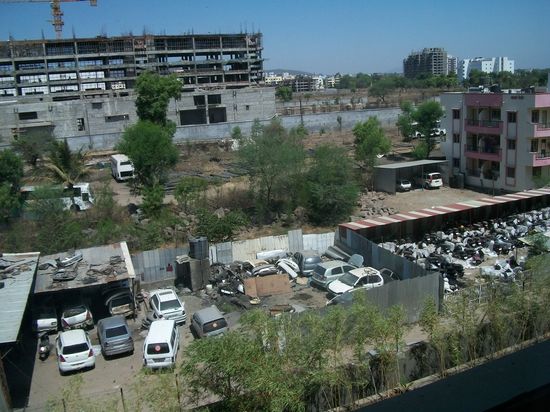
I knew you would hit us with something hard after a couple of less challenging Views, and you didn’t disappoint.  I feel we are in East Africa, based on the vegetation, metal roof architecture, small cars, and what appears to be a motorcycle graveyard. The construction suggests we must be in a growing capital or larger city, but one with space to move out into its hinterlands.  Dar es Salaam might work – it's booming and might have a wasteland like this on its outskirts – but in my self-allotted 15 minutes of Googling I am positively and absolutely uncertain.

Another writes:

Cedar trees, arid climate, signs of both rubble and rebuilding in the background, person with a full-length blue gown in the second-floor balcony, lots of scooters and subcompacts in the junkyard, illegible sign on the building appears to use a non-Roman script, the only visible license plate is white, skinny, and long.  I'm thinking Lebanon.  Since the window appears to be located in mostly flat terrain on the outskirts of a city, my guess is Haret Hraik, Lebanon, in the coastal plain just to the south of Beirut.

Another:

It looks like Beirut (which I just moved to six days ago), but I can't check on Google Earth for sure because the Internet connection in Lebanon is absolutely horrendous and I'd end up spending a week just to scan a few square kilometers. I'll go out on a limb and say it's in the Fern el-Chabbak area of the city.

Another:

I know it's not Palm Coast (or "Calm Post" as some refer to it), Florida; it's likely somewhere in the Eastern Mediterranean or North Africa. BUT! The scenery does evince Palm Coast – and many other Florida municipalities. Half-completed structures? Check. Abandoned automobiles in severe disrepair? Check. Trash? Check. Nobody around? Check. There's even a huge mountain of shit in the distance! (That'd be Daytona Beach.) And yes, I live in that area.

Another is correct:

I'm predicting this is one of the very few weeks where no readers are able to guess this!

I usually do my research by googling some key words that stand out about the place. Last week it was "historic wooden water towers" that brought me to Mendocino, but the only key words I can think of when I look at this is "craphole" and "sadness," which don't bring up the most helpful google image results.  I'm guessing Sombor, Serbia because the name just seems to fit the picture.

Another gets on the right track:

It is rare that I have ever looked at a VFYW and felt like I immediately recognized it. Today, I looked at the entry and thought THAT'S INDIA!

In the last few times I've visited India, I've been struck by how much open land exists and how rapidly it is being developed. The contrast between the buildings and the vast openness in this week's photo is similarly striking. The pink tint of the building on the right also struck me very Indian – the buildings are painted with such colorful hues of yellows, pinks and blues. But it feels like this picture could have been taken anywhere in the country. I've seen similar scenes in Bangalore, Chennai, Gurgaon, and Haridwar, because development is just happening where across the country.

Another:

Well, straight off I am sure this is India.  The smaller cars, the water tanks both in the workshop and out on top of the pink building (called Sintex tanks I think), and the arid topography screams India to me.  The hard part is to identify which part of the country.

After trying for many hours without much success to sharpen the letters on the name of the pink painted building to identify the language, which would be the big key to the geographic location, I am leaning towards three places. If the letters are of Tamil language, we are talking the outskirts of Chennai. If the letters are of Telugu language, it would be the outskirts of Hyderabad. If those are of Hindi language, I am in trouble, since that could be a lot of places in North India. For the sake of picking one, I am choosing the outskirts of New Delhi as my final answer.

Another gets very close:

I got hooked on to your blog a few years back when I was doing my Masters in USA. I am back in India (at Chennai) now. I have been waiting eagerly for the day when you will have a VFYW from India. God, I sure hope I am right. There are so many clues. The multi-colored small residential building, the black water tank in the car shed, the haphazard way the cars and bikes are present in the shed, the TATA cars in the shed, etc. Most of all, it is the building construction in the background. Wherever one steps in India, there are so many new ones showing up. 

My choice of Mumbai is just a shot in the dark, as it is the most populated city in India. This VFYW can be a snapshot of pretty much any place in India right now.

No one this week guessed the correct location, which is the village of Hinjewadi, on the outskirts of Pune, a city in the Indian state of Maharashtra. But the following reader had both the most proximate guess and the most precise analysis, so she wins the prize this week:

The cars and scooters are definitely from India. The writing on the pink building looks like devnagari script, which is the script of the language marathi used in the state of Maharashtra. The vegetation also looks typical of the region. The area is developing and looks like the outskirts of a second tier city. My guess is it is Nashik, which is developing rather quickly.

Details from the photographer:

Marriott Courtyard, room 215, Hinjewadi/Pune, India.

I captured the view while I was in India on a business trip – software engineer gets training.  India, or at least Pune … remains the same, in a fervor of change – major construction in all directions, most of it upward – and right next door a Socialist-era apartment complex, dreary as can be, and a hundred yards on a brightly colored temple, but no sign of the formerly endemic small phone shops, where you could go in and call someone for a few bucks, as the cellphone industry has wiped them out. To me it's inspirational, bewildering, exhausting, and, looking at the roads, just terrifying.

(Archive)
Is Faith A Weapon?

Richard Dawkins believes it can be:

Twenty-six human beings were murdered yesterday over a Shiite-Sunni battle over the shrine in Samarra, while the papacy forbids its best theologians from thinking out loud. But to go in one breath from defending some positive aspects of faith to opposing any teaching of children that there is virtue in faith seems, well, conflicted to me. There is a strange illiberal strain in Dawkins that works against his better – indeed, important – arguments.

Why The Bain Attacks Won’t Stop

Beinart puts Romney's private equity background in perspective: 

There’s a reason Newt Gingrich and Rick Santorum went after Bain: because Romney’s super-rich, out-of-touch image was hurting him among white, working-class voters. And as The New Republic’s Alex MacGillis has shown, Ted Kennedy’s campaign used Bain’s layoffs to devastating effect in his Senate victory over Romney in 1994. The Kennedy folks even flew workers laid off by companies Bain had invested in to Massachusetts to campaign. …

Obama can’t win reelection simply with the votes of young, single, and minority voters. He needs to hold down his losses among blue-collar whites, a group with which he has always struggled. Using Romney’s stewardship at Bain to drive a wedge between him and the culturally conservative working-class whites whose turnout he desperately needs made a lot of sense, especially if the Obama campaign had tied Romney’s record at Bain to his support for unpopular Republican budgetary proposals.

Along the same lines, Nate Cohn finds little evidence that Obama's Bain attacks have backfired.

They Are Both Keynesians Now

Gov-spending-00

Ezra Klein anticipates the Romney debt balloon:

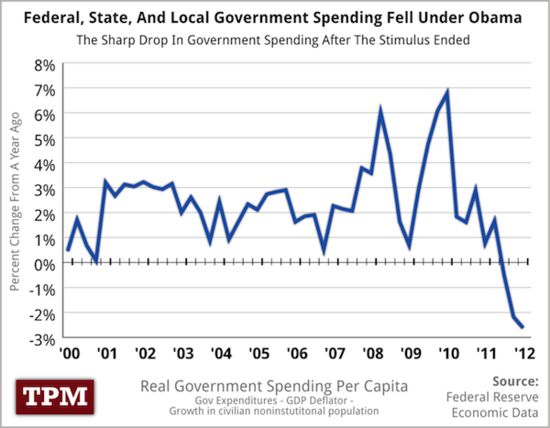
There will almost certainly be deep spending cuts if Romney is president, but both the Romney and Ryan proposals include trillions of dollars in unpaid-for tax cuts and defense spending. If Republicans decide to assume that deep tax cuts will lead, through supply-side magic, to larger revenues, their deficit-reduction plans might well end up increasing the deficit over the next few years, even if it does so in a regressive way. Remember, wrote Business Insider’s Joe Weisenthal, “Republicans were pro-deficit, and pro-entitlement expansion under Bush and Reagan. Deficit cutting only became part of the party’s ideology under Obama.” Compared to anything Obama is likely to get from a Republican House, that is, at least in the short term, a much more expansionary, Keynesian approach. But it’s also an awful precedent. In a sense, Republicans are holding a gun to the economy’s head and saying, “vote for us or the recovery gets it.”

The graph showing government retrenchment is via TPM. Allahpundit wonders how plausible this is:

[Romney is] not going to do something which he thinks will force a major economic contraction; does he try to build congressional majorities to delay deep cuts by replacing recalcitrant tea partiers with Democrats, knowing that the optics of that might only increase his headaches? If he thinks that conservatives will grant him a honeymoon period after he’s sworn in on issues as critical as the size of the federal budget and the speed with which meaningful cuts are made, I think he’s kidding himself. But maybe Klein’s right that this can be finessed by signing Paul Ryan’s budget — and getting to work on entitlement reform, assuming that Romney has the nerve to do so.

If you assume that the sanest, most feasible approach is stimulus-now-retrenchment-later (because sunsetting Bush's tax cuts and the sequestration process would mean an almost certain double dip recession), then the practical immediate question in this election is: what brand of stimulus-now-austerity-later admixture do you prefer?

In that choice, it seems to me we have two options on the table. The first is Romney's: huge defense spending increases and lower tax revenues than the Bush regime, accompanied by turning Medicare into a voluntary voucher scheme, where you will henceforth be guaranteed only the healthcare your voucher affords. The second is Obama's: sunsetting the Bush tax cuts on those earning over $250,000, more infrastructure investment, cutting defense spending (though they're getting way too squishy on that), and more serious cost controls in Obamacare and Medicare (higher premiums for the wealthy, an end to fee-for-service, rationing at some point) to slow spending in the long run.

To put it bluntly, Romney favors more tax cuts, more defense spending and decimating Medicare. I don't think much of this is popular, especially the latter. Ponnuru is onto something:

Most people believe the [entitlement] programs need reform. But in a Pew poll in 2011, Americans favored preserving benefits to reducing deficits by almost 2-to-1. By 56 percent to 33 percent, they worried more about Social Security benefit cuts than about tax increases. In a March 2012 poll, just 26 percent of the public favored the Republican idea of changing Medicare so that beneficiaries pick a health plan and get a “fixed sum of money” to meet the costs.

That's your attack. You also point out, in the final stretch, that voters risk handing over the entire government to the most radical Republican party in decades if they elect Romney alongside a GOP House and Senate. Obama can be framed as the indispensable negotiator for half the country in the coming fiscal showdown.

Here's your positive message: Obama inherited an economy in free-fall and the most obstructionist opposition in decades. He prevented a second Great Depression, achieved a halting recovery, passed universal healthcare and won as solid a victory against al Qaeda as is conceivable. What he needs to argue is that this is just the beginning of a national renewal, a downpayment on the rest  – by insisting that long-term debt reduction can be done now, that immigration reform must be achieved for the next generation of Americans, and that the insane tax code can be rescued from the special interests.

Obama will not win by playing safe, it seems to me, or defensively, so that external events determine his fate, and Romney can crudely but mercilessly try to blame all our woes on the incumbent. Obama's brand is inextricable from reform, and his campaign must be designed to break the Republicans' resistance to such reform. You don't need a new slogan. "Yes We Can" needs just some tinkering.

"Yes We Must" is more 2012.

Ask Bartlett Anything: What Do You Think Of Paul Ryan?

While critical of both parties, Doug Bandow echoes Bartlett’s point:

Republicans are posturing as the party of fiscal responsibility, but they continue to protect their sacred cows. Unless the GOP is willing to slash corporate welfare and cut unnecessary military outlays, Republicans don’t deserve to be taken seriously when they talk about fiscal responsibility

You can buy Bruce Bartlett’s latest book, The Benefit and The Burden: Tax Reform – Why We Need It and What It Will Take, here. Read him regularly at the Economix blog. Previous videos of Bruce here, here and here. “Ask Anything” archive here.

Mitt Romney As Don Draper

Judith Grey spells out the appeal of retro this year. Call me crazy (and they do) but I'm just not-so-sure bewildered Americans want a corporate suit cutting his own taxes while ramping up military spending and slashing entitlements. In fact, the more the Obama team emphasizes the cultural differences between the two camps, the better, I suspect, they'll do – especially with younger and minority voters.

Obama’s Positive Campaign

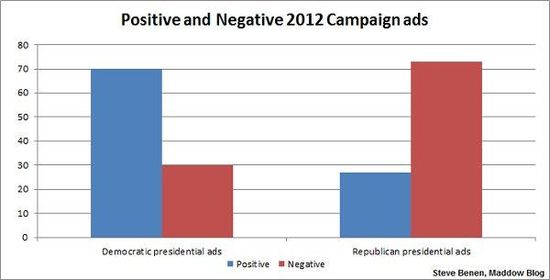
Josh Green compares GOP and Democratic party messaging. Steven Benen graphs the numbers:

Positive_negative

Kevin Drum is wowed:

That's….amazing. Not the fact that Democratic ads are 2:1 positive while Republican ads are 2:1 negative — exactly the opposite of the media spin you're likely to hear these days — but the fact that the two campaigns have run 63,793 ads in six weeks. That's 1,400 ads per day six months before the election.

The Pain In Pro Sports

Boogaard_GT

After the NYT's expose on hockey player Derek Boogaard's fatal painkiller overdose, Ellen Etchingham fumes:

Professional sports are a world of pain. We seldom consider this, although we are well aware of the frequency and severity of injuries. But though we see people getting hurt all the time, we don’t see very much suffering. Players are always presented to us placidly lying down for stitches, joking with media about their knee rehab program, smiling through broken teeth. They don’t look like they’ve been hurt. They don’t look like people who’ve suffered something. They seem fine. So we wince and laugh and praise their toughness, and go on with our lives figuring that they’re somehow just a more badass class of person than ourselves.

She thinks addiction poses a bigger problem than concussions: 

In our alarm over CTE and brain trauma, we focus entirely on causes, but what if we’re wrong about the causes? What if the problem isn’t really concussions at all? What if concussions, in the end, only account for a small fraction of hockey-related psychological problems? What if we reduce concussions and pat ourselves on the back for doing something while dozens of players are still suffering the exact same problems Boogaard had due to chronic pain, closeted mental illness, and dysfunctional treatments for both? We believe that the League must reduce head hits, and it must, but even with a dramatic decline in concussions, hockey will still cause pain and it will still cause addiction.

(Photo: Derek Boogaard #94 of the New York Rangers fights with Trevor Gillies #14 of the New York Islanders at the Nassau Coliseum on December 2, 2010 in Uniondale, New York. By Bruce Bennett/Getty Images)