The Canadian Waiting Room

While waiting at his doctor's office, Joseph Heath realized he was sitting next to Nadir Mohamed, the president and CEO of Rogers, a major communications company in Canada:

I paused for a moment to consider that he (who, according to Forbes magazine, made more than $8 million in 2010) and I (who, according to everyone, made significantly less) shared the same doctor. 

Heath's takeaway:

[A] democratic society requires certain experiences, and certain institutions, where everyone is on an equal footing and everyone is treated the same: standing in line to vote, or to get a driver’s licence, for instance. Some theorists have called these situations points of "forced solidarity." Among other things, they serve as a check on the tendency for the ultra-rich to drift off into their own little world, to insulate themselves from the travails of the ordinary person. In Canada, most of the health care system constitutes a point of forced solidarity.

I don't see why healthcare should be used for "coercive solidarity." But if the best doctors are in the public sector, you can see why this happens.

Annoy The Vatican. Read This Book.

Screen shot 2012-06-04 at 1.24.30 PM

A quote for the day:

“Growing out of my work as a Professor of Christian Ethics at Yale University Divinity School, this book was designed to help people, especially Christians but also others, to think through their questions about human sexuality. It suggests the importance of moving from what frequently functions as a taboo morality to a morality and sexual ethics based on the discernment of what counts as wise, truthful, and recognizably just loves. Although my responses to some particular sexual ethical questions do depart from some traditional Christian responses, I have tried to show that they nonetheless reflect a deep coherence with the central aims and insights of these theological and moral traditions … This is what my book, Just Love, is about," – Sister Margaret A. Farley, R.S.M, whose book, Just Love has just been deemed non-kosher by the Vatican's orthodoxy arm, the CDF.

A review here. Farley's intellectual biography is truly impressive (which is, perhaps, why the old men in the Vatican, who want dumb but obedient priests, have just designated her book on the proscribed list):

“A Sister of Mercy, Farley was the first woman appointed to serve full-time on the YDS faculty and shared with Henri Nouwen the distinction of being the first Roman Catholic faculty member at the Divinity School. She is widely published and the recipient of the John Courtney Murray Award from the Catholic Theological Society of America. She has served as president of both the Catholic Theological Society of America and the Society of Christian Ethics. Respected not only as a scholar but as a teacher as well, she appeared on the cover of the Yale Alumni Magazine in 1986 in connection with a feature article on great teachers. She began teaching at Yale Divinity School in 1971 and earned her Ph.D. from the University in 1973.” She retired as professor emerita in 2007.

Fittingly Catholic, I would say, that a gay man and a brilliant woman should have pioneered study of Catholicism at Yale. And fittingly Catholic that the hierarchy would want to distance itself.

Their Actual Records On Jobs

Screen shot 2012-06-04 at 4.26.43 PM

It's hard for me to see any glaring difference between these two, except that the recession Romney inherited as governor of Massachusetts was minuscule compared with the Great Recession of 2007 – 2009. Glenn Kessler notes:

The similarities are actually more striking than the differences. Both men took office as the economy was plunging, but the hole (in percentage terms) turned out to be much deeper for Obama. The jobs picture started to turn around for both men at about the same time, but because Romney’s job deficit was comparatively smaller, he moved into positive territory sooner — though it still took him 36 months.

As we have noted before, Romney’s record was weaker than other governors of similar states in the same time period. But that could be due to factors unique to Massachusetts.

Benen notes how the Romneyites are spinning away Romney's first year, while counting Obama's:

Eric Fehrnstrom told ABC, "Can I just say, on the jobs question, because this comes up repeatedly that Massachusetts was 47 out of 50 in terms of jobs growth. Actually, when Mitt Romney arrived, Massachusetts was an economic basket house." Kevin Madden, naturally, took the same line on "Meet the Press." On Fox News, Ed Gillespie went so far as to suggest the job losses in Romney's first year shouldn't be held against him.

He wasn't kidding.

This comes on the heels of Fehrnstrom arguing 10 days ago that Romney inherited a "recession" and an economy that was "losing thousands of jobs every month" in 2002, and a Romney campaign press release last week that argued, in all seriousness, "Governor Romney inherited an economy that was losing jobs each month and left office with an economy that was adding jobs each month."

As Romney once said, if it's sauce for the goose … Meanwhile, Greg Sargent reports that Axelrod was pushing the press on a conference call today to stop enabling the Romneyites in their double standards.

Why Scott Walker Is Holding On

GT_WALKER_120604

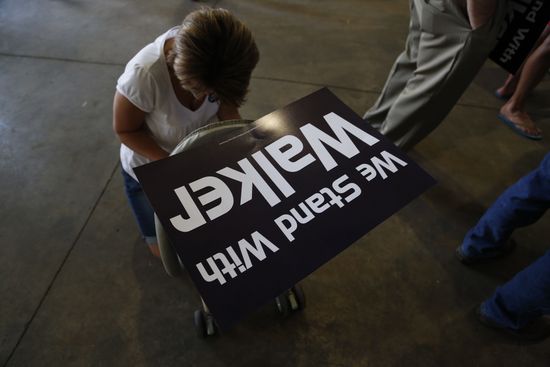
The hard-right governor is ahead in the polls and is given a 93% of winning by Intrade. Walter Russell Mead blames his opponents:

[T]he Democratic strategy in Wisconsin has been one disaster and misfire after another. Special election after special election, defeat after defeat … A generation of activists and “progressives” raised on Howard Zinn is having an important life experience in Wisconsin. The “people united” are defeated more often than not in American politics. The silent majority isn’t itching for the “genuinely progressive” candidates and platforms lefties think they want. (That majority also isn’t looking for candidates from the doctrinaire right, either, by the way.)

Josh Eidelson, by contrast, claims "no factor will have been more important than the decades of decline in U.S. union membership:"

While liberals often cite the importance of public sector unions as a counterweight to corporations in election spending, too little gets said about their role in advocating for quality public services and ensuring decent and stable jobs. But as private sector unionization falls, benefits that even non-union companies felt pressure to provide become benefits that even unionized companies seek to shirk. And right-wing criticism of public sector benefits – or of public sector bargaining itself – gains traction.

Will Oremus pushes back against the idea that Wisconsin tells us what will happen in November.

(Photo: Supporters attend a rally for Republican Wisconsin Gov. Scott Walker as he campaigns along with Louisiana Gov. Bobby Jindal at the Waukesha Victory Center on May 24, 2012 in Waukesha, Wisconsin. By Darren Hauck/Getty Images.)

Real Jews For Jesus

Peter Schäfer reviews a new book, Daniel Boyarin's The Jewish Gospels: The Story of the Jewish Christ, which argues that the Trinity and the incarnation were Jewish ideas:

That the historical Jesus was a Jew, that his followers were Jews, and that the Gospels as well as the letters written by the apostle Paul are Jewish writings, firmly embedded in first century C.E. Judaism—all this has become almost commonplace. After long and bitter battles, this fact now has a foothold not only among historians of ancient Judaism but even among the most dedicated Christian theologians and the old influential school of New Testament scholars who tried to relegate the new message of the New Testament to a less Jewish, more Hellenistic background. Indeed, the pendulum has swung far in the opposite direction, with scholars outdoing each other in proving the Jewishness of Jesus and the New Testament, and arguing that there is nothing in Jesus’s message as reflected in the New Testament that oversteps the boundaries of what might be expected from the Judaism of his day.

The most recent voice in this chorus is Daniel Boyarin’s. His new book has a somewhat misleading title, The Jewish Gospels, because nobody doubts that the Gospels are Jewish. But it is his subtitle, The Story of the Jewish Christ, which makes clear what actually is at stake: nothing less than the claim, announced with great fanfare, that the evolving Christology of the New Testament and the early Church—that is, the idea of Jesus being essentially divine and human, the divine-human Messiah and Son of his Father in heaven—is deeply engrained in the Jewish tradition that preceded the New Testament. … But for Boyarin this extraordinary claim is not enough. He lets himself be gladly carried away by the assertion that even what theologians call the Trinity (the notion of three divine figures, Father, Son, and Holy Spirit) was present among the Jews well before Jesus made his appearance.

Off With Their Headphones! Ctd

Derek Thompson adds to the Dish debate:

The 20th century did a number on music technology. Radio made music transmittable. Cars made music mobile. Speakers made music big, and silicon chips made music small. But headphones might represent the most important inflection point in music history.

If music evolved as a social glue for the species — as a way to make groups and keep them together — headphones allow music to be enjoyed friendlessly — as a way to savor our privacy, in heightened solitude. In the 1950s, John C. Koss invented a set of stereo headphones "designed explicitly for personal music consumption," Virginia Heffernan reported for the New York Times. "In that decade, according to Keir Keightley, a professor of media studies at the University of Western Ontario, middle-class men began shutting out their families with giant headphones and hi-fi equipment." Headphones did for music what writing and literacy did for language. They made it private.

Ad War Update

The RNC relishes the terrible May jobs report:

The Romney campaign offers a sense of "what a Romney administration would feel like":

Alex Burns has more

This is a more thematic spot than the first two, which ticked off a list of narrower policy areas where Romney would take action: the Keystone pipeline, for example, and the Affordable Care Act. The presentation of Romney as a reassuring figure — a person who will restore the normal order of things, rather than implementing dramatic change — is a contrast to Democratic attempts to cast Romney as a conservative radical.

Meanwhile, the Obama campaign features Republicans against "Romney economics": 

Paul Steinhauser has an early breakdown of general election ad spending: 

Seventy percent of ads run by Democrats in the general election campaign for president have been positive in nature, while 73% of commercials run by Republicans were negative, according to data provided in a weekly note to their clients by Kantar Media/Campaign Media Analysis Group, which tracks political ad spending. … The spots counted in the CMAG data include ads by the campaigns, party committees and independent groups. The CMAG data also indicates that the Democrats have aired more ads than the Republicans. Fifty-six percent of commercials aired were from Democratic advertisers, mainly President Barack Obama's re-election campaign, while 44% were from Republican advertisers, mostly outside groups such as Crossroads GPS.

Previous Ad War Updates: May 31May 30May 29May 24May 23May 22May 21May 18May 17May 16May 15May 14May 10May 9May 8,  May 7May 3May 2May 1Apr 30Apr 27Apr 26Apr 25Apr 24Apr 23Apr 18Apr 17Apr 16Apr 13Apr 11Apr 10Apr 9Apr 5Apr 4Apr 3Apr 2Mar 30Mar 27Mar 26Mar 23Mar 22Mar 21Mar 20Mar 19Mar 16Mar 15Mar 14Mar 13Mar 12Mar 9Mar 8Mar 7Mar 6Mar 5Mar 2Mar 1Feb 29Feb 28Feb 27Feb 23Feb 22Feb 21, Feb 17, Feb 16, Feb 15, Feb 14, Feb 13, Feb 9, Feb 8, Feb 7, Feb 6, Feb 3, Feb 2, Feb 1, Jan 30, Jan 29, Jan 27, Jan 26, Jan 25, Jan 24, Jan 22, Jan 20, Jan 19, Jan 18, Jan 17, Jan 16 and Jan 12.

A Humbler American Exceptionalism

Matthew Lee Anderson, following Ross Douthat, re-imagines a trope:

I owe the point to Ross Douthat’s new book Bad Religion, where he points out that John Winthrop’s famous "city on a hill" line was something of a warning that if America failed to do well than America would be judged accordingly. Douthat expands the thought, pointing out that in Lincoln’s Second Inaugural he "invokes providentialism to explain a chastisement, rather than to boast of America’s particular virtue or celebrate its particular mission in the world." A political version of the via negativa, if you will, where exceptionalism is invoked to caution America from going wrong.

This is of a piece with Mormon (and Obama's) understanding of the concept. Just not Romney's.