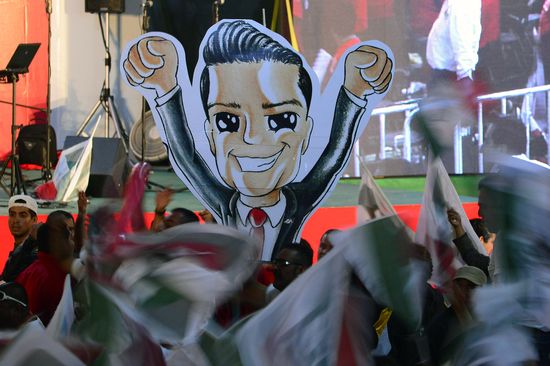
Early returns for Mexico's presidential election look good for PRI's Enrique Peña Nieto, who was expected to win. Robert Beckhusen explains why drug-induced violence will continue:
[W]hen [PRI] lost power 12 years ago, it also lost a patronage system between regional party bosses and the cartels. This system meant drugs were allowed to flow relatively freely, provided physical disputes between the cartels didn’t get out of hand. But losing a (note: corrupt) system of checks and balances, beef between cartels escalated. Nor is it likely that such a deal could be made today. In some states that maintained PRI rule, these networks were maintained but still failed to stop the surge in violence. Some of the state-level politicians with ties to the cartels are now being purged.
In any case, the PRI will be governing a different Mexico: one in which corruption is still a major problem, but in which a single party is not able to maintain control over the entire governing apparatus. Another problem is that today’s cartels are smaller, a lot more numerous and increasingly decentralized. With so many cartels operating in Mexico today, who do you cut a deal with?
(Photo: Supporters of the Mexican presidential candidate for the Institutional Revolutionary Party (PRI), Enrique Peña Nieto, celebrate at the party's headqurters in Mexico City as they wait for the official result of the presidential election, on July 1, 2012. By Alfredo Estrella/AFP/Getty Images)
 The Dish