A reader writes:
In Toronto, my home, there is an iconic bridge (the "Prince Edward Viaduct," the construction of which was at the centre of Michael Ondaatje's classic novel, In the Skin of a Lion) that spans the Don Valley. Like the Golden Gate Bridge in San Francisco, those looking to kill themselves would jump. And so the city eventually, and after much debate constructed a barrier, what was called the "Luminous Veil". Many thought it destroyed one of the city's great landmarks, but that it was worth it if it saved lives. A recent study has shown, however, that all it did was moved suicides to other bridges in the city. So San Francisco might be right not to mar the GGB if it only means that people will jump from other sites around the city.
A Cornell grad writes:
I have been reading your thread of posts with trepidation, as I’ve been waiting for someone to bring up my alma mater’s infamous bridges.
As a graduate of Cornell University, I was fortunate to walk to class along bridges overlooking Ithaca’s scenic gorges. Unfortunately, the bridges have a sinister side to them, having offered more than a few students a place to take a fatal plunge over the years. I witnessed one such incident in 2008, when an alum returned to campus, got out of her car, and leaped, headfirst, into the gorge below.
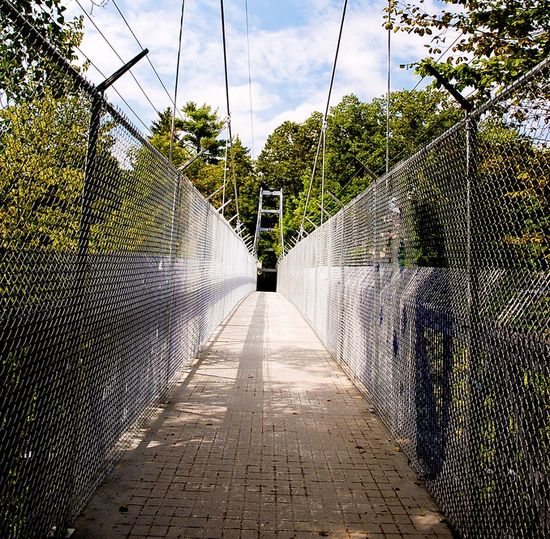
The school faced a troubling trend in 2010, when a half-dozen students committed suicide during the academic year. After two students jumped on successive days during a pre-Spring Break exam period, the school placed patrols on the bridges. During Spring Break, with the campus cleared, the school took the added, and controversial step, of erecting temporary fences around the bridges.
It’s been hotly debated by Cornellians ever since. Proponents point to the fact that fences seem to work (in fact, a few individuals have been removed from the bridges as they attempted to climb over the fences but these students’ motives were uncertain). Others believe the fences do not fix the root problem, and, in fact, make the bridges, campus, and school that much more depressing (and February in Ithaca is depressing enough). Regardless, safety measures are probably here to stay – this summer, the school and town plan to remove the fences and install safety nets located underneath the bridges.
In my opinion, the student body has provided the best deterrent to the leaps of death that have occurred all too often at the school. They’ve placed notes and inspirational messages, flowers, even underwear on the bridge to help add some humor and levity to a college experience that should be socially, and not just academically, fulfilling. Cornell can be a demanding, stressful, and sometimes depressing place. I just hope future students remember what was written by a famous Cornellian, Kurt Vonnegut, and remember this when college seems too bleak and they are beginning to be overwhelmed during exam week – "I urge you to please notice when you are happy, and exclaim or murmur or think at some point, 'If this isn't nice, I don't know what is.'"
The above photo is by Flickr user k wheeler, who captions:
this place is a prison
The suspension bridge that crosses Fall Creek on Cornell's campus in the beginning of August 2010. The ugly fence reminders of several suicides this year are still up (compare to this photo from Oct. 2008)
Update from a reader:
As a rising senior at Cornell, I wanted to make one small correction to the post referencing the suspension bridge. That picture is actually out of date. For the past two years, the fences have changed and look a lot nicer – the old ones were frightening and imposing. Here are the new fences.
 The Dish