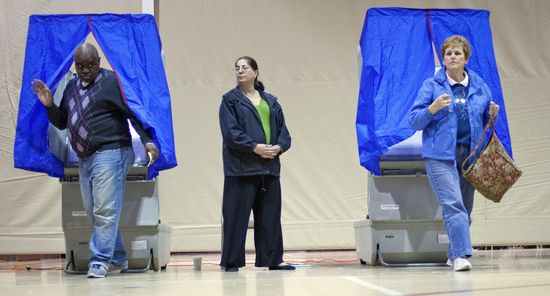
With the first court challenge [NYT] of Pennsylvania's new voter ID law starting this week, state officials admitted that voter fraud, which the law is meant to combat, hasn't been documented:
In a Pennsylvania court filing, the state says it has never investigated claims of in-person voter fraud and so won't argue that such fraud has occurred in the past. As a result, the state says, it has no evidence that the crime has ever been committed. The state also says it won't present "any evidence or argument" that in-person voter fraud is likely to occur on Election Day if the voter ID law isn't enacted.
Abby Rapoport summarizes how many people might be affected by the law, which is one of the strictest in the country:
[W]hen the secretary of the commonwealth did a study in early July, it showed that as many as 758,000 people—or 9 percent of voters—didn't have an ID from the Department of Transportation. Other studies estimate that there could be a million Pennsylvania voters without ID. That's more than the margin of victory Barack Obama had in 2008.
Another analysis suggests that the number might be twice that many. Back in June, the Pennsylvania House Majority Leader Mike Turzai (R) claimed, "Voter ID, which is gonna allow Governor Romney to win the state of Pennsylvania," among his accomplishments. But Emily Bazelon thinks the law may actually hurt Romney:
This data reportedly shows that between 60 and 65 percent of the eligible voters who may not have valid ID, and a similar percentage of people who actually voted in 2008, don’t have the right ID because their drivers’ licenses have expired. This expired-license group skews elderly and does not skew African-American. Which suggests it may not be made up largely of Democrats, since older voters are more likely to be Republicans. Also noteworthy: While many of the voters without valid licenses live in Philadelphia and Pittsburgh, plenty also live in the suburbs—where the GOP is strong.
Reihan defends voter ID laws more generally:
In my view, some states, including Pennsylvania and perhaps Texas, have moved too quickly. That is, they haven’t allowed for a phase-in period that will allow voters who don’t currently have identification enough time to get it, in part because state bureaucracies are often slow-moving or otherwise inaccessible. This is a legitimate concern. Yet arguing that a voter ID requirement of any kind represents an illiberal effort to suppress the vote of minority voters makes it harder to have a conversation about addressing these challenges. Critics of the Texas and Pennsylvania laws would benefit from acknowledging that a voter ID requirement of some kind is a legitimate demand.
Previous Dish on the unlikelihood of voter fraud here.
(Photo: Voters leave voting booths after casting ballots during the Republican primary election at Bethel Springs Elementary School on April 24, 2012 in Bethel Township, Pennsylvania. By Jessica Kourkounis/Getty Images)
 The Dish