It's affecting more than 600 million people, at least half the country's population:
The power failure on Tuesday has raised serious concerns about India's outdated infrastructure and the government's inability to meet the country's energy needs as it vies to become a regional economic superpower. The outage in the eastern grid came a day after India's northern power grid collapsed for several hours. Officials restored power, but at 1.05pm the northern grid collapsed again. About the same time, the eastern grid failed as well, with the north-eastern grid reported as being down shortly after.
Mamta Badkar details India's power problems, which include a corrupt energy industry and, of course, exceptionally high demand:
The country has seen the gap between demand and supply of power jump to 10.2 percent in March this year, from 7.7 percent in March 2011, according to The New York Times. The government has long said that coal shortages have impacted its ability to support India's massive population. And subsidies, price controls and inadequate investment in resources like coal and natural gas have hurt development of its power sector, according to the NYTimes report. India has frequent rolling power cuts through the day, and in 2011, 289 million people or 25 percent of India's population had no access to electricity, according to a report from the International Energy Agency.
Katie Fehrenbacher hopes for a clean-power silver lining. The Times Of India still has power and is live-blogging.
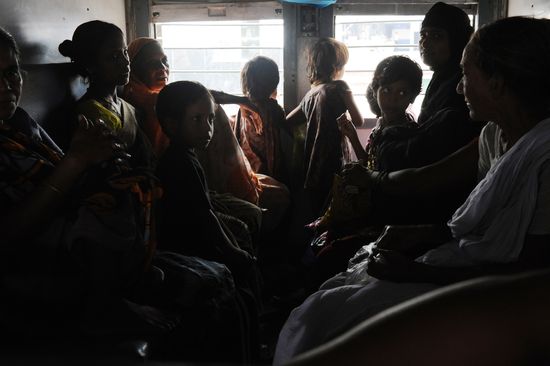
(Photo: Indian women and children wait inside a darkened train carriage at a railway station in New Delhi on July 31, 2012. A massive power failure hit India for the second day running as three regional power grids collapsed. By Roberto Schmidt/AFP/Getty Images)
 The Dish