A blast from the past on China's hilarious overthinking of the 2008 Olympic mascots, the Fuwa:
The subcommittee decided to come up with a different set of mascots, five in number, inspired by the five Olympic colors and the five elements in traditional Chinese cosmology—metal, wood, water, fire, and earth. The artists wanted a dragon, but their supervisors on the Olympic organizing committee vetoed it: the dragon was a sacred mythic animal, and it couldn't be seen on a team with any secular creatures. In addition, the organizers had consulted Chinese experts on Western attitudes, who declared that Westerners did not like dragons and associated them with evil. "We thought it was a pity," said Chen Nan, one of the designers.
The mascots were originally called "Friendlies." The dirt behind the change to "Fuwa":
Why the name change was made and why the announcement was kept so low key is somewhat of a mystery. It was a report aired last week on China Radio International (CRI) that revealed the name change and listed the reasons why the name should be altered: Firstly, Friendly is somewhat an ambiguous name, which could refer both to friendly people and friendly matches,"… a Dr. Li from Lanzhou University was quoted as saying on the site. "Secondly, the term Friendlies has a similar pronunciation to ‘friendless’ and thirdly, the spelling of Friendlies could be split and pronounced, ‘friend lies’."
Their genders were bafflingly overwrought as well:
Jingjing the panda and Huanhuan the Olympic flame were male characters, and Beibei the fish and Nini the swallow were female. Yingying the antelope had been conceived as a girl, but had been given a sex change when the designers learned that only the male Tibetan antelopes had horns.
And then there's the Tibet issue:
Beyond his transgender status, Yingying was freighted with politics: the Tibetan antelope, according to the official materials about the mascots, was a "symbol of the vastness of China's landscape." He was an ethnic palimpsest; the crown of his headgear was based on a roof design from the western region of Xinjiang, minus its traditional Islamic crescent; his ear ornaments were of Tibetan design; his hair was curly, Chen said, because baby antelopes have curly coats, and "people in western areas tend to have curly hair."
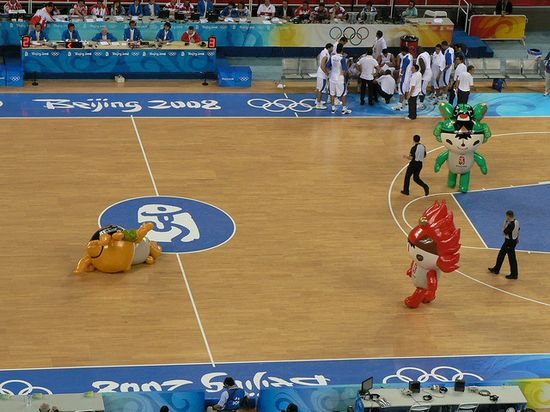
(Photo by Eveline Chao, who notes, "A fallen fuwa – they would come out and bounce around during time outs and stuff, but evidently the costumes are hard to walk in because they kept falling over. Volunteers had to come over to help them up.")
 The Dish