Stephen Walt contemplates his country while watching the Games:
I don't root for Ryan Lochte of the United States over Yannick Agnel of France because I know them both personally, and I happen to like Lochte more, or because my personal knowledge of the two tells me that Lochte is more deserving in some larger sense (i.e., he works harder, has overcome more obstacles, etc.). I have no idea, yet for some silly reason I get a certain pleasure when some American I've never even met does well. … This feature of nationalism is what Benedict Anderson famously meant by the phrase "imagined community." A nation is a group of people that imagines itself to be part of a common family, even though most of the members do not know each other personally (and might not like each other if they did).
Who knew Walt was chummy with Ryan Lochte? Poor Lochte may be in for a surprise neocon attack if he's not careful. (Update: Walt in fact doesn't know Lochte; he corrects my misinterpretation here.) National affinity gets more complicated when Olympians are either free agents or exclusively train away from their country [NYT]:
"There is no doubt that we are in the midst of the globalization of sport," said Christian Donzé, the national technical director for French swimming. "We’re living in very individualized societies, where people tend to create their own microcommunities and where athletes have their own agendas with, for example, their agent, their support team and their coach."
In a world where great talent in many domains flows across borders, sports are only a reflection of a larger, more powerful trend. At this post-modern stage, nationality can even be a symbolic choice for a star athlete. Maria Sharapova, who has lived and trained in the United States since she moved to Florida as a young girl to become a tennis champion, continues to represent Russia, the nation of her birth, because she wants to honor her parents, her roots and her Russian identity.
Alpha Abebe reflects on how the success of Ethiopian athletes will help shape the perception of a country "whose historical global image is as diverse and contradictory as Ethiopia’s":
[A]ll countries are dynamic, heterogeneous social and political constructions…right? So any effort to represent a country as something more stable and coherent than it is involves some level of fantasy, fiction and often subversion. But national images, however constructed and confused as they are, do matter. They matter in public diplomacy, they matter for tourism revenues, and they matter to individual identities. Unlike pop-stars and retail companies, countries cannot simply hire consultants and marketing firms to whip up a compelling global brand.
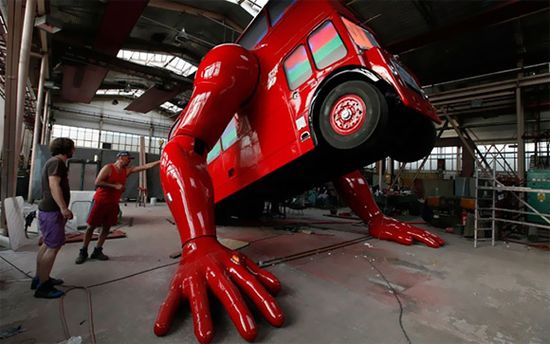
Czech artist David Cerny created the above sculpture:
[He] transformed a London bus into an athlete doing push-ups. He attached two gigantic electrical arms which lift the body of vehicle up and down, so it could do push-ups with resounding grunts and groans like the athletes you’ll see once the games begin. Dubbed as the London Booster, it will be displayed outside the Czech Olympic headquarters in London.
Watch it in motion here.
 The Dish