by Patrick Appel
Saletan loves the Ryan pick. Many pundits are making versions of this argument:
Instead of bickering about Romney’s tax returns and repeating the obvious but unhelpful observation that the unemployment rate sucks, we’ll actually have to debate serious problems and solutions. That’s great for the country.
Brain Beutler echos:
Having Ryan on the ticket will make it difficult for the losers of the election to claim that the winners doesn’t have some claim to pursue their fiscal vision. A decisive electoral resolution to this high stakes political fight is actually kind of scary no matter where you come down on issues like Medicare, Medicaid and tax policy. But it’ll also be good for the country if it means the government will have new running room to pay at least passing attention to things like mass unemployment and eroding infrastructure that the next president will have to deal with, whether he’s a Republican or Democrat.
Ramesh Ponnuru's related argument:
If Romney and Ryan do prevail in November, it will mean that voters accept the need to modernize the welfare state — and this election will end up having been the most important one since 1980.
Francis Wilkinson battles this new conventional wisdom:
If Romney wants an epic clash of visions, he doesn’t need Ryan, the House Budget Committee chairman, on his ticket. He only needs to insert real numbers in his own plan, revealing that the only way to provide his upper-income tax cuts without exploding the national debt is to initiate a sharp retrenchment of government outlays that benefit middle-class and poor Americans. Romney chose not to do that either because he deems it political suicide or because he wants the details sufficiently vague that he can shake free of them if he’s elected president; most likely both.
He quips that a "Romney plan that deliberately doesn’t add up is now complemented by a Ryan plan that deliberately doesn’t add up." James Surowiecki is in the same ballpark:
[Ryan's tax plan] calls for trillions of dollars in tax cuts (heavily weighted, of course, toward high-income earners), but also claims to be revenue-neutral, since Ryan says that the tax cuts will be offset by eliminating loopholes and tax subsidies. But when it comes to detailing exactly what loopholes and subsidies he wants to get rid of, Ryan clams up—just as Romney has done with his tax plan. This is politically astute, since eliminating the tax benefits that have a substantive budget impact would mean eliminating things voters love, like the mortgage-tax deduction. But it’s a far cry from being honest and tough-minded.
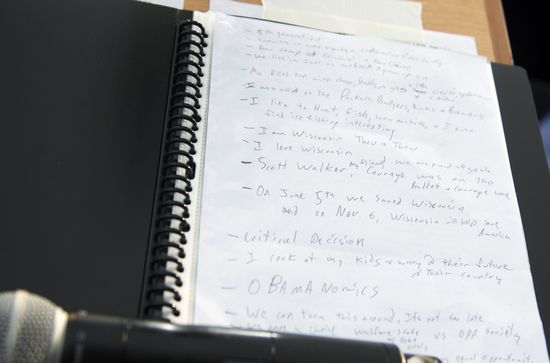
(Photo: US Republican Vice Presidential hopeful Wisconsin Representative Paul Ryan's speech notes are seen on the podium as he greets supporters during a campaign rally with US Republican presidential candidate and former Massachusetts Governor Mitt Romney at Waukesha County Expo Center in Waukesha, Wisconsin, August 12, 2012. By Saul Loeb/AFP/Getty Images)
 The Dish