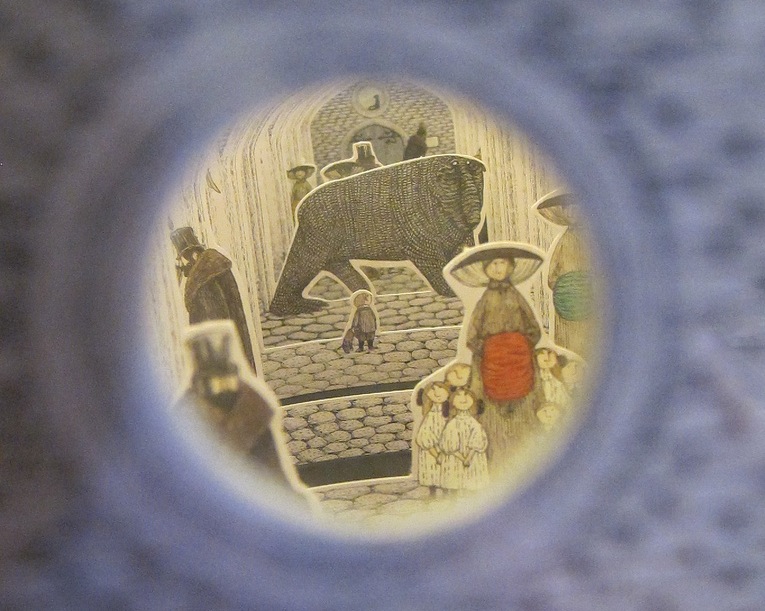
by Zoë Pollock
Eve Bowen delights in the work of Edward Gorey:
Whether they are Edwardian ladies, fur-coated gentlemen, ill-fated children, or unusual animals, his characters are almost always on some kind of journey. His stories often unfold in wallpapered rooms, on barren estates, or among statues, beast-shaped topiaries, and urns. “Few seem to return from the borders to which I’ve sent them,” he wrote to Peter Neumeyer, with whom he collaborated on three children’s books in the late 1960s. (Their correspondence has recently been collected in an absorbing, elegantly illustrated book, Floating Worlds.) Perhaps this is what gives Gorey’s work its talismanic power: his books and drawings, which are so often about imagined deaths and disasters, turn into lucky charms for his readers.
In a 1968 letter to Neumeyer, Gorey delineated "E. Gorey’s Great Simple Theory About Art":
This is the theory… that anything that is art… is presumably about some certain thing, but is really always about something else, and it’s no good having one without the other, because if you just have the something it is boring and if you just have the something else it’s irritating.
(Photo from the Edward Gorey House by Amy Hope Dermont)
 The Dish