Peter Orszag argues that competitive bidding – the cornerstone of the new version of Ryan's Medicare reform plan that is a public-private hybrid – simply doesn't work in lowering costs:
[T]here’s very good reason to believe that the 9 percent differential [pointed to as a spending reduction derived from competitive bidding] is a mirage — and that experience to date does not support claims that private plans in Medicare lower costs.
To see why, imagine two beneficiaries. One has medical expenses amounting to $150 and the other, $50. The average cost is $100. Now imagine that a private plan bids $90 to cover beneficiaries, so it looks to be about 10 percent cheaper than traditional Medicare. That plan, however, while it is designed to be very attractive to the $50 beneficiary, isn’t appealing to the $150 one, so that person stays in traditional Medicare.
The result is that total costs rise from $200 ($150 for the expensive beneficiary plus $50 for the inexpensive one) to $240 ($150 for the expensive beneficiary plus $90 for the inexpensive one). So even though the plan “looks” like it saves money, it doesn’t.
He points out that a risk-adjustment process is in place to counteract this "selection effect," but that it has a long way to go:
In 2006, Medicare Advantage plans were overpaid by more than $3,000 per beneficiary because they were able to select beneficiaries who cost less than their risk-adjusted payments. About $1,000 of that overpayment reflects what the plans were paid, rather than what they bid. So relative to their bids, the plans were overpaid by $2,000 per beneficiary — or roughly 25 percent of the bid, on average.
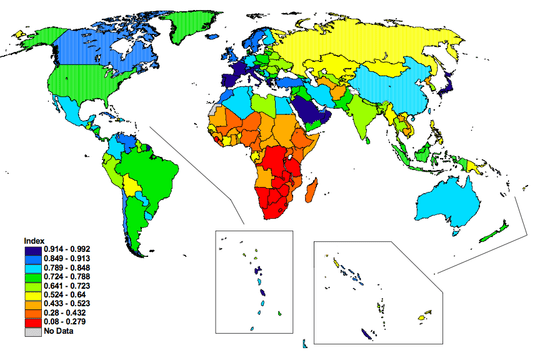
The map above is fascinating because it shows how inefficient the disproportionately private American healthcare system is. It's from a WHO study of the comparative efficiency of national health systems. You will note that Mexico and Canada are much more efficient in healthcare than the US. The US is on the same level as Indonesia and Iran in terms of value for money. In what other economic area does a private market lose out to public sector control in being efficient? In what other industry does the US trail Iran in efficiency?
Then there's the question of gaming the system:
Medicare Advantage program tries to apply a risk-adjustment formula to the patients, and Ryan proposes doing the same in his greatly expanded version of Medicare contracting-out. But this doesn't change the fact that the real profit-making opportunity here is to try to identify and exploit inevitable flaws in the risk-adjustment process. The winning strategy is to craft products that are appealing to customers the formula is willing to overpay for and unappealing to customers the formula would underpay for.
That's Yglesias. The difference, he stresses, lies in the government's role:
Now that could be a small problem or a it could be a giant problem, all depending on how good the government is at setting the rates. Which is to say that for bringing private bidders into the process to work well, you need really effective central planning. And to the extent that you have effective central planning, it seems to me that it makes sense to take advantage of the economies of scale that come from a single-payer system.
Meanwhile, Kilgore is optimistic about the government's unique ability to introduce cost-containing efficiencies:
Beyond that, I might add, Obama’s approach uses Medicare’s massive leverage to execute cost-saving improvements in how the entire health-care system operates, while the Romney/Ryan approach exposes Medicare much more than it is today to the cost pressures of the private market-place, which have boosted, not restrained, prices, even as it makes tomorrow’s retirees more “individually responsible” (i.e., stuck with the bill for) their health care.
Look: I'm a free market supporter. But as a free market supporter, I have to concede that we have precious little evidence that healthcare works like a classic market. Healthcare seems to be one critical area where the role of consumer is overwhelmed by the role of patient and third party payment. If your goal is cost-cutting, then Ryan-Romney could well take us in the opposite direction. Or perhaps at best achieve a fraction of the cost-cutting that the original Ryan plan envisaged and that Obama's pilot schemes and attack on fee-for service medicine promise.
Update from a reader:
You say that "The US is on the same level as Indonesia and Iran in terms of value for money." But you are wrong. If you look at the colors, Iran is as efficient as Mexico. Maybe you meant to say Iraq? Iran is in blue under the Caspain Sea.
The colors are a bit tricky to distinguish. But our reader is right, making the US in fact less efficient than Iran and on par with Iraq.
 The Dish