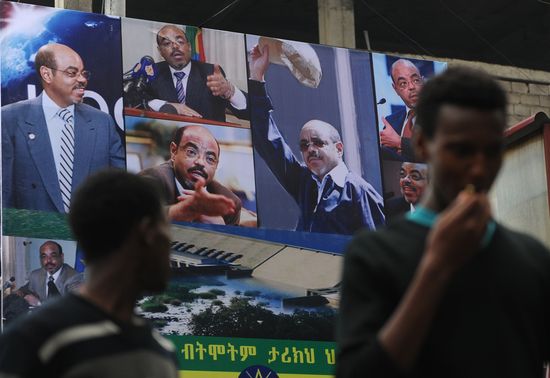
Ethiopian Prime Minister Meles Zenawi died this week after more than 20 years in power. Armin Rosen, who writes that few "dictators have so aptly balanced as many contradictions as Zenawil," looks at his mixed legacy:
His willingness to cooperate with the United States against terrorism — epitomized by the U.S.-backed Ethiopian invasion of Somalia to dislodge Islamic Courts Union militants from power in 2006 — made him a seemingly indispensable ally in an unstable region. Yet within Ethiopia, Zenawi's rule was marked by a cynical divide-and-conquer strategy that excluded several of the country's major ethnic groups from political and economic life, and that denied humanitarian aid to supposedly disloyal sectors of the country. Zenawi was one of the most-praised leaders in Africa (although never by human rights groups), a development-minded regional power-broker whose government was largely funded through foreign aid.
Adrienne Klasa's assessment:
His rule was oppressive, yet he presided over the re-emergence of Ethiopia from a state of near collapse into the dominant regional power in the Horn of Africa. He was intimately involved in brokering agreements between the warring Sudans, having developed close ties with leaders on both sides since the 1980s, and became a dominant figure in the African Union – which is based in Addis Ababa, the country's capital. Nevertheless, the distribution of his country's newfound wealth – Ethiopia currently has the fastest-growing non-oil dependent economy in Africa – remains highly uneven, with the majority of the population still living in poverty.
Harry Verhoeven, a professor of African politics at Oxford, claims that Ethiopia's future post-Zenawi is uncertain:
The [country's political] elite [are] at pains to stress that the death of the prime minister does not in any way imply that his vision of a strong Ethiopia in a strong Africa will be altered. Both his immediate successor, Hailemariam Desalegn, and Meles' long-time de facto deputy Seyoum Mesfin (co-designer of the security and energy policy as minister of foreign affairs for almost two decades) fully supported Zenawi's grand ambitions. Ethiopia's skilled corps of diplomats is well placed to continue working for the Pan-Africanist ideas set out by the deceased leader. However, this vision will now have to be pursued without its creator and chief implementer – a man in whom many outsiders and insiders trusted personally to deliver the quasi-impossible. Ethiopia's objectives will probably remain the same for the foreseeable future, mixing domestic priorities with international manoeuvring.
(Photo: Men walk past posters of late Ethiopian Prime Minister, Meles Zenawi on August 22, 2012 in Addis Ababa. Thousands of wailing Ethiopians turned out Wednesday to greet the body of Ethiopian Prime Minister Meles Zenawi as an official national mourning period began after his death in a Brussels hospital where he was being treated following a long illness. By Simon Maina/AFP/Getty Images)
 The Dish