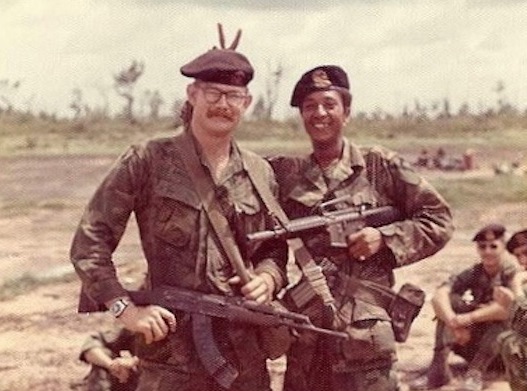
Jonathan Mirsky revisits A Pocket Guide to Vietnam, the handbook given to American GIs arriving in Vietnam that presented "the mistaken idea that they were going to a tourist destination with a bit of violence on the side":
Produced by the Department of Defense, it described how…Vietnamese love tea, and don’t like slaps on the back, how they excel at cooking fish….. We are "special guests here," the guide says, and should be courteous at all times, treat women politely, and make friends with their counterparts in the Vietnamese army.
There were more complex motives behind the guidebook than teaching soldiers to say "it's a mango," writes Mirsky:
[Former soldier Bruns] Grayson describes the average soldier handed the Pocket Guide as "about twenty years old, not well-educated, not wily enough to avoid the draft in most cases, very often on his first trip away from the United States…. But the young, uneducated soldiers described by Grayson also had to be told why they were going to Vietnam, from which, after all, they might not return.
"It is interesting," Grayson writes, "that the booklet accurately and briefly describes the history of the Vietnamese resisting outsiders—the Chinese and others—while assuming that we could never be cast in this light." To do this required telling some of the same lies that the government was telling the public and, for the most part, telling itself.
 The Dish