Romney’s Impossible Math

Romney-money-shot

In what should be a devastating moment for any campaign, a new report (pdf) from the nonpartisan Tax Policy Center yesterday exposed the upshot of Romney's tax plan:

"It is not mathematically possible to design a revenue-neutral plan that preserves current incentives for savings and investment and that does not result in a net tax cut for high-income taxpayers and a net tax increase for lower- and/or middle-income taxpayers," the study concludes. Even if tax breaks "are eliminated in a way designed to make the resulting tax system as progressive as possible, there would still be a shift in the tax burden of roughly $86 billion [a year] from those making over $200,000 to those making less” than that. What would that mean for the average tax bill? Millionaires would get an $87,000 tax cut, the study says. But for 95 percent of the population, taxes would go up by about 1.2 percent, an average of $500 a year.

Chait underscores a key point:

[T]he study embraces implausibly friendly assumptions as to how Romney would go about [raising revenue from deleted deductions]. It assumes he would ruthlessly purge the tax code of breaks for the rich, even highly popular ones like the charitable deduction. It further assumes that, in order to wring every last penny out of the rich, Romney would cut off all deductions immediately for every dollar in income over $200,000 a year.

And yet the net result is still in the end a redistribution of resources from the poor and middle class to the very rich. Even deploying supply-side hooey fails to help much:

[E]ven when you do take the economic stimulus of tax cuts into account, Romney’s tax reductions still don’t come close to making up for the lost revenue. The Tax Policy Center used a "dynamic scoring" model that factors in the impact of economic growth brought on by tax cuts, devised by Romney adviser and Harvard professor Greg Mankiw and Harvard’s Matt Weinzierl. It’s exactly the kind of analysis that Republicans have been clamoring for, and the TPC finds that Romney’s individual tax cuts wouldn’t come close to paying for themselves.

Clive Crook piles on:

It's even worse than it looks, because Romney's plan is being measured here against a "current policy" baseline (in which the Bush tax cuts are extended). If it were measured against a "current law" baseline, it would look even more regressive–and it would also fail to be revenue neutral. [Bloomberg's] Paula Dwyer writes a nice column on the findings. I agree with her conclusion. Romney's plan looks "both politically infeasible and mathematically pie-in-the-sky".

And the Romney response? Does he have any data to push back on the study, any substantive rebuttal? Nah – this is the Romney campaign:

[His] campaign is pushing back saying the report was conducted by a "liberal" group. However, TPM finds the Romney campaign cited the same group as "objective, third party analysis" during the Republican presidential primary season.

Over to you, Josh Barro.

Why Your Water Should Be A Little Dirty

Because too clean is bad for you:

Water molecules have a slight negative charge, which means they’re good at dissolving or pulling other molecules apart. When water is in an ultrapure state [such as the kind used in electronics manufacturing], it’s a "super cleaner," sucking out the tiniest specks of dirt and leaving your computer’s brain squeaky clean. But if you were to drink ultra-pure water, it would literally drink you back. The moment it came through your lips, it would start leaching valuable minerals from your saliva.

Update from a chemist:

Water is not negative; it's "polar", with one end negative and the other end positive.  It's somewhat analogous to a battery having a positive and a negative terminal.  One commenter on the Scientific American site (not me) wrote a nice correction:

"Water molecules have a slight negative charge" On one side (the oxygen atom). On the other side (the hydrogen atoms), they have a slight positive charge. That’s why both positive and negative ions are soluble in water. Of course, it’s also why water exists at all outside of strong electromagnetic fields or a vacuum.

Stripping water down to an ultrapure state makes it unfit for human consumption. You’d need to drink an awful lot of it to notice any effects, though. Tap water is practically pure. It is nothing like blood or lymph or saliva – those are halfway to seawater.

Update from another reader:

Anyone who has ever worked in the field of kidney dialysis is well aware of this fact. Many years ago I took a technical job at a clinic maintaining the dialysis machines. R.O. (Reverse Osmosis) water, made outrageously pure, is one of the primary ingredients in the various chemical cocktails mixed for the treatment. We were warned from the first day of the job to never drink the RO water, as it was so pure it literally leech the minerals right out our bones. We were told if we persisted in the habit we could actually cause a sort of self-imposed osteoporosis as we essentially urinated our bones down the toilet.

Land Of The Eternal Fax

Although Japan is one of the most technologically advanced countries, it still won't let go of the fax machine:

As of March, according to Japan’s Cabinet Office, fax machines could be found in 59 percent of Japanese homes. (That penetration rate, after climbing for years, has peaked in the past five years.) … [E]ven in the early 1990s, only about 3 percent of U.S. homes had the machines, [historian Jonathan Coopersmith] said. In terms of fax reliance, "I don’t think any other nation comes close to Japan."

Mariko Oi details some reasons why, including the large senior population, the love of hard documents, and the esteem of communicating by hand:

[T]he culture of handwriting is firmly rooted here. For example, the majority of resumes are still handwritten because Japanese employers are said to judge people's personalities from their writings. For season's greetings cards, don't dare think of sending computer generated messages, says Midori's "how to write a letter" website. "New Year's cards without handwritten messages come across as businesslike and automatic," it says. Emails lack warmth, says [fax-lover Yutaro] Suzuki. Not surprisingly, people aspire to have good handwriting. Calligraphy remains one of the most popular lessons that parents send their children to and many adults take private lessons to improve their writings, too.

Money quote from the above video, which has hints of Gabe and Max:

You can go to CountryCodes.com, on the Internet.

One Giant Bleach For Mankind

Those American flags planted on the moon? They’re probably all white by now:

For forty-odd years, the flags have been exposed to the full fury of the Moon’s environment – alternating 14 days of searing sunlight and 100° C heat with 14 days of numbing-cold -150° C darkness. But even more damaging is the intense ultraviolet (UV) radiation from the pure unfiltered sunlight on the cloth (modal) from which the Apollo flags were made. Even on Earth, the colors of a cloth flag flown in bright sunlight for many years will eventually fade and need to be replaced. So it is likely that these symbols of American achievement have been rendered blank, bleached white by the UV radiation of unfiltered sunlight on the lunar surface.

Jesus Diaz adds:

[I]t turns out that the commemorative plaque left by Armstrong, Aldrin and Collins on the Eagle’s descent stage, left on the surface of the Moon, was right:

Here men from the planet Earth first set foot upon the Moon.
July 1969, A.D.
We came in peace for all mankind.

Neil A. Armstrong, Michael Collins, Edwin E. Aldrin

We came in peace indeed. And here’s the [white] flag to prove it.

Update from a reader:

At least one side of the flag that Aldrin and Armstrong planted on the moon during the Apollo 11 moon landing likely retains some of it’ color. When the Eagle initiated its ascent stage to regroup with Columbia, the wind from the ascent module’s exhaust system toppled the flagpole, a scene that Aldrin witnessed through a window as he and Armstrong took off from the lunar surface. This was remedied on future Apollo missions by planting the flag at a greater distance from the ascent module, but in the case of Apollo 11, at least some of the red, white, and blue of the flag likely remains, albeit face-down in the lunar soil.

One Flock

Light-3 (1)

Christopher Benson reviews three "fresh and challenging" books on Christianity's reaction to homosexuality. His understanding of Oliver O’Donovan’s Church in Crisis: The Gay Controversy and the Anglican Communion is worth quoting:

O’Donovan limns the biblically acceptable identity: “Gays are children of Adam and Eve, brothers and sisters of Christ. There is no other foundation laid than that. ‘He will feed his flock like a shepherd’; from which it follows, simpliciter and without adjustment, that he will feed gays like a shepherd, too.” While acknowledging that “there are other, less fundamental senses to the concept of ‘identity’” and special needs in the flock, he cautions the church against exaggerated differences:

The gospel is addressed to human beings irrespective of their condition, and there is no prima facie place to dismember it into a series of gospels for discrete social sectors. Why would there by a gospel for the homosexual any more than a gospel for the teacher of literature, for the civil magistrate, or for the successful merchant (to name just three categories that the early church viewed with the same narrowing of the eyes that a homosexual may encounter today)?

It is for the church to address the good news, we may say; it is for the recipient—homosexual, pedagogue, politician or captain of industry—to hear it and to say how he or she hears it in and from this or that social position.

The challenge at the present moment, it seems to me, is for the church to develop a ministry of recognition, in which same-sex attracted persons are dignified—alongside others—as “beloved,” while avoiding a ministry of difference, where such persons are excused from integration, licensed to innovate beyond Scripture and tradition. Put differently, same-sex attracted persons should be grafted onto—not subtracted from—the one tree of Christ, nourished from that root (Rom. 11:11–24).

(Light painting by Simon Berger via Colossal)

Letting Your Own Guy Cheat

Dan Ariely conducted an experiment where he asked participants to rate the acceptability of a candidate indulging in "ethically gray activities" in order to get elected:

What we found was that participants who were planning to vote Democratic indicated that Romney should be held to a fairly high ethical standard. Republican participants held a similar standard for Obama. But when participants happened to support the candidate in question – whether Obama or Romney – they indicated that ethically gray activities were approximately 3 times more acceptable.

If voters hold a double standard for the ethical conduct of their own candidate and the opposing candidate, the overall standard of ethics is likely to fall to the lowest common denominator.

The “Lost Jews” Of Zimbabwe

GT_LEMBA_120801

Eugene Ulman explores the culture of the Lemba, whose distant ancestors are said to have migrated from Yemen:

The Lemba priestly clan, called the Buba, has, according to the genetic studies, a particular prevalence of the Y-chromosomal Aaron, nicknamed "the Cohen Gene," which is common to all descendants of the Kohanim, the ancient Israelite priestly caste…. [C]ertain practices seem to be common to most of the Lemba. They eat meat only from animals slaughtered in the kosher way, they circumcise their boys, and they play shofars made from kudu horns, just like the Yemenite Jews. Some Lemba celebrate Passover; others keep the ancient Temple-era practice of the priests shaving their heads and blowing shofars to mark the new moon.

Jon Cohen got his DNA tested and flew to Africa to meet a "genetic cousin". Not all Lemba are thrilled with the attention:

Alex Makotore of Harare, son of a late chief of the Lemba, says that the tribe does not claim to be Jewish. He accuses scholars of trying to impose a foreign identity on them. "We don't want to look like people who are looking for an identity," he said. "We've got our own African identity, we are not looking for our roots. "They call us black Jews, but it is them [the scientists] that call us that. If we are linked to the Jews, then fair and fine, but we cannot rightly say that it is only the Jews that [have those customs]."

(Photo: Lemba people attend a meeting on January 28, 2012 in Gutu, 250 kms southeast of the capital Harare in Zimbabwe. Yarmulkes bob as voices rise into a sacred song carried from ancient Judea to the scenic fields of a far-flung southern African village that is home to a 'lost tribe' of Israel. By Jekesai Njikizana/AFP/Getty Images)

The Dons

Depressed by the state of the modern university, which is "governed by an ever-proliferating thicket of rules" that reward hyper-specialization and publishing in arcane journals, Adrian Wooldridge celebrates two late, great Oxford dons, Isaiah Berlin and Hugh Trevor-Roper:

Berlin wrote a popular book on Marx (in the Home University library, of all tenure-destroying places) rather than bothering with a PhD. A striking proportion of his work appeared in out-of-the-way publications rather than learned journals. Trevor-Roper dispensed with even more academic formalities. He savaged the most revered figure in his field, R.H. Tawney, with the flourish that his work was not only incompatible with the truth but positively repugnant to it. He was an erratic, not to say self-indulgent tutor—sometimes relaxing his academic standards for the sons of dukes, or taking against over-ambitious protégés, as he did with Lawrence Stone, but also sweating blood for obscure young scholars.

This freedom from petty rules meant that Berlin and Trevor-Roper could devote themselves to cultivating the life of the mind rather than tilling a narrow field. They could study whatever caught their interest, whether it be the life of a sex-crazed sinologist or Tolstoy’s political philosophy. They could publish when they felt like it, holding back whatever did not pass the twin tests of rigour and readability, rather than dancing to the tune of state funding. 

They were exemplars, in other words, of what was once known as a "liberal education." We need it now as much as ever.

The Daily Wrap

Mitt1

Today on the Dish, Andrew observed that Obama's tax rationale is gaining traction – and that Romney's favorability is slipping. He then went after Obama for failing to form a debt reduction plan, pilloried the GOP for its cynical politics, and analyzed the plausibility of Harry Reid's Deep Throat at Bain. Romney went negative on Obama's auto bailout and encapsulated what's amiss with US-Israel relations.  He and Obama engaged in an app war, Boris Johnson became the Un-Romney – and got memed – and Obama endured more swift-boating. Jane Mayer and a reader explored the darker corners of outside spending, Mike Kelly compared the birth control mandate to Pearl Harbor and 9/11, Dick Morris was also cray-cray.

On the death of Gore Vidal, Andrew balanced repulsion and admiration for his work. In Olympics coverage, the blogosphere debated Ye Shiwen's spectacular performance, Egypt's football team advanced, and Michael Phelps pigged out. And while Olympics officials unfairly punished China's badmintoners, millennials had it out with NBC.

As the Drug War disproportionately hurt African Americans, Andrew defended his pot legalization position and acknowledged the accomplishments of some famous drug users. India failed its women in some horrific ways, Gustavo Sousa portrayed global inequality, and alcohol got cheaper for Brits. In other assorted coverage, Geoffrey Wheatcroft contemplated Churchill's literary efforts, Rob Dunn encouraged accuracy in paleo-dieting, Trevor Paglen prepared to immortalize human culture in space, and a reader served up some Emily Dickinson. Other readers disputed the Reddit-as-frat contention and reframed the Olympic sex appeal issue. A Korean hipped and hopped, VFYW here and Poseur Alert here. Lastly, Andrew stepped back and admired his creation.

G.G.

(Image via the DangleBoris tumblr)

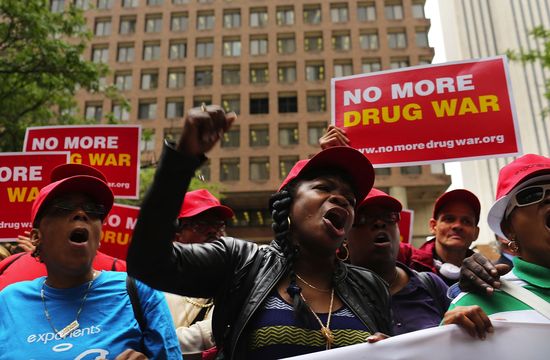
The Race To End The Drug War

GT_DRUGWAR-RALLY_120801

The Dish has previously covered how pot arrests disproportionately affect African Americans. From a current snapshot:

In Washington, more than 90 percent of the people charged for cannabis last year were black, according to the Washington City Paper. The city is slightly more than half African American. In Philadelphia, about 43 percent black, the percentage has exceeded 80 percent over the last few years, according to the Philadelphia Weekly and Gettman’s figures. In Chicago, 78 percent of the people handcuffed for hay in 2009 and 2010 were black, the Chicago Reader reported last year. The city is about one-third black. Whites, also about one-third of Chicago’s population, were 5 percent of those arrested.

Cord Jefferson sees signs of hope:

In New York City, for instance, minor marijuana arrests are down thanks to a Bloomberg-backed effort to give leeway to people in possession of small amounts of the drug…. [A]nd the Chicago City Council ruled last month to allow cops to give tickets to people in possession of fifteen grams of pot or less rather than arresting them. 

Some good news this week:

A decade after the Coalition for Rescheduling Cannabis (CRC) filed its petition seeking to have marijuana moved from Schedule I of the Controlled Substances Act, the federal courts will finally review the scientific evidence regarding the therapeutic efficacy of marijuana. The DC Circuit Court of Appeals announced late last week [pdf] that it will hear oral arguments in October in a lawsuit filed by Americans for Safe Access (ASA) to force the government to act. The lawsuit, Americans for Safe Access vs. DEA [pdf], was filed in January after the DEA denied the CRC's rescheduling petition the previous July. The DEA took nine years to decide to do nothing about rescheduling marijuana.

(Photo: Marijuana legalization advocates and members of community groups attend a rally against marijuana arrests in front of One Police Plaza on June 13, 2012 in New York City. The New York City Council is set to vote on a resolution that would decriminalize possession of small amounts of marijuana in public view. Governor Andrew Cuomo has urged the state's lawmakers to pass the law, which many say leads to the arrests of a disproportion of minority youths. By Spencer Platt/Getty Images.)