July was the best traffic month for the Dish since September and October 2008, a quarter of the pageviews due to publishing an email sent to me by an old friend. 3.5 million individual people logged onto this page at some point, for a total of close to 11 million pageviews. 20 percent of our traffic came from Facebook and social media. Welcome to all the newbies; big thanks to the loyalty of long-time Dishheads. This never gets old for me. Every now and again as an alumn of old media, I have to pinch myself when I realize that last month, the eyeball readership of the Dish was 35 times the circulation of The New Republic when I edited it in the 1990s. We get so used to this revolution it's sometimes useful to take a deep breath and see just how far we've come.
Month: August 2012
The UK’s Coming Hangover
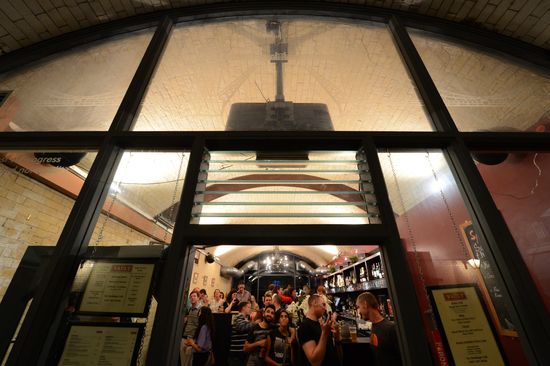
According to the Institute of Alcohol Studies in the UK, alcohol is 44 percent more affordable today than in 1988. Peter Popham thinks the combination of austerity and the Olympics spells trouble:
It has never been cheaper to get blotto, bladdered, and bombed, and more and more Britons are turning to this easy escape. Home Secretary Theresa May described how young people have got into the habit of downing large quantities of cheap booze before hitting the town for a weekend: they call it "pre-loading." Residents of Prague, Budapest, and other European destinations reachable by low-cost airlines watch in horror and bafflement as gangs of Brits stumble and puke around their elegant city centers. Town squares up and down the U.K. are disfigured every weekend by scenes of Bacchanalian excess. Hospital ERs are inundated. Cirrhosis of the liver, a disease that only used to affect people over 50, threatens to become an epidemic among the young.
(Photo: People watch the Opening Ceremony of the London 2012 Olympic Games in a pub in central London on July 27, 2012. By Kirill Kudryavtsev/AFP/Getty Images.)
China’s Badminton Victims
Simon Jenkins thinks the outrage at China's badminton team's throwing games is off-base:
Day and after day we read relentless hyperbole about the vital importance to national pride of winning: not winning a heat or a round or an exhibition, but winning medals. So obsessed is the media with this single index that the BBC has stopped displaying the medals table because it is too humiliating. This is the pastiche chauvinism of a banana republic.
Along come the Chinese, who clearly know how to win. You plan. The badminton heats were apparently staged to give an incentive, in certain circumstances, to losing games in the qualifying stages. Faced with the risk of a tougher opponent later and thus losing a medal, the players did what their tacticians said. They lost a round. I cannot see how, in sporting terms, this is any different from sprint cyclists hovering for an age on a curve, waiting for the right moment to surge forward. Anyway, the athletes were not trying to lose, they were losing so as being more likely to win.
That latter point is surely salient. Honing tactics to have a better chance at winning is not the same as throwing a game for money. And there's an obvious solution: go back to knock-out rounds.
Women, Male Geeks, And Reddit, Ctd
A reader writes:
This assumption that Reddit has a particular culture, and that that culture is hostile to women, is false. It's just not true. Look at that thread you linked to: It's full of registered Reddit users discussing the perils of male privilege. I've seen TONS of feminist opinions on Reddit in the several years I've been on the site. I've seen very sensitive guys be very nice to girls. I've even seen rape victims get great advice, such as "call the police" and "seek therapy" and "don't blame yourself".
The point isn't that there's no sexism on Reddit, or even that it's not prevalent. The point is that reducing a complex social ecosystem to a stereotype of a virgin neckbeard sexist is no better than reducing all women to the stereotype of stuck-up, entitled, frigid shrews.
In other words, it's exactly the sort of thing that writers with no real understanding of their subject matter routinely do, whether the writer is a sexist, geek commenter on Reddit, or a militant feminist writing for Jezebel who has never spent even a week reading Reddit every day.
Also, how come the negative experiences of men don't count the same as the negative experiences of women? It seems to me that, because certain women have negative experiences with certain men, they feel justified in writing negative things that sum up "men" as a whole. That's just fine. But geeks on Reddit, who largely have been ignored and laughed at by women since middle school, are sexist and out-of-line when they take to an anonymous Internet forum to vent that frustration. Isn't this the exact sort of double-standard that equality's champions purport to deplore?
How India Is Failing Its Women

An international panel recently named India the G20's worst country for women – a startling feat given that Saudi Arabia was in the running. Suparna Chaudry details the dubious distinction:
Sure, India might not be the worst place to be a woman on the planet…[b]ut 45% of Indian girls are married before the age of 18, according to the International Centre for Research on Women (2010); 56,000 maternal deaths were recorded in 2010 (UN Population Fund) and research from Unicef in 2012 found that 52% of adolescent girls (and 57% of adolescent boys) think it is justifiable for a man to beat his wife. Plus crimes against women are on the increase: according to the National Crime Records Bureau in India, there was a 7.1% hike in recorded crimes against women between 2010 and 2011 (when there were 228,650 in total). The biggest leap was in cases under the "dowry prohibition act" (up 27.7%), of kidnapping and abduction (up 19.4% year on year) and rape (up 9.2%).
It's not just violent crimes, says Chaudry:
[O]ther kinds of (non-violent) crimes—commonly referred to as "eve-teasing"—are a part of many women’s daily existence while out at work or on public transport, and include being subjected to sexually suggestive remarks and unwanted physical contact. The expression of discomfort by many women led the Delhi Metro to designate separate, women-only carriages on the train. However, as many have rightly claimed, separation of the sexes is not something that increases tolerance. An anonymous blog post by a woman highlights how her ride in the Delhi metro turned nasty when she did not board the ladies’ carriage of the train and instead traveled in the general compartment.
And India's rape laws are woefully narrow:
There is currently no special law in India against sexual assault or harassment, and only vaginal penetration by a penis counts as rape…. The maximum punishment is a year's imprisonment, or a fine, or both.
(Photo: Women's rights activists march during a rally in Calcutta, India on March 19, 2012. The rally was organised to protest against the recent physical assaults and rape on women, and also as a demand for a proper rule of law for women's rights. By Dibyangshu Sarkar/AFP/Getty Images)
The Sex Appeal Competition, Ctd
A reader writes:
I find the conclusions of this study problematic. First of all, why is the scope limited to the apparent sexiness of women? It seems to me that popular men's sports (swimming, gymnastics, track) involve scantily clad men. Why is there a double standard? But, more importantly, is this correlation even remotely true? Have you seen the US women's competition swim suits? I'm not sure you can consider those more revealing or attractive than a pair of bicycle shorts. Furthermore, one of the most popular women's events, US women's soccer, doesn't get much prime time coverage because it's really hard to slot a 90 minute game into the prime time broadcast. It's much easier to do a 10-20 minute bit on an entire swimming race than to find an elegant way to weave in US v. France.
It seems to me as though there are three factors that determine what NBC shows:
1) the chance of the US winning a medal, 2) It's ability to fit into the broadcast, 3) the actual popularity of the sport in the US. I'm sorry that nobody cares about fencing, but most people don't actually understand the sport. Meanwhile, almost everyone has played beach volley ball a few times. Which one would you rather watch?
I love the Olympics because it's one of the few places where both male and female athletes are appropriately celebrated for their accomplishments. Abby Wambach is a legitimate star at the Games; just ask my 10-year-old niece when she gets back from soccer practice. Why are we speaking negatively about the Olympics instead of celebrating the fact that we love watching our women compete on the international level? It drives me insane, and it belittles the accomplishments of some of the amazing female athletes that are receiving attention. Who cares if she's wearing a bikini … she just won a gold medal!
Chart Of The Day
Inspired by the Olympic rings, each representing a different region (Oceania, Europe, the Americas, Africa, Asia), Gustavo Sousa created an elegant visualization conveying "vast inequalities":
Everything from percentage of millionaires to McDonald’s outlets gets a graph; all-in-all, there’s 16 prints–one for each day of the games–and a live projection, which will be exhibited in East London during the festivities. And if you find yourself searching for a key while scrolling through his site, you’re out of luck; its omission was intentional. "The reason I didn’t reveal which is which because you can almost figure that out as you read through; I thought that process of discovery was interesting," [said Sousa].
Key provided after the jump:
Oceania: blue. Europe: black. Americas: red. Africa: yellow. Asia: green
To see a static version of each of the 16 prints, as well as larger font, go here.
Poseur Alert
"Drive … cannot be a subject of film criticism specifically, let alone of a review, the convention of identification already stands in the way, since it claims a film from a film and a director as an auteur. The author is the screen itself: God sive Screen, Screen sive Nature. It is not about coup de maître, but about par excellence. Is Drive a film, i.e. what is (such) a film today? What is the interest, the singularity of its emptiness? It seems to be more crystalline, more polished, more subtracted, more self-reflexive, more paradigmatic, consciously and conscientiously committed to "the consciousness industry." Winding Refn is very straightforward: "I am a fetish filmmaker." Drive is pop, absolute advertising as information, "a complete combinatorial, which is that of the superficial transparency of everything," a video, where differentiating between art-experimental and commercial appears as mere moralizing; it is a fashion/designer video, which continues to be, and is ever more so, the cultural dominant," – Marko Bauer.
#NBCFail
… is perhaps best illustrated by this clip of the network providing a spoiler for its own coverage of American swimmer Missy Franklin's dramatic race:
Millennials are in open revolt over NBC's tight control over its coverage, especially the long delays between the events occuring in the UK and their airing on American TVs:
At the centre of controversy was NBC's attempt to leverage maximum revenue from the Games, for which they paid almost a billion dollars, by foregoing live coverage of high-profile events. Instead, it intends to footage on time-delay during evening prime time, when brands will pay a premium to advertise. The tactic may very well be the most lucrative for NBC, but it's the least satisfactory for viewers, and seems to blithely ignore the advent of the internet era. It meant, for example, that Saturday's titanic swimming clash between Michael Phelps and Ryan Lochte wasn't broadcast in the USA until several hours after it took place. Adding insult to injury, NBC had already announced the result on its own evening news bulletin.
And the time delays are creating all sorts of spoilers via social media:
What's different in these Games isn't the time-shifting itself; it's that time-shifted coverage is no longer the only coverage available to us. "Real time" is now a default option in a way that it wasn't back in 1996 — or even, given the rise of Internet connections, in 2008 or 2010. That London 2012 is the first real "Social Media Olympics" is a cliché because it's true:
We consumers are experiencing these Games not just on our couches, but in our cars and in our offices and in our city buses and in our neighborhood Applebee's and in any other locations we choose, because the point of our connected mobile devices and the point of the Internet overall is the utility of omnipresent access. We're experiencing the Games not — or not merely — as a media event, but as a social event. And we're experiencing them, crucially, not just as entertainment, but as information.
Meanwhile, 64 countries are able to watch the Olympics live on YouTube, but not in the US. Heidi Moore says NBC is ignoring the shrinking cable TV market:
Forcing viewers to subscribe to cable TV can be compared to forcing an entire nation of viewers to give CPR to a corpse. A growing movement of "cord-cutters" in the US have chosen to dispense with the empty and expensive wasteland of cable programming, instead opting for more bespoke TV viewing by downloading TV shows and movies from iTunes, Netflix and Hulu. These cord-cutters are not just teenagers or cranks. With the American economy weak and households buried under debt, many Americans have economized by cutting out their cable subscriptions. The trend has accelerated in 2011, when about 1 million viewers cancelled their cable or satellite TV service, and another million are expected to cancel this year…
Naturally, most of the criticism of NBC's coverage is being aired via Twitter:
BREAKING: Jesse Owens wins gold in 100m sprint #NBCFail
— NBC Delayed (@NBCDelayed) July 29, 2012
Good grief. The montages. The profiles. The feel-good music. The inspiration. GET TO THE SPORTS. #NBCFail
— Jessica (@vdaze) August 1, 2012
Most striking difference b/t swimming on BBC and NBC – BBC: Race, race, race, race, race, ads. NBC: Race, ads, race, ads, race, ads…
— Mark Coddington (@markcoddington) July 30, 2012
Ryan Lochte could cure cancer during a race & NBC would air it 6 hours later with the cure portion removed for a Seacrest interview #NBCFail
— NOT SportsCenter (@NOTSportsCenter) July 29, 2012
It's great having a former Olympic athlete like Ryan Seacrest in this broadcast. #nbcfail @nbcolympics
— karen smitty (@karensmitty) August 1, 2012
Confirmed: The NBC-critical Independent journo Guy Adams’ Twitter was suspended because NBC Sports filed a complaint against him. #NBCFail
— Gary Whitta (@garywhitta) July 30, 2012
If you saw NBC's coverage of the Olympics, you'd be grateful that Dad banned television: bit.ly/QgjsUe #NBCFail #Olympics
— KimJongNumberUn (@KimJongNumberUn) July 31, 2012
But NBC could get the last laugh: its ratings are on track to break records for Olympic coverage.
 The Dish