Romney’s Faith, Front And Center, Ctd

LDS_Hierarchy

A reader writes:

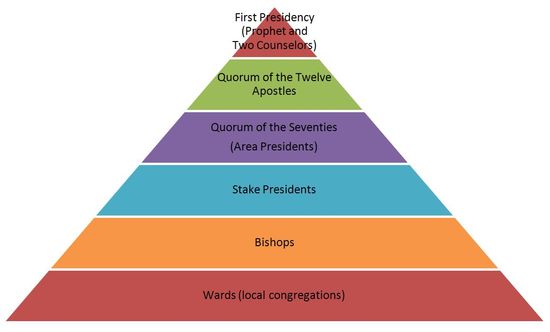
Your reader doesn’t have the facts quite right.  A "bishop" in the LDS church does head up a ward, but a ward is like a congregation or single church, not a diocese.  The LDS parallel to a diocese is a "stake", which is a geographical group of wards.

A breakdown of the LDS hierarchy here. Another reader:

As someone who grew up in the LDS church, but is no longer practicing, I think you're making too big of a deal out of MOST of Romney's positions in his church. The LDS church is very much a "people's church" in its organizational structure, and at local levels leadership is all voluntary and rotating. My uncle is currently the "bishop" of his LDS ward. But it is not his "job" — he sells real estate for a living. He does it part-time, he is unpaid, and he will only be bishop for a few years before it is handed to someone else in his ward. His ward has maybe 200 regular attendees. His church building has three or four wards, and each ward has its own bishop.

The term "high priest" is a grandiose title. They are not "priests" in the traditional sense that a Catholic would relate to. Each ward has several — usually they're older men who have been devout members of the church for a long time, and/or have a long family history in the church, like Romney.

If you're going to continue this discussion, I would focus on Romney's time as Stake President.

THAT is a prestigious senior position, especially in a major city like Boston, and much bigger than being a ward bishop. As stake president, he would have been a very visible and powerful member of the church in his area, overseeing several church buildings and all of their wards. He also would have been far more involved in the politics of the church at that level, and in the church's relationship with the citizens of Boston, where he presided.

Another offers more perspective through numbers:

I've never considered Romney's role as a bishop as very extraordinary.  Considering the fact that there are 28,784 wards (or branches) in the world, it follows that there are 28,784 bishops (or branch presidents) in the world at any given time.  A bishops serves for more or less five years.  It then follows that over the past 60 years (or over the time of Mitt's lifetime) there have been an estimated 345,408 bishops.  That's about 5% of the current male Mormon population.  While it probably is a high estimate … that doesn't make it all that uncommon.

The highest and most influential position Mitt Romney has held is Stake President (of which there are currently 2,946 worldwide).  But the media talks about bishop and the Dish is now talking about high priest.  I imagine this is because those titles sound more religious and familiar than stake president.

Another:

Your question about whether previous candidates for president have had such a high religious office is simply irrelevant.  The term "high priest" in the LDS church doesn't mean what it means elsewhere.  While becoming a high priest can go along with a high-impact church calling (such as being a bishop or stake president), it is often something that is extended to men as they age within the church, a sign of maturity or seniority. 

In my congregation (in Palo Alto, CA) as in most others, the majority of men over age 50 are high priests, and very few of them would have served as bishop or stake president.  My father became a high priest at about age 50, when he became a counselor in a bishopric of a ward for single adults – far from being a power player in the church.   And once you become a high priest, you stay it for life, regardless of what positions you subsequently hold.  After serving as a bishop, you might be called to become a primary teacher (for children) or a choir director in the congregation.  You stay a high priest, but all that really means is that you go to a different meeting during the third hour of church – a meeting that primarily consists of old men having a gospel discussion – and help the bishop provide spiritual and physical support for the ward members.  I can't know for sure, but my guess would be that all practicing male Mormons in the public arena (people like Harry Reid) are probably high priests.

I read with interest all of your commentary on Mormons, and I feel that in general you have a tendency to view as inherently sinister things that I feel are not.  You always misunderstand in one direction.  I am curious about a few things: 1) Have you ever been to LDS services, and if so, how did you find them to be?; 2) When you have questions about aspects of the LDS faith (the meaning of certain terms, or the relative importance of theological tenets, for example) whom do you ask?  Do you have any Mormon contacts that you bounce your questions off of?  I agree with you that there are some terms in common use in the church that sound scary and/or high-fallutin – things like high priest, high council, stake president.  It might serve you well to talk to a practicing Mormon about things like that, someone who can translate Mormon-speak into normal English.

(Chart from NewMormonOrder.org)
Today In Muppet Research

Jeremy Stahl gets to the bottom of an important question:

The Swedish Chef does not speak any known language, and the fact that his nonsense words are so widely interpreted as Swedish-sounding is bewildering and annoying to Swedes. "What has always struck me is that the Chef is probably based on a Norwegian sing-songish accent rather than a Swedish one," Maaret Koskinen, a film studies professor at Stockholm University, wrote in an email when I asked her about the Swedish Chef’s cultural influence in Sweden.

Update from a reader:

Were you aware that today is Ingrid Bergman's birthday (b. 1915)? We always eat Swedish Meatballs on August 29th in her honor.

Oh Dish readers.

The RNC’s Version Of Affirmative Action

Alex Altman calls last night a "diversity pageant":

Mia Love is not a household name. But ask any savvy Republican here, and they’ll tell you the mayor of Saratoga Springs, Utah, is one of the party’s political phenoms. Love, 37, is a congressional candidate for Utah’s 4th district. More importantly, she’s a black Mormon with sterling Tea Party credentials. This is the sort of improbable resume that earns you a coveted speaking slot on the convention’s first night — even when you’re down by double digits in one of the most conservative states in the U.S.

Weigel adds:

This is a pretty obvious point, but when the GOP finds a nonwhite politician with any natural talent, the politician is made up and shoved onstage within five minutes. I mean, Michael Steele got a prime-time speech in 2008 when he was just the former LG of Maryland.

The Cayman Candidate

From ABC News:

Gov. Mitt Romney's campaign toasted its top donors Wednesday aboard a 150-foot yacht flying the flag of the Cayman Islands. The exclusive event, hosted by a Florida developer on his yacht "Cracker Bay," was one of a dozen exclusive events meant to nurture those who have raised more than $1 million for Romney's bid. "I think it's ironic they do this aboard a yacht that doesn't even pay its taxes," said a woman who lives aboard a much smaller boat moored at the St. Petersburg Municipal Marina.

A Return To Cheneyism

108986758

The one thing we know about the Romney-Ryan foreign policy is that it will be about furthering American hegemony whatever the cost, another war in the Middle East, abandonment of any honest broker role in the Middle East, a trade war with China, the return of torture, and a reversion to 1981 with Russia. In other words: Cheneyism without even Bush to moderate, and with no direct experience of anything related to diplomacy (if you don't count Romney's success in alienating every citizen in our closest ally). Flagging that Romney-Ryan is the first GOP ticket since 1940 to "lack any formal military of foreign policy experience," Kevin King worries:

[W]hile an electorate focused solely on economic issues may appear to be good news for Romney and Ryan, the minimal attention being paid to the pair’s lack of foreign policy experience and avoidance of the topic is a disservice to America and our allies.

Offering his two cents in a Foreign Policy article, John McCain endorses military meddling everywhere and anywhere:

In past struggles like Syria, when brave peoples fought for their liberation from enemies of the United States, we were fortunate to have presidents, both Republicans and Democrats, who recognized that it was in keeping with both our interests and our values to help the forces of freedom prevail. And they acted on that conviction. A Republican foreign policy would reclaim this proud tradition of U.S. leadership. It would, of course, accept that our interests require us to make tradeoffs at times, but wherever people struggle for human rights, no one should have any doubt whose side America is ultimately on.

Although foreign policy isn't dominating the mainstream RNC talking points, George Packer finds America's role in the world to be a Tea Party cause celebre:

[A]sk the Tea Party Patriots what they think of Obama’s foreign policy and you get a full-throated answer. They held a tribute to the military this afternoon under a sweaty tent on a piece of concrete in downtown Tampa outside the convention perimeter that the Tea Party has occupied and christened Liberty Plaza. Every speaker wanted more war, not less—bloodier, simpler war—a message not completely at odds with the views of Mitt Romney and his senior foreign-policy advisers. The theme of the event was dishonor and defeat, and by the end some speakers were openly accusing Obama of working for the enemy.

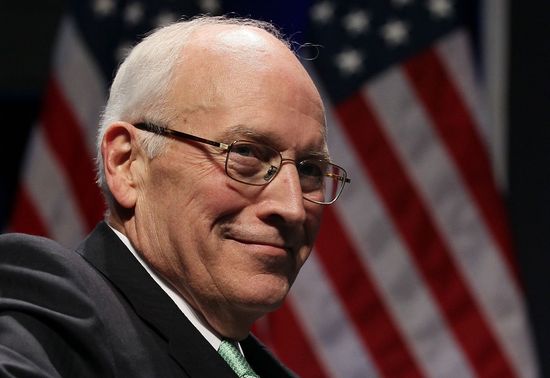
If it walks like a Dick, and talks like a Dick, it's a Dick. You want a decade of religious war? You know who to vote for.

(Photo by Mark Wilson/Getty Images)

Digging Through The GOP’s Platform

Matt Yglesias flags 10 sound economic policies in the GOP platform. Brad Plumer, meanwhile, highlights the 10 "oddest" ideas in the overall platform. Adam Serwer looks at what the platform says about gay rights:

As I reported yesterday, the GOP platform … decries efforts by the Obama administration to oppose laws in African countries that criminalize homosexuality. Some of the legislation being proposed would include prison time and even execution as punishment for homosexuality, but the GOP platform says the Obama administration of "imposing" the "homosexual rights agenda" on "the peoples of Africa" by trying to change them. The GOP's "respect and dignity" agenda for gay people apparently doesn't include preventing them from being executed or imprisoned outside of the US. 

Chart Of The Day

Romney_vs_Obama

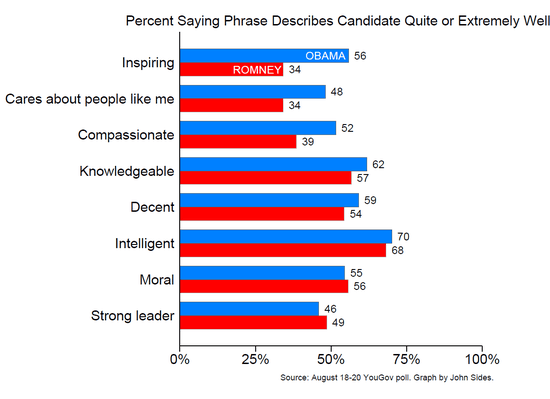
John Sides outlines Romney's challenge:

Here is something you don’t hear too much: voters view Mitt Romney about as favorably as Barack Obama. At least if voters are asked about whether the candidates are knowledgeable or decent or intelligent or moral or a strong leader. Those are important qualities, and perceptions of Romney and Obama don’t differ much. One of Romney’s challenges, in Tampa and beyond, is to close the other gaps—ones related to empathy and whether he is "inspiring."

Sides doubts Romney can accomplish that goal.

Man Of Mystery

Arguing that Ann Romney "missed an opportunity," Peggy Noonan marvels at the enduring enigma of Mitt's character:

I have just spent the past two and a half days talking to people who’ve known Mitt Romney well for ten, twenty and thirty years, even more. They love him, and in all their conversations they say either literally or between the lines, "If only you knew him like I do." It is their mantra. They mean it, and they are so frustrated. They believe he is a person of unique and natural integrity, a kind man who will give you not only his money but his time, his energy. They see him as a leader. They know the public doesn’t see this. They don’t understand why. And, actually, I don’t blame them, because it really is a bit of a mystery. If he’s so good why can’t his goodness be communicated?

Amy Davidson notes Ann's refusal to step beyond the couple's wall of privacy:

"You can trust Mitt," she said. "He will take us to a better place, just as he took me home safely from that dance." A "better place" might not have been the best phrase; there was already something stultifying about the frozen way we were asked to look at set pieces from their marriage without inquiring too much…. Her line about Mitt not liking to talk about how he helps others is baffling on its own—shouldn’t someone who is running for President give us a hint?—and also echoes the shameless explanation that she and her husband gave, in an interview with Parade, for not releasing their tax returns: that it would embarrass them by revealing just how charitable they were….

The Robespierres Of The Rich

Incomgegainsstraight

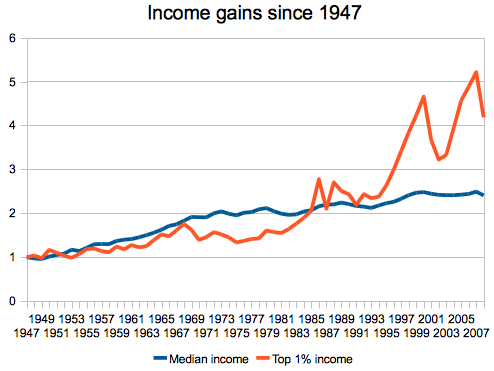
Mike Lofgren has a penetrating must-read in the best conservative magazine in America right now. It really is about how conservatism somehow ceded to materialism and how materialism then became highly unequal, and how the successful managed to leverage their advantage into a revolt against the masses. Money quote:

"Since the first ziggurats rose in ancient Babylonia, the so-called forces of order, stability, and tradition have feared a revolt from below. Beginning with Edmund Burke and Joseph de Maistre after the French Revolution, a whole genre of political writings—some classical liberal, some conservative, some reactionary—has propounded this theme. The title of Ortega y Gasset’s most famous work, The Revolt of the Masses, tells us something about the mental atmosphere of this literature.

But in globalized postmodern America, what if this whole vision about where order, stability, and a tolerable framework for governance come from, and who threatens those values, is inverted? What if Christopher Lasch came closer to the truth in The Revolt of the Elites, wherein he wrote, “In our time, the chief threat seems to come from those at the top of the social hierarchy, not the masses”?

Lasch held that the elites—by which he meant not just the super-wealthy but also their managerial coat holders and professional apologists—were undermining the country’s promise as a constitutional republic with their prehensile greed, their asocial cultural values, and their absence of civic responsibility. Lasch wrote that in 1995. Now, almost two decades later, the super-rich have achieved escape velocity from the gravitational pull of the very society they rule over. They have seceded from America."

And conservatives, it seems to me, should care about all of America, rather than seceding from it. Social and economic inequality are dangerous threats to social stability and democratic legitimacy. That is a conservative belief – and one utterly alien to the fanatics who now run one of our two major parties. If conservatism is to recover, this version of the GOP must be defeated. It's the only language they understand: the language of power.

(Graph via Ezra)