Romney’s Faith, Front And Center, Ctd

A reader writes:

What you won't hear is Mitt Romney's level of priesthood in the LDS church, which is "high priest." "Bishop" is a functional role, heading up a "ward" (like a diocese). Most males are ordained to a level of priesthood, however, which starts at deacon, proceeds to priest, then elder (most young missionaries are elders), and finally up to high priest. Not all active males make it to high priest.

Mitt is no longer a bishop, but he is still a high priest, and will be for the rest of this life and, Mormons believe, in the life to come. But "high priest" sounds a lot odder than "bishop," so those words will never come out of the Romney camp.

So far no readers have found a precedent for someone with that high a religious office running for president as the nominee of a major party. Let us know if you find one.

“We Won’t Build That”

Mark Thoma on the GOP's self-defeating, ideological hostility to government investment:

If there’s any policy Republicans ought to be able to support, it’s infrastructure spending. It’s inherently a supply-side policy, it helps to promote future economic growth, and it’s an investment with large, positive net benefits. But Republicans see a “we won’t build that” approach to infrastructure spending, an approach that is harmful to our prospects for recovery and to our prospects for future economic growth, as a way to reclaim the presidency.

How Low Can You Go For A Logo?

375185-greenpeace-bp-logo

Jack Lowe judges corporate logos and considers their value:

[T]he worth of a logo is a famously hard thing to determine. The very fact that a simple or low-key design often works far better than something intricate or brightly coloured means traditional methods for calculating how much to charge – using things like time and experience – are often thrown out the window. As such, some of the most famous logos of all time have been commissioned for next to nothing, while astronomical sums have been paid for designs most people wouldn't think about twice (not that that's necessarily a bad thing).

The logo for Twitter cost between $2 and $6 – a mind-boggling bargain courtesy of crowdsourcing. Compare that with the $211,000,000 price tag for BP's 2001 rebranding effort, designed to cast it in ecologically wholesome light.

(Image: One of the submissions for Greenpeace's contest to rebrand BP in the wake of the 2010 oil spill. Winning submission here.)

Why Have Conventions? Ctd

Jack Shafer sees their usefulness, especially for the press:

What's true of the conventions is true of the primaries: Yes, they're heavily scripted and predictable. Yes, the news-to-blather ratio is huge. Yes, there are too many reporters chasing too little "news." But that's like saying that during a gold rush there are too many prospectors chasing too little ore. With that many folks pursuing a rare good, the likelihood of a jackpot being won increases. Perhaps we should be worrying that 150,000 reporters haven't been assigned to the conventions to work the event as cultural anthropologists investigating the power of social ritual. There's something spiritual about the faithful assembling every four years to pick a would-be king who jousts with another would-be king for the crown. At least an anthropologist could determine with authority whether or not the surplus of ritual has diluted the event of its spiritual force. Maybe that's the reason that politicians like Mike Murphy pine for a convention decided, as if by magic, in a smoke-filled room by a political college of cardinals.

Jeff Jarvis thinks it's just a colossal waste of journalism's much-needed money, estimating media organizations will spend as much as $60 million covering the conventions. Previous commentary here.

More Punishment, More Crime?

Last week Norwegian mass murderer Anders Behring Breivik received the maximum sentence under Norwegian law – 21 years (the sentence can be extended indefinitely if Breivik is deemed a threat after serving his time). David Dow supports the punishment:

The cruelest irony of all is that America’s harsher attitude toward criminals does not translate into greater safety for the rest of us. It turns out that the two objectives of punishment can be at war with one another, and in America we are giving up greater security to indulge a vestigial instinct. Criminal penalties in Europe are substantially shorter than they are in America, yet Europe has fewer repeat offenders. In Germany, for example, prison sentences are a third as long as they are in America for equivalent crimes, yet the rate of recidivism is twenty-five percent lower than on this side of the Atlantic. More severity, it turns out, does not reduce crime, and might even increase it.

Along the same lines, Dylan Matthews argues that "harsh sentences, if anything, increase recidivism":

The economists Keith Chen and Jesse Shapiro exploited (pdf) the fact that the federal prison system assigns prisoners to different security levels based on a numeric score indicating  how much supervision that inmate needs. There are then cutoffs for assignment to each security level. Those scoring above a certain cutoff get medium security, those below it get low security, and so forth. Chen and Shapiro compared prisoners with scores just above and just below cutoffs to see how being assigned to a higher security level affected recidivism.

Their finding? Those at the border who end up placed in a higher security prison reoffend at a significantly higher rate than those at the border place in lower-security prisons.

Popping The Bubble Of The Korean Elite, Ctd

A reader writes:

Max Fisher's article on Psy is woefully inadequate. Granted, it was probably the best article on Psy to appear in the Western press, but it is still pretty ignorant about Korea and the Korean music scene. One, satire and social criticism is hardly new in Korea or its music industry. The rock scene of the 1970s wasn't scared about criticizing the government (well, they weren't until Park Chung Hee threw them all in jail and blacklisted them in 1976). Seo Taiji – the biggest thing in modern Korean music, from 1993 – really took a hiphop-tinged axe to modern Korean culture.

Two, Psy is hardly making subversive social criticism.

He's the goofy son of a rich family who has been making shallow, vaguely braggadocios/self-depreciating dance-pop for years. Three, Fisher should be aware that the doenjangnyeo stereotype he claims is being criticized (Psy's song only touches on this) is actually quite misogynist, and is more about young women being uppity and not knowing their place than it is about nouveau riche poseurs.

In short, Psy is very much of Gangnam, not a critic taking aim at the neighborhood or its cultural pretensions. It's basically the Korean Right Said Fred of 2012. If you want to hear some great Korean pop, you should check out Neon Bunny.

Seen above.

The Lyrical Racist

On the occasion of Philip Larkin's recently released The Complete Poems, Michael Wood considers Larkin's politics. The British poet relished playing the part of "a lonely, irreverent Tory in a world governed by solemn lefties" – and in some ways, he was that – but Wood also sees the nuances in Larkin's work:

Larkin’s dreary rear-guard nationalism … yielded what he called his “one political poem,” the lamentable “Homage to a Government.” He said in a letter that he felt 537px-Art_installation_Larkin_with_Toads_28“deeply humiliated at living in a country that spends more on education than on defence.” (Humiliated, it should be noted, not just in disagreement with a policy choice.) But even in these regions Larkin has his surprising moments. His satirical poem “Naturally the Foundation will Bear Your Expenses” pictures a jet-setting academic glad to be away from the “solemn-sinister/Wreath-rubbish” of English war-remembrance ceremonies, which Larkin honors as a patriot should. Except that on at least one occasion, he said he didn’t see why the figure in his poem “should be blamed for not sympathizing with the crowds on Armistice Day.”

This may have been a moment of perversity—teasing an interviewer—but it tips us back toward the complicated performances we have seen in “Poetry of Departures” and “As Bad as a Mile.” The poet has views, but the poem presents an occasion or a set of attitudes. There is no reason why the poet himself should not look at it, or them, from a different perspective now and then, and a good poem makes the multiplying of perspectives almost obligatory for the reader.

Recent Dish Larkin-love here, here, here and here. There was in his reactionary politics a constant gleam of irony, and the relish of offending the establishment. That shouldn't, however, distract from his rank racism. But it was a posture, not an argument.

(Photo: The Larkin Toad, painted to resemble the poet himself, in the Princes Quay shopping centre, Hull, East Riding of Yorkshire. Part of the Larkin with Toads series. By Paul Harrop.)

The Arctic Snowball Effect

7873358708_44c5f311cf_b

It's been a bad summer up north:

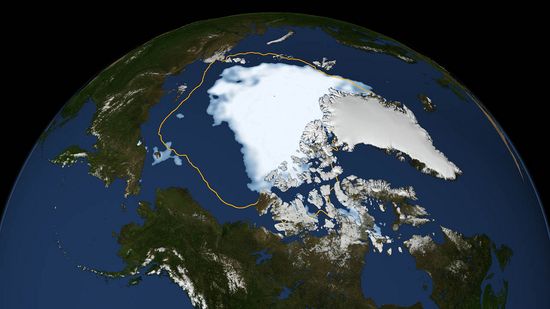
The Arctic sea ice extent [Sunday] fell below its previous record low and is currently losing frozen sea at the rate of ~29,000 square miles (~75,000 square kilometers) a day. That's equivalent to an area the size of South Carolina every 24 hours. … Note that this year's record low was set more than three weeks earlier than the 2007 record. And summer isn't over yet. There's more melting to come.

Michael Lemonick explains how all that ice isn't just ice; it's part of our defense against the sun – and its loss accelerates climate change:

Arctic ice, whether on land or on the sea, is a powerful reflector that bounces a lot of sunlight back into space rather than letting it warm the Earth. When that ice melts, it exposes the darker ground or water underneath, turning the region into an energy absorber rather than a reflector. Sea ice is especially vulnerable to melting, and over the past 30 years or so there’s been a downward trend in sea ice coverage in summer. The result is a feedback loop that accelerates global warming, with melting ice leading to more warming of the water below leading to more melting. The Arctic is warming at nearly twice the rate of the rest of the globe, largely due to those feedback loops. In addition, recent research shows that the loss of sea ice cover may be contributing to extreme weather events throughout the Northern Hemisphere, and may be partly responsible for major cold air outbreaks and paralyzing snowstorms in the northeastern U.S. and western Europe during the past few years.

(Image: Visualization showing the extent of Arctic sea ice on Aug. 26, 2012. By Scientific Visualization Studio, NASA Goddard Space Flight Center)