Romney’s Faith, Front And Center?

Nate Cohn is intrigued by “the Romney campaign’s decision to highlight in Tampa the candidate’s role as a Bishop in the Mormon Church”:

Are there risks in emphasizing Romney’s religion? I suppose, but they’re not nearly as serious as Romney’s favorability issues. A Pew Research survey found that a majority of Americans already know that Romney is Mormon and are comfortable with it. Although a minority of voters aren’t comfortable with Romney’s religion, there’s not much evidence that it has reduced Romney’s support: among Republicans and Republican leaners who are uncomfortable with Romney’s religion, Romney still leads Obama 93-4—which is actually slightly better than his 92-5 lead among Republicans and Republican leaners who are comfortable with Romney’s religion. Whatever reservations evangelical voters have about Romney have clearly been outweighed by their opposition to Obama. Realistically, voters are going to find out about Romney’s religion anyway, so they may as well own it and portray it well to ameliorate the reservations of any voters with discomfort.

What I think is different and notable about this is that it reveals that Romney isn’t just a Mormon but a former high ranking church official – roughly at the level of an archbishop in his relations to a archdiocese (though, of course, not as an ordained person but as a lay leader of his church). I wonder if there has ever been a major party nominee for president who was once a bishop, a cardinal, or a church official with the kind of authoritah that Romney wielded? Dishness, have at it.


Porn’s Prickly Question


A severe syphilis outbreak in Europe has spread to LA and seems oddly well-timed for proponents of Measure B, a ballot measure that would require porn performers to wear condoms. Scott Shackford rails against what he sees as “nanny-statism”:

[A]s for the transmission of disease, kindly Google “hepatitis outbreak” and take note of all those restaurants that are still in business. What we “don’t settle for” in the food industry and all those regulations and inspections doesn’t actually stop outbreaks from happening. We clearly do “settle for” a certain amount of risk of food-borne disease.

Other opponents argue that the measure would drive the industry underground, giving rise to riskier practices. Meanwhile, porn lawyer Michael Fattorosi offers advice to out-of-work performers on the tricky business of making scenes without sexual contact. And by the way, they tracked down the source of the syphilis outbreak, a veteran performer named Mr. Marcus. Money quote:

I tried to cover it up…because I said it was like the scarlet letter. It’s the word. Syphilis, whoa.

Payroll Taxes Are Real Taxes

Mike Lofgren, a veteran Republican Hill staffer, explores the "secession" of the financial elite. Some startling stats:

[M]illions of Americans who do not pay federal income taxes do pay federal payroll taxes. These taxes are regressive, and the dirty little secret is that over the last several decades they have made up a greater and greater share of federal revenues. In 1950, payroll and other federal retirement contributions constituted 10.9 percent of all federal revenues. By 2007, the last "normal" economic year before federal revenues began falling, they made up 33.9 percent. By contrast, corporate income taxes were 26.4 percent of federal revenues in 1950. By 2007 they had fallen to 14.4 percent. So who has skin in the game?

How Not To Touch Up A Masterpiece, Ctd

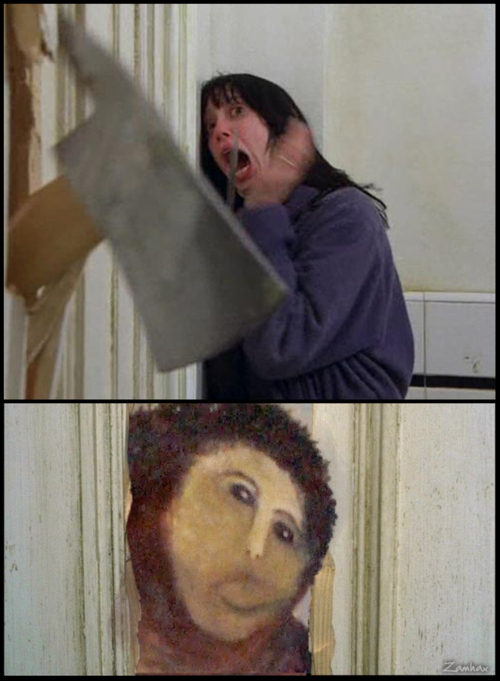
Ecce homo

Jillian Steinhauer reports on the response to octagenarian Cecilia Giminez's edit of the Ecce Homo in Borja, Spain. The fresco is attracting tons of new tourists, but the news isn't all upbeat:

[E]ven though she’s getting tons of love from both the internet and visiting tourists, 81-year-old Gimenez is in bed after having an anxiety attack about the whole affair. It doesn’t help that the city council is apparently contemplating legal action against her. Now that she’s bringing in tourists, will they relent?

The Internet won't. One of the rapidly accruing remixes:

Enhanced-buzz-18088-1346095892-22

Previous Dish coverage here.

(Photo by Peregrinos)

When Central Is Essential

Monica Potts outlines five things that governments do better than the disaggregated masses. She thinks risk-management is one of them:

Health insurance works best, and is cheapest, when we spread risk out over as many people as possible, which is why every wealthy country but ours has decided to spread risk out over its entire populace…. [And k]eeping the federal government in charge of disaster relief spreads risk out over the entire country, and ensures that victims in poor states—basically every state in Tornado Alley—get as much help as residents of wealthier states would.

Meanwhile, economist Glen Weyl views changes in technology as leveling the playing field between central governments and free markets:

In his famous 1945 article, "The Use of Knowledge in Society," F. A. Hayek argued that despite their inequity and inefficiency, free markets were necessary in order to allow the incorporation of information held by dispersed individuals into social decisions.  No central planner could hope to collect and process all the information necessary for social decisions; only markets allowed and provided the incentives for disaggregated information processing.  Yet, increasingly, information technology is leading individuals to delegate their most "private" decisions to automated processing systems. … While these information systems are [currently] mostly nongovernmental, they are sufficiently centralized that it is increasingly hard to see how dispersed information poses the challenge it once did to centralized planning.

Rated AARP

Boomers are dominating the box office:

There are 78 million baby boomers, defined as those born between 1946 and 1964. In 2010 — thanks in great part to advances in medicine — 40.3 million were over age 65, making them the fastest-growing segment of the population, according to the U.S. Census. That compares with 30.7 million people between 18 and 24. It's also the segment that most likes to go to the cinema. The MPAA reports that movie attendance across all age groups dipped in 2011 — save for those 60 and older.

And the studios are taking notice:

Midday on Saturday, Aug. 18, the top-grossing theater in the U.S. for The Expendables 2 — a who's who of 1980s action stars now in their 60s, led by 66-year-old Sylvester Stallone — was the Cinemark Palace 20 in Boca Raton, Fla., ground zero for affluent retirees. About 245 miles away, Hope Springs, starring Meryl Streep, 63, and Tommy Lee Jones, 65, was the No. 1 film at the Rialto 8 in The Villages, a sprawling retirement community northwest of Orlando that is the country's fastest-growing small town (presumptive GOP vice presidential candidate Paul Ryan stumped there the same day with his 78-year-old mother, Betty Douglas).

Where Do The Cartels Keep Their Cash?

A lot of it passes through big banks:

Some officials warn that mafias such as the Sinaloa operation have capitalised on the global financial crisis in ways we have yet fully to understand. "The illiquidity associated with the banking crisis, the reluctance of banks to lend money to one another . . . offered a golden opportunity to criminal institutions," Antonio Maria Costa, the former executive director of the United Nations Office on Drugs and Crime, said in April. "The penetration of the financial sector by criminal money has been so widespread that it would probably be more correct to say that it was not the mafia trying to penetrate the banking system, but it was the banking sector which was actively looking for capital – including criminal money . . ."