Swaziland’s Voodoo Economics

GT_SWAZI_120831

In Swaziland "70 percent of the country lives on less than two dollars a day, and yet the royals are wealthy enough to skew World Bank statistics, making it seem a lot less bad." Nelli Bowles locates the source of Swaziland King Mswati III's lock on power:

"The rest of the world keeps saying we should have democracy, and we agree," Vusie Majola, who runs a nonprofit, said. "But what they don't understand is that the king, he can point a stick at you and you die. We are dealing with someone whose power the world can't understand."

Despite its commitment to reform, even the burgeoning pro-democracy organizers fear Mswati's sorcery, writes Bowles:

"You know what happens," added a young man in a New York Yankees T-shirt. "The king had his inyangas sprinkle a circle of powder around the palace. You cross that line and you die." Come now, I said, you're all smart and youthful and fighting for democracy. You can't believe King Mswati is really a god. The young man in the Yankees shirt shook his head. "This is why the revolution in Swaziland will be so hard," he said. "Maybe impossible."

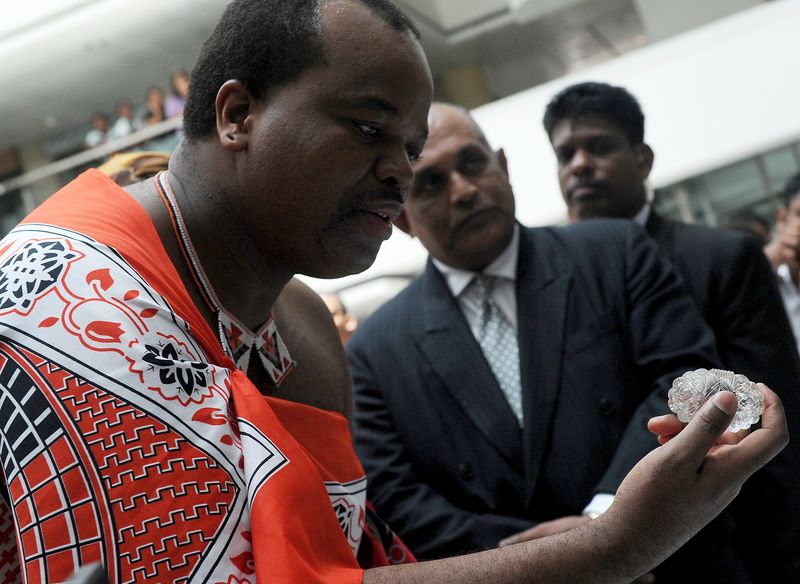
(Photo: King of Swaziland Mswati III (L) visits the Gem and Jewellery Exchange in the capital Colombo on August 15, 2012. The Swazi king is on a three-day visit to the island. By Ishara S. Kodikara/AFP/Getty Images)

The Jolly Rancher Fix

Alyssa Figeroa explores several strange phenomena cropping up as a result of climate change. Perhaps the weirdest:

With corn nearly $9 a bushel due to the drought, Nick Smith, the co-owner of United Livestock Commodities in Kentucky, said his farm had to come up with a cheaper way to feed his cattle. The remedy? A concoction of candy rejected for human consumption, an ethanol byproduct and a mineral nutrient. Joseph Watson, also a co-owner of the farm, said, "Just to be able to survive, we have to look for other sources of nutrition." Watson claims the cows seem to be doing okay.

What The Netanyahu Government Will Demolish In The West Bank

The homes and amenities of Palestinians who have lived there since before the illegal occupation:

Israel yesterday destroyed five cisterns and several tents, sheepfolds and storage sites in four Palestinian communities in the West Bank. During the process, the contents of several feed sacks were spilled and damaged.

Altogether, according to UN data, Israel razed some 400 Palestinian structures in the West Bank's Area C between the start of the year and mid-August, including 120 houses; more than 600 Palestinians were hurt by these demolitions. Area C is the part of the West Bank that the Oslo Accords assigned to full Israeli control.

The Israeli government says the homes and cisterns and wells and crops are illegal. Unlike all the Jewish settlements they are building around them. Seriously, if this were in the Balkans, would there be the same indifference?

A Guide To Convention Bounces

Convention_Bumps

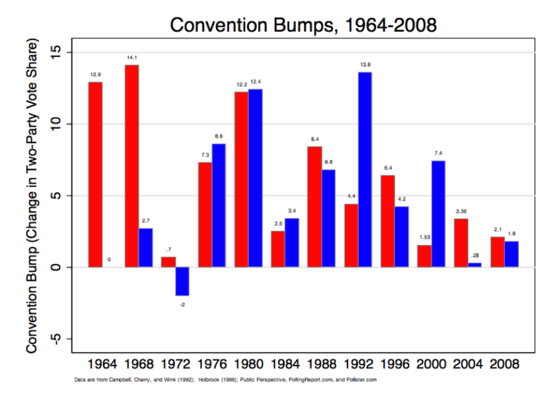
Nate Cohn provides one:

As a general rule, the incumbent’s share of the vote is more predictive than the challenger’s peak, so if Romney doesn’t near 49 percent after his convention, that wouldn’t preclude him from such a showing in November.

Many voters with deep reservations about the president’s performance could justifiably hold out for more information about Romney before choosing to support him. On the other hand, if Obama can’t inch close to 49 percent, that could be a sign that a majority of voters have very deep reservations about giving him a second term. Again, it wouldn’t outright prevent him from winning, but it would contradict the view that the voters who like him but are disappointed with Obama’s performance are itching to join his cause in November. However, if one candidate gains a decidedly higher share of the vote at the peak of their bounce, that would be a very good sign for that candidate, even if they fall short of 49 percent. The candidate with the highest peak has won 10 of 12 presidential elections since 1964, including every election involving an incumbent president.

(Chart from Seth Masket)

Don’t Fear China’s Rise

Minxin Pei is much more worried about China's rapid decline.

The United States should reassess the basic premises of its China policy and seriously consider an alternative strategy, one based on the assumption of declining Chinese strength and rising probability of an unexpected democratic transition in the coming two decades. Should such a change come, the geopolitical landscape of Asia would transform beyond recognition. The North Korean regime would collapse almost overnight, and the Korean Peninsula would be reunified. A regional wave of democratic transitions would topple the communist regimes in Vietnam and Laos. The biggest and most important unknown, however, is about China itself: Can a weak or weakening country of 1.3 billion manage a peaceful transition to democracy?

Daniel Larison pushes back:

We already know that the U.S. response to the end of the USSR and the subsequent decline of Russian power was to move into eastern Europe, expand NATO, and take advantage of Russian weakness. As it did in Russia during the 1990s, that sort of response would go down very poorly in a nominally democratic and probably even more nationalist China. If China were declining in strength, the smartest thing the U.S. could would be to avoid taking actions that the Chinese would perceive as humiliating and aggressive. The U.S. would want to reassure the new Chinese government that ours would not try to use their domestic transition to their disadvantage.

Will The Fed Act?

Felix Salmon analyzes Bernanke’s speech today:

The overall tone here … is defensive: Bernanke’s on the back foot, trying to justify past and future actions against critics on all sides. And when an institution is in a defensive crouch, it’s not going to do anything bold. The Fed was bold in 2008-9, at the height of the financial crisis; those days are over now. And so, whether we like it or not, any real boost for the economy going forwards is not going to come from the Fed, and is going to end up having to come from Congress instead. I’m not holding my breath.

Bill McBride differs:

Bernanke's comments suggest QE3 will be launched very soon, perhaps on September 13th following the next FOMC meeting. I thought the odds of QE3 in August were high – and the minutes of the meeting indicated they were very very close. It is possible that the FOMC in September will announce an extension of the extended period until 2015 (from late 2014), and wait again for QE3, but that would seem at odds with Bernanke's comments today.

Is There A Limit To IQ?

Since the beginning of the 20th century, IQ scores have been on the rise, up a full three points per decade, a phenomenon known as the Flynn effect. Tim Folger looks to the future:

The Flynn effect means that children will, on average, score about 10 points higher on IQ tests than their parents did. By the end of this century our descendants will have nearly a 30-point advantage over us—the difference between average intelligence and the top 2 percent of the population—if the Flynn effect continues. But can it continue? Will the trend go on indefinitely, leading to a future filled with people who would be considered geniuses by today's standards?

Bryan Appleyard examines Flynn's explanation:

Human ­potential at birth is unchanged; we are not, in any fundamental sense, becoming a smarter species. But the way we live has changed. IQ tests were first ­established in the 19th century at a time when daily life was concrete and ­practical. The tests, however, had to be abstract to make them culturally ­neutral. People, therefore, found them harder because they were unaccustomed to such modes of thought. In the 20th century, greater ­educational possibilities combined with technological advances introduced abstract thought into daily life. It takes, for example, a high degree of abstract thinking to operate a mobile phone or computer. People became better at IQ tests and, steadily, the scores rose.

Appleyard also believes Flynn has debunked the great IQ race debate:

Flynn’s interpretation overturns one of the most ­dangerous myths of IQ research — that blacks have been shown to be fundamentally less intelligent than whites. With what seems to me to be a series of cast-iron statistical analyses, he shows that this has, in fact, never been proved and that the logic on which it is based — “this steel chain of ideas” — is flawed. What the evidence actually shows is that racial differences, once all external factors are removed (primarily the social and cultural context of the testees), seem to be almost undetectably small.

Given my history with this subject and a wealth of new research, I am going to revisit this again soon, when I get some campaign relief. This is and always has been an empirical question, which means it is open until the evidence accumulates in one direction. New work is shedding new light on race and IQ, and I won't duck it. Promise.

Anti-Obama Ads On The Dish


Anti-obama-ad Anti-obama-ad-2


A reader writes:

Perhaps you’re not aware that there is an ad by a Romney PAC running right now on the Dish that repeats his “Obama guts welfare” lie.  I appreciate you calling Romney out, but I suppose we are all now at the mercy of ad-placement bots that care only that you cover politics and have a lot of page-views.

Another notices different ads and sends the above screenshots:

It’s not necessarily that you should be offended over anti-Obama ads – you yourself feature criticism of the president and his policies all the time – but featuring them on the Dish just doesn’t make any sense from a business prospective, since nearly all your readers are pro-Obama (I remember your Urtak poll showed that 90% of readers voted for him last time around).

Ads are the only way to pay for the Dish if we do not ask you directly for money – and you see them roughly when I do. We can’t patrol them for political correctness, especially given the tough economics of the web right now. But thanks for the input. We’ll pass it along.