How Not To Touch Up A Masterpiece

Spanish-painting-jesus-badly-restored-thg-120822-wmain-jpg_190910

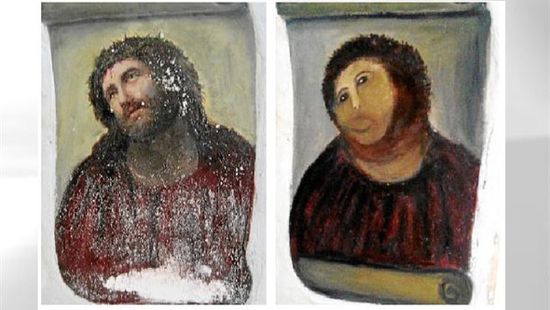
Katie Kindelan reports on an elderly woman's attempt to restore a 19th century fresco by Elias Garcia Martinez:

Her handiwork, or lack thereof, was discovered after the painter's granddaughter donated the work, "Ecce Homo," to the archive of religious paintings housed at the Centro de Estudios Borjano, also in Borja. When officials from the center went to examine the work at the church a few weeks ago, they found it was not as Martinez had left it, the U.K.'s Telegraph reported.

Apparently, she came clean:

Juan Maria Ojeda, the city councilor in charge of cultural affairs, told the Spanish newspaper El Pais that the woman turned herself in and admitted causing the damage when she realized it had "gotten out of hand."

(Image: Centro de Estudios Borjanos)

TV News Needs To Raise Its IQ

Continuing debate on how to reform cable news, Frum gives some free advice to news shows:

Cable news is inescapably a niche market. There are 311 million people in the United States. Even at peak hours, 306 million of them are not watching cable news. At nonpeak hours, 309 million of them are not watching cable news. The 2 million- to 5 million-person cable news audience is made up of unusually smart and curious people, and they should be served appropriate content. The people who can be reached by "dumbing down" TV have already been successfully reached by the Kardashian family.

Iraq Is Still At War

Iraq_Bombing

Joel Wing compares Iraq to Afghanistan:

Events in Afghanistan receive far more press coverage than Iraq these days. That’s largely because there are American and European forces in the former, while none in the latter. The fighting in Afghanistan also seems more intractable and open ended than in Iraq. What the statistics reveal is a far more determined and adaptable group of insurgents in Iraq than in Afghanistan.

Despite the increase in operations, the bases in neighboring Pakistan, and the support of parts of the government there, the Afghan insurgents have proven to be less deadly over the last five years. The exact opposite has been happening in Iraq. There, the militants have become more and more efficient. They have adapted to the loss of much of their popular support and the end of the sectarian war, and honed their skills. That all shows their resiliency when many believed they would be in decline by now. It also highlights the deadlock in security that Iraq is currently facing where the insurgents cannot challenge the government, but it cannot eliminate the militants.

(Photo: An Iraqi man shifts through the rubble of a destroyed house following a series of bomb attacks in the town of Taji, north of Baghdad which killed at least 42 people and wounded 40, on July 23, 2012. A wave of attacks in Baghdad and north of the capital killed 91 people in Iraq's deadliest day in more than two years after Al-Qaeda warned it would mount new attacks and sought to retake territory. By Ahmad Al-Rubaye/AFP/Getty Images)

Under Pressure

Looking at the research of Robert Sapolsky, Mike Springer lays out how "the human species has managed … to turn one of its most basic survival mechanisms … against itself":

"If you’re a normal mammal," Sapolsky says, "what stress is about is three minutes of screaming terror on the savannah, after which either it’s over with or you’re over with." During those three minutes of terror the body responds to imminent danger by deploying stress hormones that stimulate the heart rate and blood pressure while inhibiting other functions, like digestion, growth and reproduction. The problem is, human beings tend to secrete these hormones constantly in response to the pressures of everyday life.

Springer points out that stress affects certain groups more:

By studying baboon populations in East Africa, Sapolsky has found that individuals lower down in the social hierarchy suffer more stress, and consequently more stress-related health problems, than dominant individuals. The same trend in human populations was discovered in the British Whitehall Study. People with more control in work environments have lower stress, and better health, than subordinates.

Previous Dish coverage here and here.

The Daily Wrap

Amazon heatmap
Today on the Dish, Andrew interpreted how Huckabee's Akin support affects Romney and, as Willke recalled his close relationship with Romney, weighed whether the candidate should be held accountable for Ryan/Akin abortion views. Meanwhile, readers disputed the consensuality of statuatory rape, and as Brian Fischer named Akin a victim of "forcible assault," a reader recalled the long, excruciating path to recovery after her rape.

Andrew marveled at Dolan's de facto endorsement of Romney-Ryan, called Rick Warren a hack and lamented the "cold civil war" we've descended into. After praising Clinton's new ad for Obama, Andrew worried about the fiscal crisis. And as Fareed Zakaria and Michael Pettis fisked Ferguson for China fear-mongering, Patrick Chovanec flagged the imminent threat of a Chinese slowdown.

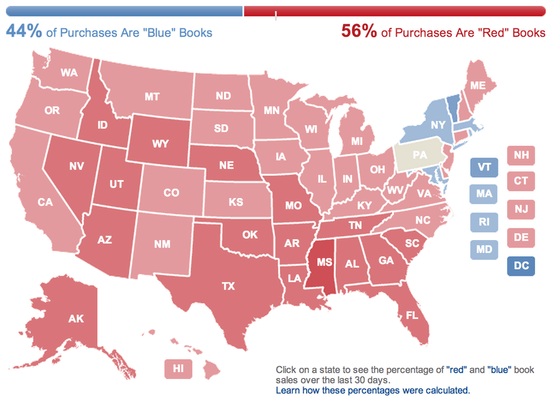
In other election news, Bernstein rehabilitated the Conventions, Dems adored Obama and Gakwer's Romney dump yielded little new info. The RNC continued to lie on welfare, readers commended Obama's charity and Sabato reminded us that post-Convention numbers go haywire. A chart of the day showed the implosion of the middle class, and more Amazon cusomters read "red" books. The Las Vegas Sun checked fairness instead of facts and new election apps debuted.

Meanwhile, on the healthcare front, David Cutler disputed Ryan's voucher system argument while Josh Barro hailed Medicare cuts as good policy.

In assorted commentary, 648 journalists have been killed since 1992, plutonium powered Curiosity and Kevin Drum heralded American education's non-decline. A DoD pocket guide framed America's occupation, inaccurately, David Ansen hailed Paul Thomas Anderson's direction and Sacks recalled tripping. Jesse Bering discussed his biggest controversy, reusable grocery bags bore e coli and readers praised Pink Ladies.

And while Chinese filial piety looked an awful lot like porking, a reader hair-grafted Windsor lineage onto an anti-Obama protester. D'oh explained here, MHB here, and VFYW here.

G.G.

Huckabee’s Dissent

I was wondering when someone from the evangelical pro-life base would come to Akin's defense against the Mormon and Catholic ticket trying to force him out of the race. Huckabee is as big a deal as it comes. Notice the language of evangelical pro-life insecurity in the GOP:

If Todd Akin loses the Senate seat, I will not blame Todd Akin. He made his mistake, but was man enough to admit it and apologize. I'm waiting for the apology from whoever the genius was on the high pedestals of our party who thought it wise to not only shoot our wounded, but run over him with tanks and trucks and then feed his body to the liberal wolves. It wasn't just Todd Akin that was treated with contempt by the thinly veiled attack on Todd Akin. It was all the people who have faithfully knocked doors, made calls, and made sacrificial contributions to elect Republicans because we thought we were welcome in the party. Todd Akin owned his mistake. Who will step up and admit the effort being made to discredit Akin and apologize for the sleazy way it's been handled?

Huckabee knows the base and they trust him. I think they trust Romney a little less now, and cooler heads in the GOP should probably try to move on, rather than keep hounding a man who just inelegantly expressed what the party platform supports.

Sharing A Patient’s State Of Mind

Oliver Sacks used drugs to do so:

Sacks recently wrote about his hallucinogenic experiments in a paywalled New Yorker article. Colin Marshall reflects on it:

His desire to conduct these self-experiments flared up in his thirties, when, among other sudden jolts of curiosity, he felt a suspicion that he had never really seen the color indigo. "One sunny Saturday in 1964, I developed a pharmacologic launchpad consisting of a base of amphetamine (for general arousal), LSD (for hallucinogenic intensity), and a touch of cannabis (for a little added delirium). About twenty minutes after taking this, I faced a white wall and exclaimed, ‘I want to see indigo now — now!'"

Why The Conventions Matter

Bernstein wants the networks to reconsider their decision:

[T]here’s no way that you can gather that many activists, political professionals and politicians in one place and not have a whole lot of fascinating stories to tell, many of which will help the American people understand what each of our major political parties are about in 2012. Isn’t that news? There’s also the platform, the ticket, the other candidates the parties want people to know about (and all those candidates they don’t want people to know about), the donors, the party-aligned groups and what they want … aren’t all of those things news?

Ad War Update: The GOP Won’t Gut Its Welfare Attacks

In addition to the Obama ad we featured earlier, Bill Clinton is also appearing in this new RNC web video repeating the (false) welfare rhetoric:

Nate Cohn analyzes the GOP's strategy regarding these continued welfare attacks:

The welfare advertisements represent a marked shift in Romney's strategy. Rather than reinforcing existing perceptions of Obama, the Romney campaign is trying to introduce new information about the president to critical white working class voters. Realistically, Romney's chances hinge more on building up his own image than bolstering Obama's negatives, but if the Romney campaign just doesn't possess any tools to restore their candidate's image, then an attack targeted at swing voters and drawing on powerful underlying sentiments is probably their next best option. Whether Romney's welfare angle works without sustained media attention remains to be seen.

Regarding yesterday's Obama ad hitting Romney/Ryan on education, it's been called misleading by CNN and others, but Yglesias does a better job explaining:

The [ad] levels two accurate accusations against Mitt Romney. One is that Romney has said class size reduction policies aren't a good way of improving school outcomes, and the second is that the House GOP budget that Romney supports implies huge cuts in federal education spending: On the latter point, I have no real complaint. Romney's put out a K-12 education plan that contains some interesting ideas and some problematic ones but the big story really is that his budget won't leave much money for anything. But on class size while Obama's claim is perfectly true, it's a strange allegation to level in light of the fact that Education Secretary Arne Duncan believes the same thing.

In outside spending news, pro-Obama Super PAC Priorities USA's Romney-cancer ad may have blown up in their face: the ad the Romney campaign released in response to P-USA's attacks was apparently a hit with swing-voters:

[A new study by Vanderbilt University] found that Romney's "America Deserves Better" commercial was resonating with swing voters, moving "pure independents" who remained undecided some 6 percentage points in the Republican's favor. The researchers said this was the first ad of the campaign cycle they had studied that resonated with true swing voters.

Meanwhile Karl Rove's Super "non-profit issues" PAC, Crossroads GPS, is sinking $4.2 million into four states including their first forray into Florida. (They are focusing on the "issue" of there potentially being too many Democrats in the Senate.) Here's their TV ad targeting Senator Bill Nelson (D-FL):

And lastly, in pre-convention news, the DNC launched a pre-emptive pop-up video against former Democrat and RNC keynoter Artur Davis:

Ad War archive here.

Democrats Heart Obama

In a new e-book, John Sides and Lynn Vavreck partially explain the president's resiliency by looking at his base:

Although commentators have often been quick to compare Obama to Carter, one key difference between them is how much more Democrats supported Obama than they did Carter. When Carter’s approval was at its nadir in the fall of 1979, barely one-third of Democrats approved of the job he was doing (compared to about 20% of Republicans), according to Gallup polls. Even Bill Clinton, now seemingly beloved by Democrats, was less popular among Democrats—63% of whom approved of him in June 1993—than was Obama in his first term. In fact, averaging over each Democratic president’s first three years in office, Obama was more popular with Democratic voters than every one of them except John F. Kennedy—and even Kennedy’s average approval among Democrats was only 4 points higher than Obama’s. Obama was actually as popular among Democrats during these years as was Reagan among Republicans in 1981–83.