Faces Of The Day

Mating_pigs01

Horace Lu marvels at a recently, um, erected sculpture in the landmark square of Zhengzhou, a city in central China:

Some locals have taken to nicknaming the sculpture "hooligan pigs" while others have wondered aloud if such a "vulgar" statue should be placed so prominently on a public square. …  [But the] urban management authority, when contacted by journalists, said the sculpture is part of a series of 21 cartoon stone sculptures designed to inculcate values — such as perseverance, diligence and love — in young children. This sculpture, the spokesman reveals, depicts a young pig giving his mother a back massage, and was meant to show the importance of filial piety.

So it's incest! Between Pinky and Perky?

Barack Obama And Private Charity

A reader writes:

So, let me get this straight: President Obama's income in 2005 is eight times as much as it was in 2004, but his charitable givings are 30 times as much? And this is criticism?

Another:

Re: Paul Ryan and Private Charity, it's also worth putting into context Obama's past charitable contributions with his overall wealth.

Obama fondly recounts that his credit card was declined in 2004 when he was renting a car in Boston just before giving the keynote speech at the Democratic National Convention.  It's well known that he was still paying back student loans until the time his book sales took off, coinciding with his successful run for the U.S. senate.

I don't discount that the Obamas' very generous donations to charity are in part rooted to the fact the numbers are made public.  That said, I'm not sure that they could have afforded to donate any more before 2004 considering they, like many Americans, were balancing a mortgage, two kids and remaining school debt – thus, a clear example of why the private charity argument is hollow at its core.

Update from a reader:

This is actually inaccurate. Obama's credit card was declined when he tried to rent a car for the 2000 convention.

Another:

Aren’t you only able to "put [those charitable contributions] on record" because President Obama has released his tax returns covering those years?  Where are Mitt Romney’s returns for those years, which would allow an apples-to-apples comparison of the top of each ticket?  Over and over we see how Romney’s unwillingness to be forthcoming with information for voters allows him to avoid public examination of his record, even on relatively minor or tangential points.

We can also put on the record that Obama did not take advantage of the 2009 tax amnesty for funds held in Swiss bank accounts.  Can the same be said of Romney?  No, we can’t say that, because the Romneys doesn’t believe voters deserve or are smart enough to be trusted with transparency, or because they're simply arrogant enough to think "you people" only deserve whatever information they deign to offer.

Another:

Obama may not have a long pre-national political scene charitable history, but Gov. John Hickenlooper of Colorado is a nice example of someone who does. He released 23 years of tax returns (take that, Mitt!) during the 2010 race, saying:

When I made a decision to go into public service, I accepted there would be a certain level of transparency. That's ethical and responsible. I want people to believe in government and believe in elected officials and a lot of it comes down to trust. As long as you're hiding stuff, it's hard to get that trust.

He made about $16 million during that time, of which he donated $2.8 million (roughly 17%). But even before he was wealthy or even remotely involved in politics, he always donated. From the Colorado Independent:

His charitable giving began before he got rich. In 1986, he gave away $9,200 on an income of $62,000. In 1987, he gave $2,900 out of an income of $15,000. In 2008, he gave away almost $120,000 out of a joint income of just under $500,000. The most he has given in one year was $626,235 on an income of just over $1.3 million in 2004.

648

648

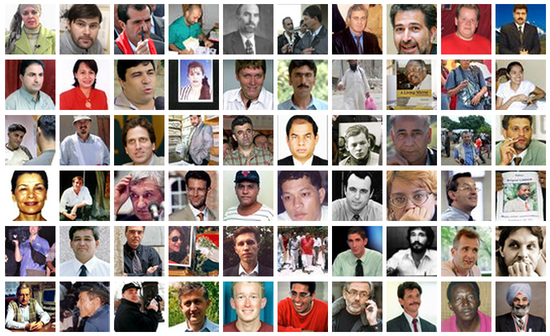
That's how many journalists have been killed in the line of duty around the world since 1992, according to the Committee To Protect Journalists, which maintains several interactive sections on its website to help visualize the dangers journalists face. They track not only those who have been killed but also those who are missing or have been imprisoned or exiled. The latest to be killed was Japanese video journalist Mika Yamamoto on Monday. She was travelling through Aleppo with a unit of the Free Syrian Army when she was reportedly fired upon by regime forces. This is the last footage she filmed.

(Hat tip: Nick Turse)

Fairness Checking

The Line of Attack feature at the Las Vegas Sun seeks to keep politicians honest. Jay Jones explains how it differs from similar projects:

[T]he Sun’s feature doesn’t use the standard lingo of the factchecking industry, which generally tries to sort out true and false claims, and labels the most outrageous assertions as lies, if only idiomatically. (The Post’s Glenn Kessler awards "Pinocchios"; PolitiFact’s lowest rating is "Pants on Fire.") Instead, the Sun’s approach evaluates an attack’s fairness: each item concludes with a "fairness meter," and the headline of many installments asks "Is it fair…?" In keeping with that approach, Damon and her team of political writers assign each attack they evaluate a rating on the following scale: Legit, Eye Roll, Guffaw, Laughable, and Outrageous.

As a result, the paper’s approach may sidestep an issue that many critics, including some at CJR, have raised about the factcheckers—the difficulty they face in pushing back at political rhetoric that’s irresponsible or unfounded, but not demonstrably false.

The App War, Ctd

App_war

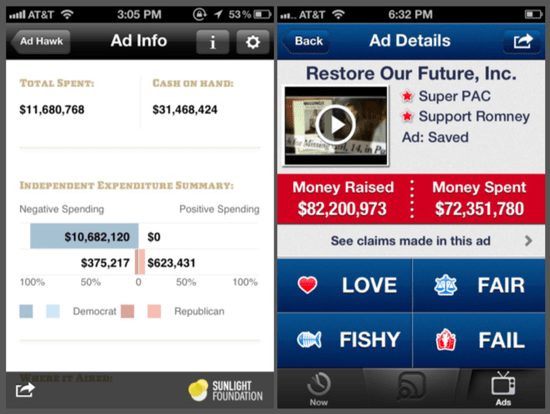
While Obama and Romney campaigns face criticism over their apps being too invasive of users' privacy, two new apps are now available from non-political groups to help voters decipher who is behind all the political ads out there, especially when it comes to outside spenders. Ad Hawk, from the Sunlight Foundation, and Super PAC App, from Glassy Media, both use a Shazam-like technology to identify the ads and then provide info about them and their backers. Here's how Ad Hawk works:

When you press the "Identify this ad" button, Ad Hawk starts listening to the audio coming into your mobile phone. The app creates a short digital fingerprint to compare against the database of hundreds of political ads we collect. If the audio fingerprint finds a match, we send you the information collected in our database about the sponsor of the ad and other details such as money received or spent, where the ad is on the air, media reports on the political group or ad and places to find more information Sunlight identifies new ads by monitoring media reports and the YouTube channels of political groups and campaigns. We research and pair these new ads with Federal Communications Commission data on ad spending, Federal Election Commission data on political contributions, press releases about ad buys and relevant news articles.

By the way, about that Romney app that promised to give its users VIP access to the veep announcement:

Although the app failed to scoop the press on the news about Rep. Paul Ryan, it did generate 100,000 "likes" on the Romney campaign's Facebook page, [Romney campaign Digital Director Zac] Moffatt says, while gathering e-mail addresses and other data on potential supporters. The campaign has been mum on how it is going to retool its Mitt's VP app for the general-election drive, but Moffatt says he has a plan. "I wouldn't be much of a digital director otherwise," he says. … In the 2012 cycle, Moffatt says, digital has seen a transformation from a "base list-building and fundraising effort" to "becoming a persuasion and mobilization tool." In 2008, digital strategy was not a major piece of Romney's primary-election bid. Now, Moffatt says, the numbers make it impossible to ignore.

Gawker’s Big Dump

Their "EXCLUSIVE" Bain documents can be read here. Fortune's Dan Primack calls them "worthless":

I saw many of the exact same documents months ago, after requesting them from a Bain Capital investor. What I quickly learned was that there was little of interest, except perhaps for private equity geeks who want to know exactly how much Bain paid for a particular company back in 2006. Sure I would have loved the pageviews, but not at the expense of tricking readers into clicking on something of so little value.

Joe Weisenthal likewise believes that the document dump reveals no real surprises. But Alex Seitz-Wald homes in on one discovery:

[O]ne immediate revelation is that Sankaty fund, based in Delaware for tax purposes, lent over $3 million to Las Vegas Sands, the casino company owned by Adelson. The fund made two loans of $2.4 million and $600,000 in 2009 to the Sands. Romney’s IRA held between $250,000 and $500,000 in the partnership, and made $50,000 and $100,000 from it in 2011. Adelson has become the largest donor to the Republican Party and conservative outside groups, dropping at least $70 million.

Gawker's John Cook also unearths some new details on Romney's IRA, which we have covered here and here. In a post earlier this month, tax expert Lee A. Sheppard broke down in fine detail the tax implications and legality of Romney's finances (those that have been made public at least).

Mental Health Break

Stop-motion on steroids:

Jobson has details:

This new music video from Marc Donahue and Sean Michael Williams starring Beau Brigham was shot over a six month period in two states and is the second part of a two part series that explores some interesting ideas in animation and what they describe as "lyric lapsing". According to the producers the final edit is comprised of some 15,000 stills and involved 6-8 hours of work to produce just 3-4 seconds of footage. I urge you to stick with it for at least a minute as there are some increasingly amazing sequences after that. (via booooooom)

Our Children Is Learning

After reviewing test scores from past generations, Kevin Drum says that the "one thing you cannot say, unless you torture the numbers beyond recognition, is that kids today are more poorly educated than kids of the past two generations." In short:

We have plenty of failing schools, and we should be doing a lot more to figure out how to fix them. It's a disgrace for a rich country like the United States to be failing so many of its kids. At the same time, taken as a whole, the American educational system isn't in decline. That's something you don't hear very often because there are a lot of interest groups who are invested in a narrative of educational failure. But the data just doesn't back them up.

Yglesias chimes in:

An interesting thing about the politics of this is that polls continually show that Americans rate the schools in their own communities quite highly, even while having a dark view of the school system as a whole. I take this as a sign that on some level people actually know the good news about American education. There are still lots of kids—especially poor kids whose parents have weak education backgrounds or kids experiencing a lot of disruption in their home life—who aren't doing as well enough, but the trends are pretty clearly on the upswing.

Raped And Pregnant II

Renee Devesty describes her rape and the aftermath:

I was mentally, emotionally and spiritually broken, and the thought of what had resulted from this vile act took my self-hatred into another dimension. I wanted no memory of that night, would do anything possible to erase it in the hope that it would somehow ease the sick, disgusting feeling I got every time I looked in the mirror. I realized that in order to maintain what little sanity I had left, I had to terminate the pregnancy.

Six months after the rape, I dropped out of college and developed an eating disorder. I collapsed into alcohol abuse and had abusive relationships. It took me 12 years of trying to kill myself before I could actually verbalize to a trusted counselor what happened to me. I spent the next eight years trying to reverse the damage that was done.

Twenty years of serving time for a crime I didn’t commit.

Another woman's story here.