Yes, Sequestration Is Still The Law For 2013. Gulp.

Fiscal_cliff

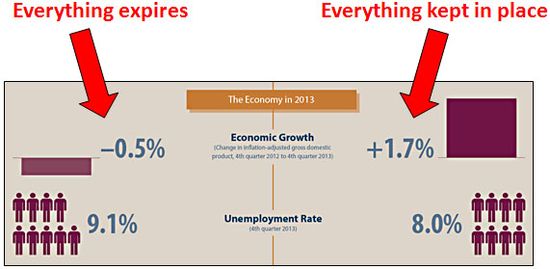
The CBO updated its fiscal outlook yesterday. I have to say that the fact that keeping all the current support for the economy in place only leads to a paltry 1.7 percent growth next year helps explain more deeply the depth of the crisis we are still in – globally as well as nationally. Drum, who provides the modified CBO graphic above, weighs in:

If we extend everything, CBO figures economic growth will clock in at about 1.7% next year — not great, but not catastrophic either. But if everything expires, the country will fall back into recession, with the economy shrinking by 0.5%. It's vanishingly unlikely that Congress will even attempt to address this before the election. That means we're due for yet another exciting lame duck session in December.

Greg Ip warns that a series of smaller fiscal drags also threaten the recovery:

Here's the real threat. Even if the Bush tax cuts are extended and the sequester delayed, a huge amount of fiscal drag remains in place. They include the expiration of the payroll tax cut, the expiration of extended unemployment insurance benefits, imposition of a new 3.8% Medicare investment tax on the wealthy, and the bite to discretionary spending embedded in the Budget Control Act and prior continuing resolutions. ISI Group projects $220 billion of fiscal tightening in 2013, or 1.4% of GDP. JPMorgan, noting that many Recovery Act programmes are rolling off at the same time, puts the hit at a slightly higher $266 billion, or 1.7% of GDP. The IMF reckons fiscal policy will tighten more in America next year than in Spain, Italy or Portugal. Though smaller than the full fiscal cliff, the fiscal clifflet still poses a significant headwind to the economy. If enough other bad stuff is going on, it could push the economy back into recession.

The Horserace Is About To Get Bouncy

From Sabato's primer on convention bounces:

Bounces oftentimes fade by Election Day. Jimmy Carter slid from 62% after his convention to 50% on Election Day 1976; Michael Dukakis from 54% to 46% in 1988; and Bill Clinton from 56% to 43% in 1992. Meanwhile, George W. Bush lost six points from the end of the convention to Election Day in 2000, and John McCain lost three points.

Gallup also uses history as a guide:

Everything else being equal, Romney and Obama could each expect to see a five-point increase in his support after the coming political conventions, which could change voter preferences at least in the short term. Gallup Daily tracking has shown Romney and Obama generally within two points of each other in registered voters' preferences. Thus, if Romney gets a typical bounce, he could lead Obama after the GOP convention, although Obama would essentially erase that lead if he, too, gets a similar bounce. If one of the candidates gets a bigger bounce than the other, that candidate could well establish a lead in the race after both conventions are over.

Ferguson’s Yellow Peril

YellowTerror

Fallows makes an important point:

A little earlier I had a testy on-stage exchange with [Niall Ferguson] about the United States and China. He said that U.S. budget deficits would lead to the certain collapse of the U.S.-China relationship, since China would cut off further credit to the spendthrift Yanks. I said that might sound like a neat theory but reflected no awareness of actual Chinese incentives and behavior, and that the showdown he considered "inevitable" in fact would not occur. As it has not.

Niall has made considerable contributions to the argument that holding US bonds is a strategic device advancing China's rise. Back in 2011, Fareed Zakaria broke down why this is off-base:

Here in the U.S. you hear many people worry that the Chinese government might stop buying American T-Bills. I think these fears are vastly overblown. The economic situation between China and the U.S. is the financial version of mutually assured destruction – that cold war doctrine of nuclear deterrence…. China is addicted to a strategy of export-led growth, which requires that it keep its goods cheap. This means keeping its currency undervalued. That's why it buys dollars.

In a 2010 post, economist Michael Pettis framed the issue in a little more detail:

China’s reserves are often thought of as if they were a treasure trove available for spending.  They are not. They are simply the asset side of the mismatched balance sheet. … [A]s long as China ran the largest current account surplus ever recorded as a share of global GDP, and the US the largest current account deficit ever recorded … it was almost impossible for the [Chinese central bank] to do anything but buy US dollar assets.  Given the sheer amounts, a substantial portion of these assets had inevitably to be USG bonds.

This was not a discretionary lending decision.  It is the automatic consequence of China’s currency regime, in which it pegs the RMB to a foreign currency, in this case the dollar. …  The moment the [central bank] stops buying [dollars], in other words, the RMB will rise in value.

Niall's argument that Obama has failed to generate a consistent policy on China is certainly legit. But does he think that declaring China a "currency manipulator" on the first day of Romney's presidency – as Mitt has promised – is sound policy? Stephen Roach imagines a Romney presidency in which Mitt pushes forward with a currency manipulation bill:

Taking the cue from the new premier, the Ministry of Commerce immediately announced retaliatory tariffs of 20 percent on all U.S. exports to China. This hits growth-starved America right between the eyes. After all, with US $104 billion of American-made goods sold in Chinese markets in 2011, China had become the United States' third-largest and most rapidly growing export market. With consumer demand mired in a post-bubble quagmire and the fastest growing segment of exports now under pressure, an already weakened U.S. economy is suddenly facing stiff new headwinds. Meanwhile, to add insult to injury, Wal-Mart announces average price increases of 5 percent – pointing to sharp tariff-induced increases in import prices that it was only able to offset partly through reduced profit margins. Other retailers follow suit and already hard-pressed American consumers hunker down further in response. Talk of U.S. stagflation is in the air as forecasters lower their sights on growth but raise predictions for inflation.

Previous coverage here.

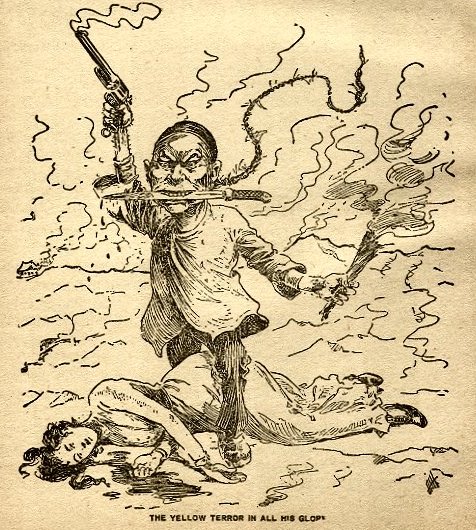
(Illustration: an 1899 cartoon, in which the features of the dreaded Oriental seem to have been merged with African stereotypes as well.)

The Master’s Master

David Ansen calls the upcoming film "magnificently unsettling" and spends some time exploring the mind of its creator:

Scene for scene, shot for shot, Paul Thomas Anderson may be the most exciting American writer-director of his generation. He’s a kind of cinematic chemist who works with unstable, dangerously flammable human particles. At any moment his characters—and his movies—are capable of exploding, and there’s no telling which way the shards will fly, or, as in Magnolia, the frogs will drop. Think of the seething ambition of Daniel Day-Lewis’s power-hungry oil magnate in There Will Be Blood; the powder keg of anger underneath the shy Adam Sandler in Punch Drunk Love; the cold, narcissistic fury behind the cocky surface of Tom Cruise’s sex-guru in Magnolia; the coke-fueled desperation of the porn-world denizens in his exhilarating Boogie Nights. There are rarely conventional heroes and villains in Anderson’s emotionally charged sagas, and that’s one of the reasons his movies feel so alive; he keeps us out of the comfort zone of predictable Hollywood formulas.

Anderson has grown to lament the film's now infamous connection to the Super Adventure Club:

Anderson freely acknowledges that this flamboyant character—a self-described author, sea captain, physicist, and philosopher—was inspired by L. Ron Hubbard. Once word of this leaked out, The Master immediately got tagged as Anderson’s "Scientology movie." "I was naive," the director says, somewhat ruefully. "I should have known that’s what people would latch onto." But if you’re expecting to see an exposé of that controversial "religion," you’ve come to the wrong movie. This is not to say Scientologists are going to like what they see. But Anderson, who gets a bit stressed when the subject comes up, finds himself "much more defensive and protective of [Scientology] than I would have thought."

Recent Dish coverage of The Master here and here.

Clinton Campaigns For Obama

Again. And effectively frames the debate:

I think this will help a lot with independent voters. It may be critical. Clinton’s convention speech may be the most important after Obama’s. Sargent analyzes here:

The ad rebuts one key part of Romney’s argument (Obama doesn’t have the answer; I do) by reframing this as a choice between the Clinton and Bush approach. But it doesn’t directly take on the other part of Romney’s argument (you have already shown your approach has failed). This is rooted, I believe, in a reading of the electorate by the Obama campaign that has gone underappreciated. The Obama camp makes a distinction between whether voters think Obama has failed, and whether they are merely disappointed that he hasn’t lived up to expectations, but find that understandable given the situation he inherited. This is a crucial difference that is central to understanding this race, one that turned up in my conversations with undecided voters in Colorado.

The Phoniness Of Rick Warren

The self-appointed “faith-monger” in America has just – surprise! – canceled the Faith Forum he was supposed to hold this weekend because the campaign, in Warren’s view, has become too uncivil. Rick Warren is far too principled to descend into this unseemly gutter. Why, it’s giving him the vapors:

It would be hypocritical to pretend civility for one evening only to have the name-calling return the next day.

But one simple question: wouldn’t a completely innocuous conversation with Romney and then Obama separately over a couple of hours be a way to actually defuse the name-calling or directly challenge both men to defend it in the context of their faiths? Since when does a Christian stomp off the stage with a hissy fit when there is peace-making to do?

Or is Warren doing what he always does: ponce around America purporting to be an apolitical missionary, while doing everything he can to ensure the GOP’s fundamentalist agenda – which is his too – is enacted? I was staggered this intense Republican partisan was ever prepared to expose his evangelical audience – and a more general one – to 50 minutes of discussion of Mormonism with Romney – and thought much better of him as a result. But the current cancellation gets Warren everything he wanted: a self-righteous harrumph, success in keeping Mormonism from being discussed in this race, and setting up his real campaign event: a September forum on how Obama is attacking everyone’s religious freedom.

Face Of The Day, Ctd

Prince Harry II

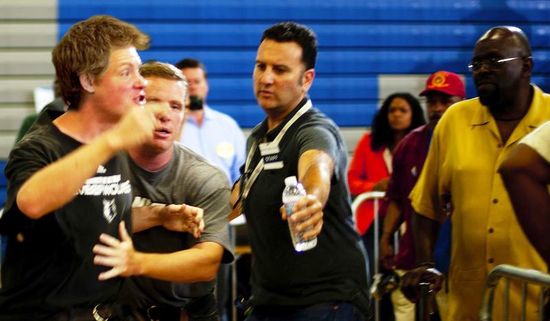
A reader sends the above image:

Please take a second look at your most recent FOTD.  I believe that is actually an angry Prince Harry going after the girl who photographed him in the nude. When I first saw the photo, his face and complexion and even his hair color reminded me of the prince's, so I borrowed Harry's hair from another photo.

The Dish, killing workplace productivity since 2000.

Romney On Rape And Incest

Several readers are echoing this one:

I would disagree with this statement in your Ad War Update: "One of those ad's claims is misleading; Romney doesn't oppose abortions in the case of rape or incest, though Ryan does." This is another area when Romney is trying to have it both ways. He supported the personhood amendment in 2007. And in the Huckabee faith forum in 2011, Romney said he agreed with the statement that life was formed at conception and that he would sign a personhood amendment if it hit his desk. 

So Romney is all over the map on this – being pro-choice, pro-life, for a personhood amendment, for pushing this back to the states, for legislating this at the federal level. Do you even need to think twice about trusting him?

The Obama ad in question says, "Both Romney and Ryan backed proposals to outlaw abortion, even in cases of rape and incest." While Ryan's support is not in question, the evidence cited to corner Romney was a somewhat rambling statement he made at a 2007 primary debate. The moderator asked: "If hypothetically, Roe v. Wade was overturned, and the Congress passed a federal ban on all abortions and it came to your desk, would you sign it? Yes or no?" Romney replied:

I would welcome a circumstance where there was such a consensus in this country that we said, we don't want to have abortion in this country at all, period. That would be wonderful. I'd be delighted. I'd be delighted to sign that bill. But that's not where we are. That's not where America is today. Where America is ready to overturn Roe v. Wade and return to the states that authority. But if the Congress got there, we had that kind of consensus in that country, terrific.

From that it is very difficult to assume that what Romney meant by "all" was abortions "even in cases of rape or incest", especially when considering the numerous times that he or his campaign have stated his support for such exemptions (examples here, here, here, here and, just this week, here). Romney has voiced support for personhood amendments in the past – and that is the basis for the Obama campaign ads. And sure, if a zygote has all the rights of an adult, I fail to see how rape and incest are justifications for what some would see as murder. The trouble is the following:

The National Committee for a Human Life Amendment, a Washington-based advocacy group, has compiled the congressional bills in favor of an amendment dating back to 1973. Some of those bills have no exceptions for rape and incest. However, the most recent versions do.

Romney has backed constitutional amendment that would define "human life" as being created at conception, but life is not the same as "person" – and the Romney campaign made this clear to Ben Smith last November. Also, the Obama campaign had this to say yesterday:

Mr. Romney supports the Human Life Amendment, which would ban abortion in all instances, even in the case of rape and incest. In fact, that amendment is a central part of the Republican Party’s platform that is being voted on [today].

Indeed, just as it did in 2004 and 2008, the GOP this cycle has included the Human Life Amendment in its platform, and it again includes no language regarding rape or incest exemptions. But party platforms are not equal to a candidate's views, and never have been, as both Bush and McCain supported [NYT] rape/incest exemptions despite the similarly broad platform language. As Mataconis puts it:

The GOP has included support for the so-called Human Life Amendment in its platform going back decades now and there’s never really been any serious attempt to pass such an amendment in Congress. Furthermore, the actual importance of party platforms is largely overblown by pundits, and political opponents. Most voters apparently don’t pay much attention to them, and neither do the politicians once their elected.

The problem, of course, is that after Akin, this year much attention is focused on it. As it should be. The platform is identical with Ryan's past views – and he is the veep nominee – even if it is not formally identical with Romney's (at last check).

Dissents Of The Day, Ctd

Image-2

A reader writes:

I disagree with the proposition put forth by your readers that statutory rape amounts to consensual relations, at least as consent is understood under the law.  Statutory rape laws remove consent.  The rationale, whether true in practice or not, is that the nature of a relationship between an adult and a minor of a determined age is such that the minor is so easily coerced or susceptible to pressure from the adult that he or she can not truly consent.  And if that is the case, then a resultant pregnancy can be as unwanted and psychologically damaging to the mother as a "legitimate rape". 

Perhaps Akin and his fellow travelers should be fighting the minimum age of statutory rape laws, but then they’d be in agreement with godless European socialists.

Another writes:

An 18 year old going to jail for 10 years because he slept with his 15 year old girlfriend does seem absurd.  But few would argue that a 40 year old doesn't deserve punishment for sleeping with a 12 year old girl, even if she gives her "consent." 

The idea is that a 12 year old girl can never be truly giving her "consent" to such an act.  Statutory rape laws are meant to formalize the idea that a child's capacity for rendering "consent" in sexual encounters is sufficiently susceptible to manipulation that we simply declare that there cannot be any such thing as "consent" when one party to a sexual encounter is a child.  To the extent that the specifics of our legislation lead to circumstances we find objectionable, it simply means that we haven't drawn the lines properly.

Another:

I worked in the juvenile prosecution division of a County Attorney's office for a while, and it was a tough decision for prosecutors to decide whether to prosecute cases where either both partners were underage, or one was slightly over age and the other was slightly underage. Unless there was an extremely irate parent involved, the prosecutors would often decline these cases, not least because the defendant, if found guilty, would land on the registry of sex offenders, possible for the rest of their lives, a punishment that simply does not fit the crime since there was no evidence that these defendants were predators. It is an ironic, unintended consequence of the sex offender registry law that it causes some sexual offenses not to be prosecuted.

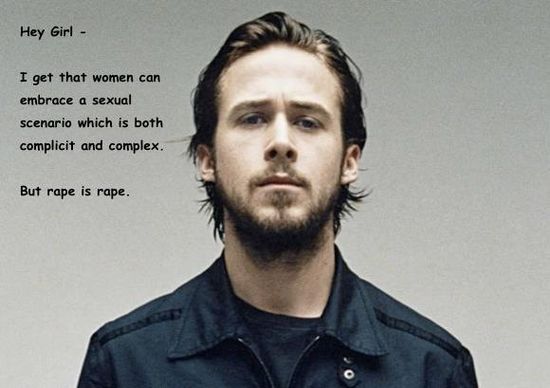
Another sends the above image:

I stayed up too late last night creating this addition to the "Hey Girl" meme. I thought you might enjoy it. (FYI, the quote is from Ryan Gosling's letter to the MPAA about their NC-17 rating of his film Blue Valentine.)

The Republican Party Cardinal

Dolan

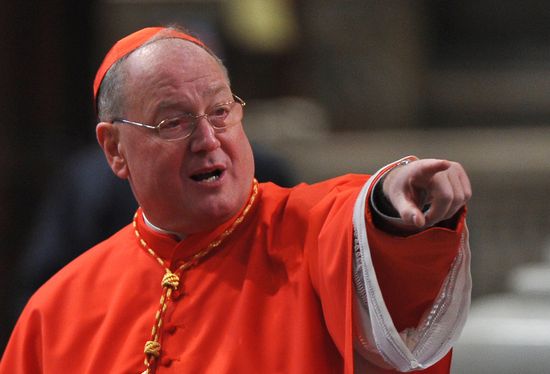
The de facto endorsement of the Romney-Ryan ticket by the Catholic hierarchy became close to authoritative yesterday, as the Cardinal Archbishop of New York accepted – in unprecedented fashion – an invitation to offer a benediction on the last day of the RNC, having gone out of his way to praise Paul Ryan as a "great public servant" whom he is "anxious to see in action." The usual practice is the local bishop for a benediction in his diocese. But the Romney-Ryan ticket persisted for obvious political reasons, argued for a big name Catholic, and Dolan, astonishingly, said yes.

The reason this is a big problem is that Dolan is in many ways the national leader of the Benedict XVI hierarchy. His stature turns a benediction into political act. It may just be a prayer – but it is one offered by one of the most recognizable Catholic leaders in the country, at a party political convention. It just can't get more partisan than that – to up-end protocol to inject himself into the political scene. 

The other problem is that he has already all but endorsed Paul Ryan:

"I came to know and admire him immensely," Cardinal Dolan added. "And I would consider him a friend. He and his wife Janna and their three kids have been guests in my house; I’ve been a guest at their house. They’re remarkably upright, refreshing people. And he’s a great public servant." Stating he was "speaking personally and not from a partisan point of view" and "not trying to be an apologist" for Ryan, Cardinal Dolan praised Ryan’s "call for financial accountability and restraint and a balanced budget” as well as his "obvious solicitude for the poor."

Noting that there may be differences in "prudential judgment" over how to assist the poor, Cardinal Dolan added that “I admire him. He’s honest. He’s refreshing. Do I agree with everything? No, but . . . I’m anxious to see him in action."

Ryan, an enthusiast of Ayn Rand, wants to drastically gut Medicaid and Medicare, deny 30 million people impending access to health insurance and Dolan interprets this as his "obvious solicitude for the poor." He praises a man who voted for an unfunded Medicare D entitlement, two disastrously expensive wars, and now pledges to balance the budget only over three decades is a model of accountability and restraint and a balanced budget! Dolan argues that slashing funds for the poor while slashing taxes for the rich is simply a "prudential judgment" with respect to how to help the poor. I don't think that preventing the old from getting home care is about helping them. More to the point: "I'm anxious to see him in action" is not a neutral statement. It's an endorsement.

And make no mistake: Dolan is an old-school Catholic pol – a figure who approved payments to molesting priests to expedite their firing, brazenly lied about it, then ran away abroad when the press demanded an explanation. His most important issues are criminalizing abortion, stripping gay couples of any civil legal protection, and making sure that non-Catholic employees of Catholic hospitals and schools be denied access to insured contraception. That he is saying the benediction for a ticket that explicitly endorses a priority for the super-rich over the working poor and views illegal immigrants as beneath contempt also tells you a lot about Dolan's priorities.

The Cardinal's spokesman insists it's just a prayer – but as Michael O'Loughlin of the Jesuit magazine America has noted, the leading Catholic Archbishop in the country traveling all the way to Florida to big-foot the local bishop and finish up the GOP Convention is such a staggeringly partisan act, especially given the politics around contraception and religious freedom, it's deeply reckless:

The cozy relationship between a sizable portion of U.S. bishops and the Republican Party should be cause for concern, and not just among progressive Catholics. For the church to be able to live out its role as prophet, it cannot be tied to one political party. Cardinal Dolan’s appearance in Tampa will damage the church’s ability to be a moral and legitimate voice for voiceless, as those who view the Catholic Church as being a shill for the GOP have just a bit more evidence to prove their case.

The Ryan pick was designed in part to appeal to the Catholic hierarchy, to get their implicit and quiet endorsement.

And, even though he is that oxymoronic creature, the Ayn Rand Catholic, it worked.

(Photo: US cardinal Timothy Michael Dolan gestures prior to the mass led by Pope Benedict XVI with new Cardinals in St. Peter's basilica at the Vatican on February 19, 2012. By Alberto Pizzoli/AFP/Getty Images)