The following thread discusses the violent instincts of domesticated cats:
Thu Aug 16, 2012 – 9:55am:
by Chas Danner
A new study has been bouncing around the web in which cameras were attached to pet cats so that their behavior (and kill-totals) away from home could be better understood. Deanna Pan goes over the numbers:
About 30 percent of the sampled cats were successful hunters and killed, on average, two animals a week. Almost half of their spoils were abandoned at the scene of the crime. Extrapolating from the data to include the millions of feral cats brutalizing native wildlife across the country, the American Bird Conservancy estimates that kitties are killing more than 4 billion animals annually. And that number’s based on a conservative weekly kill rate, said Robert Johns, a spokesman for the conservancy. “We could be looking at 10, 15, 20 billion wildlife killed (per year),” Johns said.
Amanda Marcotte points out who’s really at fault for the death toll:
Apologists for outdoor cats often shrug these numbers off by saying that since it’s a cat’s instinct to kill small animals, then this can all be chalked up to “nature” and not really a matter of human concern. But the only reason there are so many cats out there is because of people; we introduce them to new environments and sadly, we often let the reproduce rapidly without any check until they’ve completely overrun the place. Spay and neuter programs help, as do catch-and-release programs to sterilize feral cats who have no hope of living with people. Still, the bird death toll could be even more seriously reduced if people stopped letting their cats roam about unsupervised.
Indeed the study’s authors also recommend just leaving your cat indoors. Marcotte summarizes her attitude:
I approach cat ownership in the spirit of the TV show Dexter: Accept that your cats have troublesome urges and learn to channel those urges productively.
(Video: Tibs by Sam Huntley, who had some issues with his feline actor)
Thu Aug 16, 2012 – 3:09pm:
by Chris Bodenner
A reader writes:
Since getting a cat, Carina, with a remarkable resemblance to Tibs (from the video you  of my apartment, and since I signed a form from the shelter that I would keep her an indoor cat, I opted for a leash. I have become the crazy lady who takes her cat out on a leash two to three times a day at half hour intervals. We explore the backyard, the perimeter of the house, she sniffs and swats at bugs, she yearns to climb trees and has attempted the occasional fence. Oh and she loves to eat grass! The neighbor’s cat, who is allowed to run free, gets into cat fights and has depleted the local bunny population by at least three, by my neighbor’s account (I no longer see bunnies eating clover in the yard next door, so it is likely more) and earlier this week Carina and I spied a fly-invested bird carcass in the backyard. My kitty longs for this sort of blood sport, too. I see it in her soft yellow-green eyes, especially at twilight, the witching hour, when they turn red and black and she wants to lurch at my ankles. Then we play chase the furry ball that looks like a small rodent.
Another:
One solution I was told, was if your cat wears or tolerates a collar, put a bell on it. It will warn potential prey of the cat’s movements.
That seems like a dubious solution:
A fact sheet put out by the Mammal Society but unfortunately no longer available on their website showed that putting bells on cats does not limit their hunting ability, in fact belled cats in one particular study caught more wildlife than their unbelled equivalents. Some reasons given were that belled cats learn to move even more stealthily, the bells are not loud enough to alert wildlife of danger anyway, and inertia holds the clanger stationary and therefore silent when the cat makes the final attacking leap. At least two other studies have highlighted that the belling of cats has no effect on number of birds caught. “The efficiency of fitting cats with bells is contentious. Barrette (1998), found that belling of cats has no significant effect on the amount of prey caught.”
Other possible solutions:
Wildlife experts have told cat owners they need to regularly change their cat’s bell to stay one step ahead of their pet. They are also calling for owners to give their cats garishly coloured collars and to install sonic devices in their gardens to scare their pets indoors.
More tips here.
(Photo by Matt Bodenner)
Fri Aug 17, 2012 – 8:58am:
by Chris Bodenner
A reader writes:
We got two kittens at the end of last year and I was soon at the end of my tether about the number of murdered birds they were bringing back to us as presents. I searched 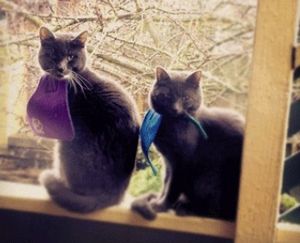 high and low for an online solution and came across catgoods.com, which sells thin neoprene cat bibs recommended by the Audubon Society. Supposedly the bibs prevent cats from making the overarm pouncing motion necessary to catch birds, and disrupt the split second timing they need. I was desperate enough that I bought a couple. Yes, my cats do look like dorks, but no, they don’t seem to stop them running, jumping and climbing; and no they don’t object to wearing them (after the first few times, much like a dog on a leash). And as far as we can tell the number of murdered birds and mice has diminished to almost zero. We now get ‘presents’ about once every 6 months instead of about once a day. In addition the cats are more visible on the road and the bibs have proved to be invaluable for striking up conversations with neighbours.
I’m not in any way affiliated to the sellers, but since my cat owning life has been transformed I would love to see the bibs become more widely known and used. I blogged about my experiences here, which includes a pic of my dorky cats.
Seen above.
Fri Aug 17, 2012 – 2:34pm:

by Chris Bodenner
A reader writes:
A bell on a cat will scare away the birds? Not. I grew up with a castrated and de-clawed basic gray cat who wore a collar with a jingly-jangly bell, and he still killed a seagull. A smallish, year-old seagull, but a seagull none the less. I’m not sure the cat weighed as much as the seagull. We watched with anticipation of something absolutely hysterical happening as he stalked the bird, and to all our horror, he killed it in about three seconds.
Another tops that:
Despite being deaf, declawed, and wearing a bell, our cat still killed mice, rabbits, and probably birds; we don’t know how many. After being affronted that my dad “wasted” a good baby rabbit by burying it in the back yard, she gave up on bringing us her kills and at some point learned to eat them herself from a feral cat that spent a summer in the neighborhood. She also figured out that drinking from a guppy bowl would entice the poor dumb things to come check out her tongue. Mom caught her at it one day after wondering where the guppies disappeared to.
Another:
I’ve been reading the posts on cats’ killing instincts with bewilderment. That’s because I regard my cat as a working animal whom I expect to go outside and kill all sorts of vermin.
I live in the country in an early 19th century farm-house w ith a rubble foundation that allows mice and other critters to easily invade my house. I’m also a gardener, so I view rabbits, chipmunks and such not as cute little critters but damaging nuisances. Thus, I love it when I open the door in the morning to find my cat’s, “gifts” to me of dead mice, moles, voles or other creatures that regularly invade my house, tear up my gardens or ravage my vegetable plot. To me, that’s the whole point of owning a cat, and why I typically adopt “barn cats,” that have been shown how to hunt by their mothers.
After all, the very reason why cats were domesticated in the first place was due to their propensity to kill. Cats kept the vermin in check that otherwise ransacked food supplies and carried nasty things like the plague. Even now, by killing vermin my cat helps to keep in check the mice that carry Lyme in my area.
Another:
Having grown up in the Texas hill country, with wildlife all around, my parents kept several cats around the house. Now, my dad really didn’t like cats, but soon after we moved into our house he realized that, one, we had a mouse problem, and two, there were a lot of rattlesnakes around. With two small children in the house, he decided the best way to deal with these problems was to keep some cats, and he promptly went to the animal shelter and picked up a couple kittens.
And the strategy worked marvelously. After the first few months, the mice disappeared completely. And over the years of my youth the cats killed at least four rattlers, one of which was caught and killed right in front of me in our large garden, seconds before I was headed in there to pick tomatoes and cucumbers.
Of course cats are killers. That this is so surprising to people indicates to me that some city folk need to get out more.
More stories at our Facebook page:
My cat’s retired now – if he’s killing, he’s not bringing them home often anymore. But he used to bring home kills, and artistically gut them, laid on their backs, belly splayed-out, guts neatly placed to the side. Sometimes he’d leave just hands, feet, and tail. One time, a rabbit-head. One time, on the welcome-mat, square with the edges, he lined up, all neat and parallel: a lizard, a hummingbird, a fish, and a rat. All in one night. (The fish was the neighbor’s koi – he’s brought us at least 3 … I think they just gave up restocking.) He’s tried to train our younger cat, but she can’t even succeed with moths. She tries so hard, bless her heart.
(Photo from the site What Jeff Killed)
Mon Aug 20, 2012 – 2:21pm:
A reader writes:
I’ve been biting my tongue during the whole “Purring Murderer” debate, but as the owner of two rescue cats and a die-hard bird-lover, I feel it’s my duty to say something after seeing those preposterous bibs and other “tricks.” Here’s how you keep your cat from killing birds, contracting feline HIV, or getting run over by a car: Keep them inside, permanently.
Our cats are happy living indoors. Sure, they would probably love to go outside and chase (and kill) birds, etc., but since they’ve never done it, they don’t miss it. It’s why we would never do “supervised” outdoor time. Our dogs would love to chew on shoes and furniture all day (and probably would have eaten the cats, happily), but we’ve trained them not to do it. The difference with cats is that you can’t train them like you can train dogs. Keep them indoors, always. The occasional moth, mouse or laser pointer for them to chase is just fine. They can sit in windows. They’re cats – feed them, love them, play with them, and they’re happy.
I have one friend who is insistent that her cats are happier because they’re outdoors. But she also buries a cat every other year from cars or fights with unknown animals – and those cats are also killing an untold number of birds in their shortened lives (but supposedly “happier”) lives.
You hear this same argument about people. There are some folks who think that life was better for hunter gatherers because they didn’t have to ride a bus to work or answer idiotic emails from dumb co-workers or clients. No – prehistoric people lived shorter, nastier lives, dying from what are now treatable diseases or in childbirth at alarming rates. Sure, they weren’t cooped up in the house, but I think they would swap places with us, who have to worry about very little in comparison, in a heartbeat. They might not understand why the house cat is wearing a bib, though.
Another writes:
Growing up, my family had cats that were allowed outdoors. Not only did they kill, but they every so often got fleas or ticks, and even more so ended up the victim of being the inferior cat at the hands (er – paws!) of the neighborhood bully cat. Also, there’s risk to several cat diseases if there’s a run-in with another cat who is infected (namely FIV, Feline Leukemia, and of course, rabies from any animal – especially infected kill!).
So, what is the benefit to letting a cat out of doors? There is none, really. Or at least the risks WAY outweigh any benefits. My current kitty Gretel and my last one who passed away last year never saw the out of doors. And actually, the shelter I adopted them from had it in in their contract: indoors only.
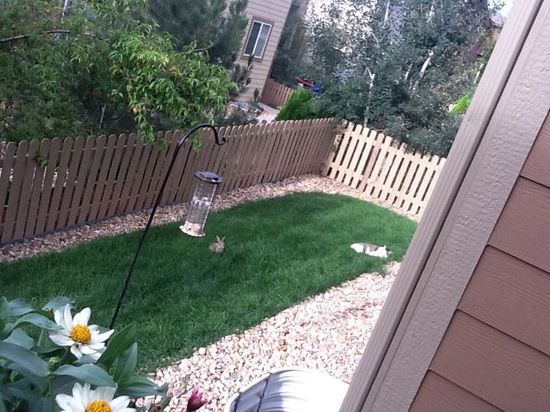
Another sends the above photo:
“Bitty” is a now 9-year-old DSH whom I found on the road as a kitten, suffering from maladies that would make her almost completely blind. Only a few days ago, I took this photo of Bitty near-comatose in the sunshine as a feral bunny grazed itself across our back lawn. Can’t we all just get along?
Tue Sept 04, 2012 – 2:45pm:
Another reader continues the discussion:
I own two cats that go outside, and I study behavior. Here’s the question: Do you want your cat to live 20 years, guaranteed, looking out the window and wishing? Because they do. Bored, because you’re not playing with them for three hours a day? Sleeping extra time and getting fat because there’s nothing to do in your house? I have to respond when people claim their cats are happy inside. They compare them to hunter-gatherer humans? Well, let’s go the other way – what does an indoor cat look like on that spectrum? The person stuck in the cubicle all day who comes home and can barely stay awake to watch TV, with terrible joints and no life. There’s risk to the cat to letting them out, but that’s not a great argument for not doing it. Preventing them from killing birds is a good reason; keeping your cat “happy” is not.
Another tries to provide the best of both worlds:
Like several other of your readers, my family keeps a cat outside as a mouser and are pleased, not dismayed, by killer tendencies. We originally got cats when chipmunks kept tunneling under a brick patio, caving in the bricks on a daily basis. They solved the problem. And with a heated cathouse, our working pets enjoy a free life winter and summer. It’s a hard fact that living outside in a rural area exposes them to coyotes and other dangers and we’ve lost a few over the years. We’ve even witnessed our cat being attacked by an owl and fall screaming from their claws, but mostly it’s the cats posing a danger to birds, rabbits and pests.
Another has a story of remarkable perseverance:
I once had a cat whose ego was fully invested in self-perception as a warrior killer. Frankie was a tuxedo Manx, and I was living in a large rural spread when I got him as a kitten, so I didn’t even contemplate restricting his activities. In fact, I was glad that he was killing the various furry vermin that ravaged my gardens. When he was about a year old he went out into the woods one winter day and got caught in a squirrel trap.
By the time he returned home a few days later (presumably having been freed by whomever set the trap), his front right leg was cold and dead, and it was necessary to amputate it all the way to his shoulder. Needless to say, he looked very bizarre with three legs and no tail.
I assumed that he would settle into a domestic lifestyle, lounging around the house, but the loss of his leg seemed to have a psychological effect that spurred him on to a desperate level of hunting. He hadn’t often brought home trophies before the loss of this leg, but afterward he was constantly depositing them on the doorstep. It was heartbreaking watching him laboriously drag the carcass of a dead rabbit for a dozen yards, and he was often exhausted by the time he brought home the bunny, but it was obvious that he wanted me to see that he still had the ability to perform that function.
He also spent a lot of time on top of my dresser, gazing into the mirror and positioning his body so that the reflection didn’t show him as a cripple. There was no doubt in my mind that Frankie had a very specific physical image of himself, both before and after the amputation. I’ve since watched lots of pets gaze at themselves in a mirror, but I’ve never seen one that was as mesmerized by his own reflection as Frankie was after he lost his leg.
Frankie only lived for about six months afterward, and he died of a heart attack on a hot summer day after chasing a rabbit in the field. I really wish that I had prevented him from going outside after he lost his leg, but he seemed so miserable when I did try to keep him indoors that I thought it was better for his happiness to be able to continue hunting.
Another:
Our cat, Blackie Lawless, was an abandoned-pet-turned-feral which we “rescued”, who survived on his hunting prowess before we adopted him (ie, coaxed him into our home). Even after he became domesticated, sleeping in our bed every night and cozying up to our two indoor cats, he still spent his days catching jack-rabbits, gophers, field mice and roof-rats whose populations were exploding in our Scottsdale, Arizona neighborhood. Our neighbors LOVE him for helping to maintain a balance when the fauna was decimating the flora – especially roof rats, which destroy citrus trees and nest in roofs eating electrical wiring and are the scourge of the greater Phoenix area. The typical option for eradicating them is poison, which endangers more than just the rats.
We are naturally ambivalent about some of his prized catches that also include the odd gambol quail, and we had to get used to the gruesome carnage (which was not easy) but on the whole, he has been an integral part of our neighborhood’s peaceful co-existence with nature. He may be a purring murderer, but he is also a “working cat”.
Another says that “sometimes, killer cats do their duty inside”:
The killer cat thread reminded me of a story in the NYT a few years ago about bodega cats prowling the narrow aisles of shops in New York. There’s a $300 fine for having a cat in a store, and a $300 fine for rodent feces. You can either get a weekly exterminator (and then have the smell of rotting rat carcasses) or a cat. There have been calls for the city to allow and regulated cats, but they haven’t gone anywhere, apparently.
Wed Sept 05, 2012 – 4:00pm:
A few readers share tales of cats turning on humans:
My 68-year-old mother has three cats. One of them found itself caught in the handle of a plastic bag two months ago. As she freed it, the panicked feline bit her hand. This was around 9:30pm on a Thursday night. Friday morning she woke up to find her arm swollen to the elbow, unable to bend her wrist, and in what she described as the “worst pain I’ve ever felt”. Her doctor admitted her to the hospital, where she stayed for THREE NIGHTS, on an IV drip to kill all the bacteria. For a while, they were considering surgery to release the pressure the infection was putting on her arm.
From what her doctor said, cats have really really dirty mouths. They also have long, pointed teeth, so when they bite, they go deep (dogs have cleaner mouths and tend to tear the skin). I’ve always been told that if a cat bites you, you should go to the doctor or ER immediately.
Another:
Here’s the story about how an outdoor cat scarred my little sister physically and emotionally.
She has a pet rabbit whom we all dearly love, and we mostly keep him inside the house, where he hops around wherever he wants. If we take him outside, it’s inside a pen, and only with supervision, because one of our neighbors have an evil outdoor cat. It kills with impunity, and not for food. It’ll stalk, kill and decapitate small animals, then just leave them around our yard and and everyone else’s.
A few years ago we had a litter of wild baby rabbits living in our backyard. And my sister, being the rabbit lover that she is, loved to go outside and feed and watch them. Then came along the evil cat. As soon as it came into our yard, she knew what it was going to do. She tried to scatter the baby rabbits, but the cat managed to corner one in our garden. My sister panicked and tried to shoo it away, and the cat hissed and scratched her, leaving a scar on her leg that is still there today. Then she had to watch helplessly as the cat stalked a tiny baby rabbit and then bit it’s head off. She can’t even look at cats these days without being frightened.
So basically, the whole point of this story is: cat owners, please be aware that your outdoor cats may like to play in trees and bring you “presents”, but you are not the only ones who have to deal with them. Outdoor cats roam neighborhoods freely, and often get into scuffles with other animals and humans. The least you can do is be considerate.




 The Dish