Every season, the coverage seems to narrow. This year, no network will be carrying Ann Romney’s speech next Monday. CNN will. The Dish, of course, will be live-blogging every night.
Month: August 2012
What If China Becomes #1?
Frum agrees with Ferguson that China’s rise is a threat:
If living standards mattered most, then Denmark would be a superpower. A China that becomes richer in aggregate than the U.S. will exert new global sway—and make this planet a less congenial place for those who cherish liberal democratic values. … The prospect of the U.S. as number 2 is a threat and challenge. So long as China remains a repressive authoritarian oligarchy, the prospect of a world reordered to meet Chinese imperatives is an ugly one.
The premise behind this is that freedom requires a superpower to enforce it. But it’s one of the great contradictions of neoconservatism that its real founder is Rousseau, not Burke. It was Rousseau who argued that people must be forced to be free, a paradox he seemed to savor but the neocons do not see. In fact, the desire for freedom springs from within, filtered through history and culture and accident. The US did not force the people of Egypt to be free; which is why their revolution has a chance of succeeding. The US did try to force Iraq to be free, which is why I remain profoundly skeptical of that country’s “democratic future.” And China is not Mao’s China. It is not powered by nineteenth century delusions, but by 21st Century economics. And so an almost completely China-dependent Burma has nonetheless moved toward democracy even as China’s power waxes, as it must. This is not to say that handling China’s rise is not one of the most pressing issues we face – and it will be as hard as managing Germany’s rise in the nineteenth century. But this is not a return to the past, however much Romney needs it to be. Greg Scoblete explains:
By all means the U.S. should take China seriously – more seriously than it has to date. As far as potential challenges to global stability goes, the territorial disputes in Asia are arguably more dangerous than an Iranian nuclear weapon. But we’re not facing a Cold War style contest for global supremacy. Acting otherwise is not conducive to clear-headed thinking about what the U.S. does next.
Larison sides with Scoblete:
The world wouldn’t be reordered to meet “Chinese imperatives” because most of the world would not accept Chinese “leadership.” The main error that hegemonists make is in asserting that U.S. hegemony has to be replaced by another state’s hegemony. In fact, the existence of a single global hegemon is extremely abnormal and cannot be sustained over the long term.
Further thoughts from yours truly here.
Ask Jesse Bering Anything: Is Homosexuality Nature Or Nurture?
In 2010, Bering touched on similar questions about how to know whether a child will be gay:
In looking carefully at the childhoods of now-gay adults, researchers are finding an intriguing set of early behavioral indicators that homosexuals seem to have in common. And, curiously enough, the age-old homophobic fears of parents seem to have some genuine predictive currency. In their technical writings, researchers in this area simply refer to pint-sized prospective gays and lesbians as “prehomosexual.” This term isn’t perfect—it manages to achieve both an uncomfortable air of biological determinism and clinical interventionism simultaneously. But it is, at least, probably fairly accurate.
Previous videos of Jesse here, here and here. “Ask Anything” archive here.
Chart Of The Day
Razib Kahn breaks down public opinion on abortion and rape. Note that no demographic group, not even biblical literalists or the extremely conservative, breaks fifty percent in denying abortion to rape victims:
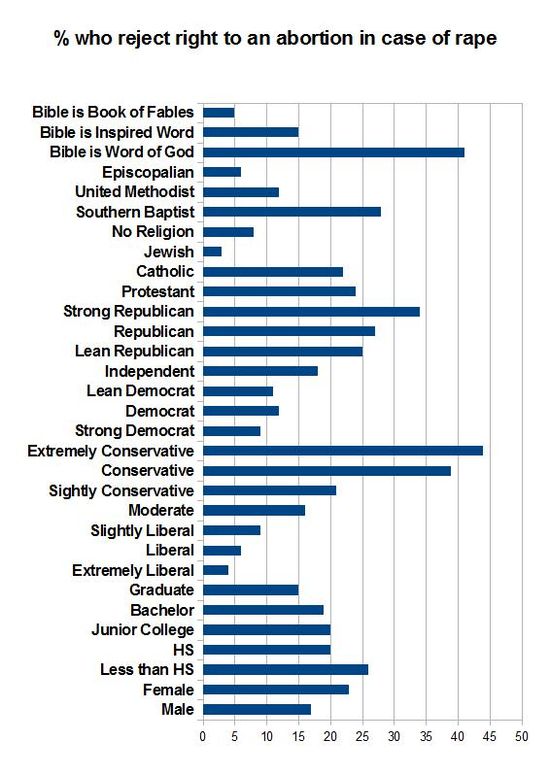
How did a major political party adopt a policy position that is so so so far out of the mainstream? One word: fundamentalism.
From 2004’s “Defining Marriage” To 2012’s “Defining Rape”
The parallels between the two elections have been often cited. But one that is emerging strongly this time as last is a cultural-social issue ginned up by the incumbent party to discredit the opponent. In 2004, it was John Kerry and the "war on marriage". This time it is Mitt Romney and the "war on women." And the wedge issue is hurting him.
And there is a solid defense of Akin's staying in the race, as MoDo points out today. He said what he evidently believes and something that has been a staple on the pro-life fringe for a while. It's obvious where this myth comes from. If you are pro-life, i.e. if you hold that a newly fertilized egg just attached to the uterus has all the constitutional rights of an adult or a newborn, then an exception for rape makes no sense. I actually find that position more coherent than saying that a newly fertilized egg created by rape or incest is less of a person somehow. The sane and past Christian view is that it's a mystery when a human "person" emerges from human "life" but Aquinas figured it probably occurred in the first trimester. Abortions were still always morally wrong – but this modern neurotic fixation on full human personhood beginning at the zygote stage is absent from previous Christianity. And yes, it's a function of fundamentalism – pioneered by John Paul II and orchestrated by Benedict XVI.
This fundamentalism hasn't changed since 2004; it has merely spread and intensified as each last non-Christianist element of the GOP has been purged. Religious fanatics are very talented and interested in purging heretics, which is why, for example, Akin emerged in Missouri in the first place. This is not John Danforth's Missouri.
In 2004, this new fundamentalism could command enough mainstream discomfort to win a major victory against a tiny "sinful" minority.
In 2012, they're still trying to keep this minority in its place but public opinion has changed dramatically against them. (Support for marriage equality was at only 32 percent in 2004, compared with 47 percent now in the Pew poll). But now, the crusade is inevitably focused on women, because of renewed opposition to contraception among Christianists – the popular front between evangelicals and Ratzingerian Catholics made this essential – and, of course, abortion.
There is a difference between a culture war where you have majority support and are persecuting a minority of around 2 percent of the population … and a culture war where you have very little non-Christianist support (and shock among those not exposed to what is mainstream thought in the GOP base) and are targeting more than half the population.
Karma, as they say …
Where Are This Era’s Protest Songs?
Stephen Walt asks:
You’d think this would be a moment where at least one or two artists would be writing political songs and attracting a huge audience, and maybe even using their art to inspire political change. But I get little sense that contemporary musicians are shaping political attitudes or behavior as they might have in earlier eras.
Galupo's take:
When you think of the attitude-shaping influence of acts like Lady Gaga, Taylor Swift, and the cast of Glee, there’s an identifiable connective thread between them: an ethos of self-acceptance and tolerance, and a hatred of bullying. They are apolitical if by politics you mean wars or elections — but not so in a moral or communitarian sense.
Stimulus Or Census?
The hole gets deeper in the Ferguson brouhaha. Krugman piles on:
For what it’s worth, in this case I don’t think we’re looking at a blatant attempt to mislead; I suspect that we’re just looking at raw ignorance.
Meanwhile, Dan Drezner (note to Niall: no lefty) fisks the foreign policy section – which I hope to do myself soon:
My verdict: the foreign policy section isn't as bad as the domestic policy section of Ferguson's article, but it's still sloppy. Ferguson makes a lot of lazy assertions without backing them up with facts. Some of the facts he uses are a bad fit for the arguments he's trying to make. And he values similar data points differently depending on whether they support his argument or not.
There are some good critiques that can be made of the Obama administration's foreign policy, and Ferguson skirts close to some of them. But Romney supporters can do better.
Why Marriage Matters
Another powerful anecdote:
Brittney Leon and Terri-Ann Simonelli have a domestic partnership, which under Nevada state law grants couples all the same rights as married couples. When Leon checked into the hospital last month because of complications in her pregnancy, the admissions officer told Simonelli she would have to secure power of attorney to be with her partner. Leon ended up losing her baby, and Simonelli had to rely on the doctor for updates, spending long stretches of time without news on her partner’s condition and the fate of her family.
And something important happened yesterday. The GOP effectively proved that its concern is not “protecting” civil marriage, but keeping gays permanently marginalized and vulnerable in our relationships. They officially oppose even civil unions for gay couples. So next time someone argues that the Christianist right is not anti-gay, just pro-marriage, ask him why he opposes civil unions as well.
The answer is fundamentalism, not social policy.
The View From Your Window

Alexandria, Virginia, 12 pm
Talking Past My Generation
John Quiggin mulls the disconnects between generations:
The group of people born in a given period, say a year or a decade, is called a cohort. Members of a cohort have things in common because they have shared common experiences through their lives. But, at any given point in time, when members of the cohort are at some particular age, they share things in common with the experience of earlier and later generations when they were at the same age.
Most of the time, age effects are more important than cohort effects. The primary schoolers of the 1960s were very like the primary schoolers of today and, of course, totally different from the middle-aged parents they have become. The grandparents of today are more like their own grandparents than the bodgies and widgies they may have been in the 1950s.
The same applies to the standard rhetoric that one age group applies to another. For example, Mark Davis in Ganglands quotes various baby-boomer pundits denouncing the younger generation as ‘slackers’ and dole bludgers’. In the 1970s, precisely the same thing was being said about the younger members of the boomer cohort, then in their late teens and early twenties.
 The Dish