When Will The GOP’s Fever Break?

Ryan Lizza imagines what will happen if Obama wins re-election:

The most conservative faction of Republicans, to which Ryan may have a claim, will certainly argue that alleged moderates like McCain and Romney have led the party to back-to-back defeats, and thus make the case for purism. This is the most likely scenario: another cycle of the Republican march to the right. But much will depend on Obama’s success in a second term (again, if he wins one). If the economy recovers, and Obama presides over robust growth in a second term, the more partisan and right-wing case against the Democrats will likely be defanged, much as it was in 2000 when Bush felt the need to fashion his compassionate conservatism in response to Clintonism’s success.

The hope is, on my part, that by lashing himself to the Ryan mast, Romney has done us all – in particular, his party – a big favor. The base will not be able to blame squishiness for defeat. Romney has morphed with Ryan, with Romney the patriarch and Ryan the eager dauphin. Defeat will be for both. Then a small faction in the GOP may actually decide they have to deal with Obama on saner terms, i.e. with revenues on the table.

The reason this can happen – and why, in my view, Obama must explain very seriously and in detail what’s about to happen after November – is sequestration. Something has to give. We are approaching in some ways the final resolution of the massive struggle between supply side economics and fiscal reality that has been going on for thirty years. Do you want Obama at the Peace Treaty signing – or Ryan? Who would be more able to compromise to get this thing done, to quote the Randian?

Romney’s Speech: Blogger Reax II

Pareene responds to Romney's line in the above video:

As we learned last week, Tampa is particularly vulnerable to hurricanes, because the sea levels are actively rising. But you know Obama didn’t make good on that promise so I guess maybe instead of mocking the concept of doing anything at all to halt or even slow the human activities leading to the sea level rise, Romney was just being realistic. It’s probably already too late, vote Romney and continue not thinking about how we’re all doomed.

Henry Blodget believes the line gets at "an important truth":

[I]f we really want to help the planet–and we should want to, given that we live on it–we need to remember where that priority falls in the hierarchy of most people's decision-making. And we need to do everything we can to help everyone on the planet satisfy their basic needs–food, shelter, safety, and healthcare. Because it's only once those needs are met that people can reasonably begin to care about things that are as vague as "rising oceans" and "healing the planet."

Bob Wright was deeply disappointed with the foreign policy section of Romney's speech:

I realize convention speeches aren't the place for think-tank-worthy critiques of an incumbent's foreign policy. But couldn't Romney do better than spout neocon abstractions that, when fleshed out, don't make any sense? He's so allergic to concrete specificity that he didn't even mention the war America is currently involved in!

Larison critiques the needless Putin-bashing:

Calling out Putin by name in this speech may get him a few cheers from delegates and some glowing reviews from his stenographers in the media, but it will confirm Putin in his assumption that Americans aren’t to be trusted and should be viewed with suspicion. Romney has gone out of his way to make sure that relations with Russia will sour if he is elected, and I don’t think he or his advisers have thought through what that might mean for the U.S. The same goes for all of the other foreign policy positions the Romney campaign has taken so far.

Howard Gleckman wonders what happened to tax reform:

The rhetoric and policy papers that came out of Romney’s convention won’t be the last word on taxes or fiscal policy. But these events are forums for candidates to make their best case for why they should be president. And, if this convention is any evidence, tax reform is no longer a major part of Mitt Romney’s argument.

Noah Millman was underwhelmed:

[Q]uite plainly, Mitt Romney has no intention of saying anything that his audience doesn’t want to hear, and what he thinks his audience wants to hear is that America is great, and the only reason everything isn’t hunky dory is that we are led by a man who doesn’t understand that America is great. So believe in Mitt Romney, who believes in America, and trust that he will do the right things to steer America toward brighter shores. That’s the whole speech, and it’s the whole campaign. It’s really that infantilizing.

Frum thought the speech fairly effective:

Absent from the speech were the rancor and apocalyptic fervor that have gripped so much of the Republican party since the election of Barack Obama. The Mitt Romney on that stage was not angry at Barack Obama – just terribly, terribly disappointed.

Nate Silver's view:

It was a speech that Mr. Romney’s pollsters and consultants should have been pleased with, although it may have suffered from trying to check too many focus-group-approved boxes. But most of all, and in contrast to Mr. Romney’s selection of Mr. Ryan, it was full of the choices that a candidate makes when he thinks he can win the election by running a by-the-book campaign.

Chait doubts Romney "closed the sale": 

I don’t get the sense that Romney came across as sincere. To be perfectly clear about this, looking sincere is not the same thing as being sincere — John Edwards and Paul Ryan are both incredibly good at looking sincere. That’s the crucial part of the con man skill set. In any event, Romney seems to lack a talent for faking sincerity. The best he could do was a furrowed-brow expression that made him look as though he were about to cry at any moment for his entire 45-minute speech. 

Ponnuru wishes Romney had focused more on offering "better times for the middle class":

The Romney campaign seems to think that once Americans see Romney as likable, they will trust him to be president. They may be right. Or it may be the other way around: Not until they trust him to promote their interests will they find him likable. This is what I suspect. I would have preferred for Romney to spend more time making the case for how his agenda would help the country. But maybe what he said about it was just good enough.

Drum detected a lack of enthusiasm:

I doubt that it really did much for Romney. There just wasn't enough energy, enough oomph — and the crowd reaction from the convention floor seemed kind of forced and even a little muddled at times. I predict a small bounce for Romney, but no more than a couple of points or so. Overall, it was a missed opportunity.

And Beinart was left without a clear sense of Romney's authority:

Mitt Romney wants to convince Americans that he can lead the country, but two months from election day, it’s still hard to tell if he’s really leading his party or it’s leading him.

More blogger reax here. My instant reaction here. Twitter reax here. Eastwood Twitter reax here.

Romney’s Government Handout, Ctd

Kevin Roose puts the Bain bailout in a better light:

Bain's debt negotiation was nothing like the taxpayer-funded Wall Street bailouts of 2008 and 2009. In fact, it wasn't funded by taxpayers at all.

It's confusing, because the FDIC is a government agency. And government agencies tend to be funded by taxpayers. But the FDIC is a special case. Essentially, it's a bank guarantor that is funded by the banks it guarantees. Every year, banks write a proverbial check to the FDIC for the equivalent of life insurance, and in return, the FDIC promises to backstop them if they're ever about to go out of business. The agency gets no funding — as in, zero dollars — from the government's coffers.

So while Romney's deal may have been unseemly (Dickinson points out that the FDIC chairman at the time was an adviser to George Romney during his 1968 run for president), it didn't screw taxpayers, at least directly.

Earlier coverage here and here.

Making Culture Indestructible

Dezeen_Jardin-de-la-Connaissance-by-Rodney-LaTourelle-and-100-Landschaftsarchitektur-–-update2_784

Matt Simon profiles Brewster Kahle, a man recently inducted into the Internet Hall of Fame for his efforts to save our cultural inheritance:

Here’s the problem with libraries. They catch on fire really easily. As such, they were the prized targets of the invading hordes of antiquity – the model collections of knowledge of their times, whose only fault was their inherent flammability. They were one-man, one-torch jobs. But the hordes didn’t prize the library only for how powerfully it burned. Back in those days, if you wanted to kill a culture, you killed its library. All it took was one chucklehead with a flaming stick to annihilate thousands of years of accumulated knowledge. And it happened often.

How Brewster Kahle combats this problem:

Kahle took the library of libraries — the internet — and made a couple of copies of it, and keeps making copies. One he keeps in servers in San Francisco, the other in mirror servers in Alexandria, where the world’s most famous library burned 2,000 years ago. (His data survived the Egyptian revolution unscathed.)

(From the Jardin de la Connaissance, the garden of decaying books in Quebec, via Dezeen)

A Father’s Love

Neetzan Zimmerman highlights the story of a dad who wore a skirt in public in order to put his dress-wearing, nail-painting son at ease:

"I didn't want to talk my son into not wearing dresses and skirts," Pickert tells the German feminist magazine EMMA. "He didn't make friends in doing that in Berlin already and after a lot of contemplation I had only one option left: To broaden my shoulders for my little buddy and dress in a skirt myself."

At first, Pickert's son was reluctant to wear a dress in public, fearing he would be laughed at, particularly by other kids at his preschool. But that all changed one "skirt and dress day" when he and his dad made a resident of the town stare so hard she slammed into street light face first.

Internet-Famous In Japan

The country is the global epicenter of Internet cat videos, where some felines earn more than the nation's average salary. Despite months of trying, Gideon Lewis-Kraus is unable to set up a interview with Maru, possibly the most famous (168 million views) yet reclusive cat in the world. The reason may be cultural:

In the US people post a video of themselves whistling "Free Bird" in a tutu and they're heartbroken if they're not immediately invited on to chat shows. It's different in Japan, though. There, they haven't yet cottoned on to the idea that the whole point of the internet is not only that it might make you famous and universally loved but that it might make you famous and universally loved overnight, and for no real reason, and that then it would give you fairly precise metrics for just how famous and loved you were, and for how long. For the Japanese, the internet is primarily not about self-promotion and exposure but about restraint and anonymity.

(Video: Maru's first commercial, just released, via Copyranter)

Cooking Is Work

Tracie McMillan admits that when "you have no choice but to cook for yourself every single day, no matter what, it is not a fun, gratifying adventure":

Making food quickly and well is easy once you know how to do it, but it is a learned skill, the acquisition of which takes time, practice, and the making of mistakes. To cook whole foods at a pace that can match box-meal offerings, one needs to know how to make substitutions on the fly; how to doctor a dish that has been overvinegared, oversalted, or overspiced; how to select produce and know how long you have to use it before it goes bad; how to stock a pantry on a budget. Without those skills, cooking from scratch becomes risky business: You may lose produce to rotting before you get the chance to cook it, or you may botch a recipe and find it inedible. Those mistakes are a natural part of learning to cook, but they will cost you and your family time, ingredients, and money without actually feeding you. They also make a persuasive case that cooking is not worth the trouble and that Hamburger Helper is worth the cost.

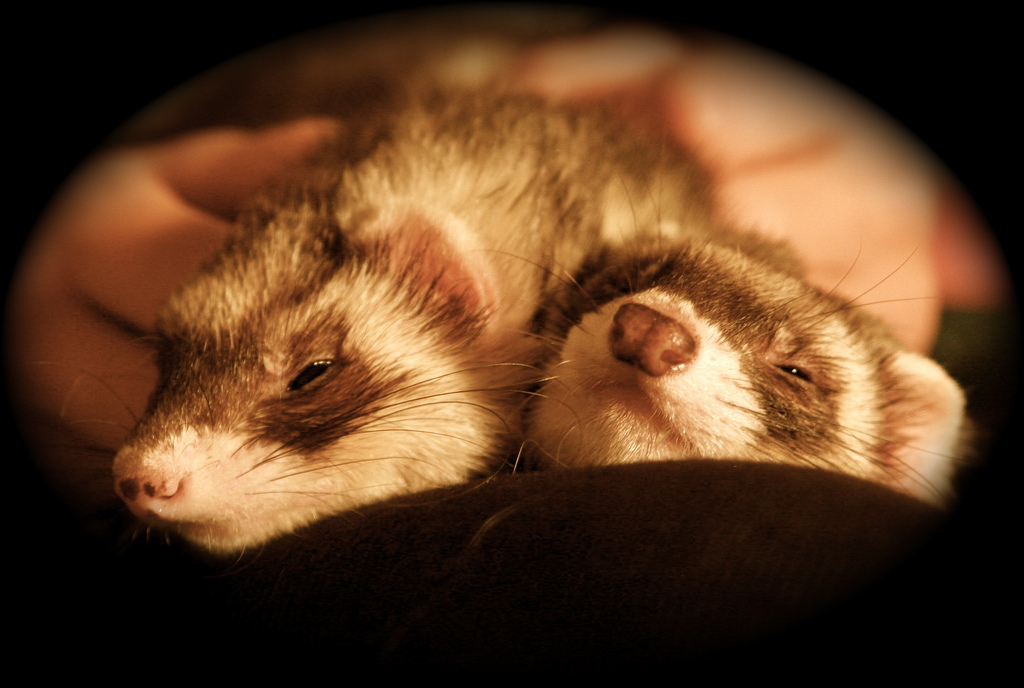
What Ferrets Share With Dogs

5201035804_cdd2278129_b

They both have many of the same traits, thanks to domestication. A new paper in PLoS ONE explores their social cognition. Jason Goldman summarizes:

Like dogs, [the researchers] say, ferrets originally were bred for practical reasons like hunting. Their role within human society has since shifted, as they now predominantly serve as pets. If ferrets adapted to a new social ecology within human society as have other domestic species, like dogs and horses, then they ought to respond to humans differently than their wild forebears.

So how did the ferrets do in a test?

The domestic species – ferrets and dogs – tolerated prolonged eye-contact from their owners, but not from strangers, while the wild mustelids [a mix of polecats, weasels, otters, badgers, minks] did not show this distinction. Ferrets and dogs were also both more likely to accept food from their owners than from strangers, while the wild mustelids made their approach decisions randomly, equally preferring their owners and a stranger (In fact, there was a slight but statistically insignificant preference for the stranger!) 

(Photo by Flickr user downatthezoo)

The GOP’s Split Personality On Spending

Greg Scoblete read the foreign policy section of the GOP platform. He was struck by "the platform's complete repudiation of the kind of limited government principles espoused in the domestic chapters of the platform":

At one point, rather amazingly, the platform slams President Obama's national security strategy as "budget-constrained." In other words, when it comes to the federal government's obligation to American citizen's welfare, education, infrastructure, etc. there must be a strict accounting (something, incidentally, I agree with), but at the water's edge, any and all budgetary concerns are literally not operable.

Larison chimes in:

"Limited government" is the phrase that big-government conservatives use to paper over the fact that they favor a powerful and activist federal government, albeit one with different spending priorities for the benefit of different interest groups.