Three Biological Parents

A British ethics board recently approved an experimental treatment that results in babies with genetic material from two women and one man. Annalee Newitz explains the need for "three-person IVF":

This procedure is designed to help women who suffer from heritable diseases that are passed on via small pieces of genetic material in the main body of the cell. Most genetic material in your cells is packed into the tiny nucleus at the very center of the cell, but a few pieces of it reside in cell organs called mitochondria that float around in the cell outside the nucleus. The problem is that the child inherits all its mitochondrial DNA from its mother, which means that mitochondrial diseases are hard to shake from one generation to the next. In this procedure, doctors would take healthy donor egg cells, scrape out the genetic material inside the nucleus, and replace it with the mother's DNA. Presto — a baby will be born with the donor mother's mitochondrial DNA, plus nuclear DNA from mom and dad.

“A Vast Left-Wing Conspiracy”

Niall Ferguson responds to critics once again. Read it and make your own mind up. Here's his summary:

My central critique of the President is not that the economy has under-performed, but that he has not been an effective leader of the executive branch. I go on to detail his well-documented difficulties in managing his team of economic advisers and his disastrous decision to leave it to his own party in Congress to define the terms of his stimulus, financial reform and healthcare reform. I also argue that he has consistently failed to address the crucial issue of long-term fiscal balance, with the result that the nation is now hurtling towards a fiscal cliff of tax hikes and drastic spending cuts.

Niall is surely aware that the Congress writes laws, not presidents. This is not Westminster. And Niall's preferred top-down approach was indeed pursued by the Clintons in 1994. Healthcare reform failed that time spectacularly precisely because it didn't flatter Congress' prerogatives; under Obama's "failed" executive leadership, universal healthcare passed for the first time in history. It's very close to Romneycare. Was that as big a mess as well?

The well-documented difficulties on economic policy come from Ron Suskind's book, which was subject to strong pushback from the people it quoted. I'm sure there were divisions and fights in the greatest economic crisis since the 1930s. But the results are pretty clear: the economy under Obama has performed much better than the British economy under Osborne, or Europe or Japan. The private sector has recovered at Reagan-like rates. It's the slashing of public sector jobs that has kept employment so subdued – but far less subdued than anywhere else in the developed world. If this is executive mismanagement, more, please.

Then the notion that Obama "has consistently failed to address the crucial issue of long-term fiscal balance." What, then, was the Bowles-Simpson Commission about? Ryan didn't create it – he merely torpedoed it because it dared to raise revenues in order to cut the deficit! Obama actually created it and if the necessary majority in Congress had backed it, he would have gone a long way to sign it. Why not? It would give him credit for the biggest deal since 1993. And that's precisely why the GOP – spearheaded by Ryan – killed it.

Yes, Obama deserves a shellacking for not owning Bowles-Simpson – in what was, in my view, the biggest error of his presidency. But I have no doubt he wanted and wants a Grand Bargain – and revealed how far he would go by cutting $700 billion from Medicare in the ACA (which Ryan is now exploiting on the campaign trail). But how do you get a Grand Bargain between the two parties when one party refuses to bargain on its central priority, no tax increases? Given Obama's record of Medicare cuts (never before imposed by a Democratic president), it's clear who the culprit is for the fiscal cliff: a Republican party that wanted the US to default rather than agree to even a tiny revenue increase, and that pledged in the primaries to refuse a budget deal that was 10-1 spending cuts to revenue increases.

As for the executive banch, the commander-in-chief role is part of the job. Niall doesn't mention the extremely successful attack on al Qaeda in Afghanistan and Pakistan, the end of torture, the killing of Osama bin Laden and capture of mounds of intelligence, or the fact that, unlike his predecessor, Obama has not presided over a major terror attack in this country or authorized grotesque torture that effectively destroyed America's moral standing. As for Iraq, Niall says the exit was premature. It was negotiated by Bush. Maliki didn't want us there any more. Niall thinks we should occupy a country with all the massive expense that entails – against its will? Seriously? And it's Obama who is unserious on the debt?

The Housing Bust In Retrospect, Ctd

Unlike Ezra, Dean Baker doubts bolder housing policies could have done much good:

Suppose we had instantly written off all underwater mortgages, would that have kept construction going? That's hard to see, since the enormous oversupply of homes would still be there. Would that have sustained house prices? It's hard to see how or why, the problem is that the bubble had raised prices far above any level that could be justified by the fundamentals of the housing market.

Shooting Upstream

Apocalypse Now arrived in theaters 33 years ago last week. Dan Colman revisits the hellish production:

The making of Apocalypse Now is a legendary tale. Shot in the Philippines in 1976, the production ran into immediate problems. After only two weeks, Coppola fired Harvey Keitel, the lead actor, and replaced him with Martin Sheen, who stumbled into chaos upon his arrival. As biographer Robert Sellers noted in The Independent, "Coppola was writing the movie as he went along and firing personnel, people were coming down with varioustropical diseases and the helicopters used in the combat sequences were constantly recalled by President Marcos to fight his own war against anti-government rebels." And things only got worse from there.

Marlon Brando showed up enormously overweight and not knowing his lines. Then, during the difficult filming, Sheen suffered a heart attack, and Coppola himself had a seizure and eventually a nervous breakdown, apparently threatening to commit suicide on several occasions.

Anisse Gross spoke to Coppola about his new film, TWIXT, and his return to a more student-oriented style of filmmaking:

Beginning in reverse, the self-financing forces the budget to be limited and there’s no producer, distributor, or financier to weigh in with; the personal focus means in the end I might learn something about myself; and having to write an original story means that I won’t take the shortcut of starting with a book or otherwise adapting anything someone else worked out.

The Conservative Case For Bank Break-Ups

Simon Johnson shares how Romney-Ryan can gain the upper hand:

The big opportunity for presumptive Republican presidential nominee Mitt Romney and for conservatives more broadly is to choose this moment to pivot against big banks. Ryan is plugged into the Tea Party wing of the Republican Party, which has been consistently opposed to megabanks and the subsidies they attract through being too-big-to-fail (talk to Representative Ron Paul)….

The megabanks — such as Bank of America Corp., JPMorgan Chase & Co. (JPM)and Citigroup Inc. — have become today’s government-sponsored enterprises. They receive large, opaque and dangerous subsidies, encouraging them to engage in excessive risk taking. The question is how best to remove those subsidies.

Erick Erickson likes the idea, as do I:

It is absolutely a conservative imperative to break up the big banks. Conservatism should eschew public-private partnership at this level. The banks have, in effect, become an extension of the government in that they now exist in a wholly symbiotic and unhealthy relationship with Washington. If we want smaller government, we need smaller banks too.

Michael Brendan Dougherty notes the Dems have been utterly silent on this topic, though that doesn't mean he's holding his breath for Romney-Ryan to embrace a bank break-up:

To me this is a no-brainer for Republicans. Combining an attack on privilege and cronyism in a defense of a free and fair market could be extremely effective. Of course they’ll miss this opportunity. But I’ll give Johnson’s idea a little credit. Almost no one on the Democratic side is talking about this. Right now the only spokespeople for this kind of bank-reform are Republicans.

Ferguson Returns Fire

Niall defends his article and, on the CBO Obamacare numbers, claims that I don't "understand the issue that well." He says that none of the critics have addressed the substance of the piece – and that it's all a liberal lynch mob. That's insane. He's right that calls for him to be fired are egregious and over-the-top. But the criticism we've run on the Dish is entirely devoted to data.

A word here about friendship and public debate. Many of my peers regard me as unfriendly because I often criticize their arguments with as much aplomb and effect as I can. But I really do not 96208925see public debate between public actors as being in the realm of friendship, a subject I take seriously enough to have written a book on the subject. Friendship, for me, has never rested on a shared ideology or politics. I'm actually a little uncomfortable around people who agree with me. I grew up in a family that never stopped arguing, and no one took it personally when it was about a subject like politics or even religion. I take the Westminster view that you can verbally lacerate an opponent in the House of Commons and still have a few beers with him afterward. I mean absolutely no personal animus. Same with Goldblog.
My friendship with Niall is, from my point of view, unshakable. We became very close at Oxford, and we have shared many intimacies over the years and great, hilarious times. I love the man. I read Corinthians at his wedding and am the godfather of one of his sons. I was honored in both respects. He has an amazing intellect and a record of deep scholarship.

But I have a duty to write when I think he's wrong and why – and it would have been impossible for me to have ignored a cover-story in my own magazine that roiled up the blogosphere. So I have given my response. With all due respect, I think I do understand these issues as well as Niall, having covered and read about them for years. I'm not an expert, but I can't find an expert who agrees with Niall that there are no cost control efforts in the ACA. You can argue they won't work, as I've said. But you cannot argue they don't exist and on that basis say that Obamacare will add a trillion to the deficit. You cannot also monkey around with statistics, get no fact-check and expect no pushback. It isn't personal. Truly.

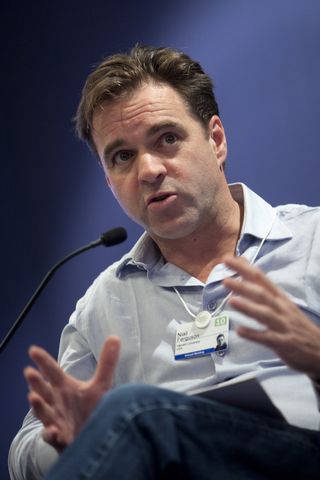
(Photo: Niall Ferguson, professor of history at Harvard University, speaks at a panel session on day one of the 2010 World Economic Forum (WEF) annual meeting in Davos, Switzerland, on Wednesday, Jan. 27, 2010. By Nelson Ching/Bloomberg via Getty Images.)

Can Akin Survive? Ctd

Sam Wang takes a closer look at the latest polling data (discussed here and here):

PPP is making a comparison with its own previous poll in mid-May, showing the same numerical margin (Akin 45, McCaskill 44). It is more appropriate to make a comparison with polls conducted after the August 6th primary, since after a primary a nominee’s support firms up considerably.

Akin was +3% (median, n=3) before August 6th, and +11% (n=1) afterward — an 8-point bounce. So if he is unchanged since May, then he must have lost all this gain. An 8-point loss in one day is an enormous drop.

Fisking Ferguson IV

China_US_GDP

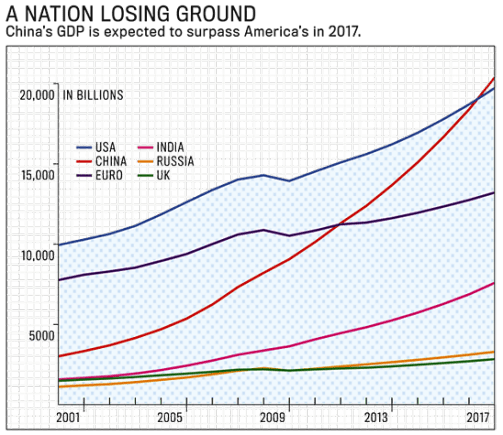
Richard Green counters the above chart, taken from Niall's article:

Niall Ferguson is horrified at the prospect that total Chinese GDP will catch the US in 2017.  Let us leave aside for a second the fact that if China's total GDP matches the US', its people will still be less than 1/4 as affluent, or the fact that maybe it would be a good thing if the most populous country in the world had living standards comparable to ours.  So far as I can tell, his 2017 projection comes from assuming growth in China will continue over the next several years at the same pace it has experienced since 1989.  Such projections are always problematic.

Yglesias adds:

Ferguson is implicitly making two points with this graphic and it's difficult to know which of them is more absurd—the idea that Obama is responsible for rapid economic growth in China or the idea that if he were responsible that would be blameworthy. 

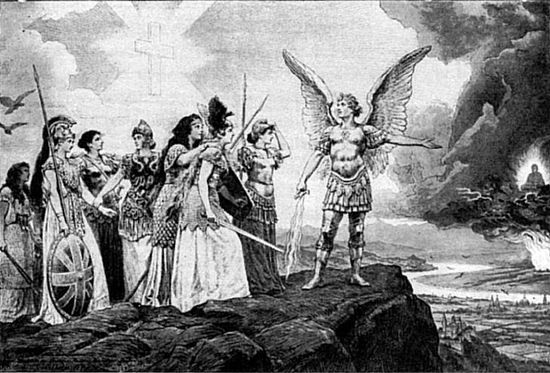
The only reason to include this seems to me an echo of the late nineteenth and early twentieth centuries, when Europe and America were gripped by a largely imaginary "yellow peril." (see the fantastic 1895 German sketch below, captioned, "People of Europe, Guard Your Dearest Goods!")

Voelker_Europas

Obama, we are led to believe, is standing pat while the yellow peril advances. Cartman would approve. You've gotta love the image of a militaristic Buddah throwing lightning around.

But the premises of the argument are that economic growth is zero-sum and that China is a global military threat. We all know that's not true – and in so far as it may be, Obama's Pacific pivot, and a new military base in Australia, is designed to gently push back. So what we really have smuggled in here is a classic neocon argument for world hegemony … not because we are truly threatened by any force equivalent to the old Soviet Union, Nazi Germany or Imperial Japan, but because ruling the world is what empire is all about. And what's the point of wealth if you can't have empire and global power?

I think this is where our disagreement now lies. I've always been leery of foreign intervention that is not meticulously planned, strictly limited in scope and executed swiftly. I let go of that caution after 9/11 for a couple of years and have come to regret it. But to have lived through the Iraq and Afghanistan nightmares and still conclude that we should have stayed in both countries for decades – while lamenting that the US has no imperial talent and has an unsustainable debt – baffles me as an argument. Because it isn't an argument. It's an agglomeration of feelings.