Quote For The Day II

"Liberals regularly defend Soros without calling their opponents anti-Semites. Why are Adelson’s defenders not similarly confident?" – Marc Tracy.

Does he not realize that any criticism of any Jewish public figure and any Jewish organization in America, let alone the policies of the far right Israeli government, is, for neocons, always anti-Semitic? Even when it is written by someone who recently edited the Tablet, focused rather brilliantly on all things Jewish. It's a weapon, Marc. And any weapon to hand …

The View From Your Window Contest: Winner #116

Vfyw_8-18

A reader writes:

First-timer here. The buses, parking, lot lights, and the green fields scream Japan to me (28 year resident). The hotel in the distance (probably a love hotel), greenery to the left, balcony above and light fixture in the reflection combine to make me guess somewhere just outside Narita airport. Not close enough to win, but worth a try.

Another writes:

Something about the mixture of sleek newer highway busses and worn out old school busses reminds me of the bus station at Chetumal, Mexico. The nice busses get you to the Belize border. The decrepit ones take you into Belize. Just a hunch … although I don’t remember the large trees.

Another:

I’m guessing that’s a football stadium in the distance, but googling “central american football stadiums” hasn’t given me a match, and I don’t really have time to look at other regions.  I’m just going to guess Tegucigalpa, Honduras.

Another:

It’s missing a large lake in the center of town, and I can’t figure out where this photo would have been taken from, but to me this looks like the small eco-tourist community of Las Terrazas in the Piñar del Rio province of Cuba. I visited a few years ago when I was studying in Havana and the foliage and the color of the buildings in the distance ring true to me.

Then again, my girlfriend says Ecuador, so there’s that.

Another gets much closer:

I was in Nepal two years ago hiking in the Annapurna range and I remember how the buses seemed to be independent from one another – similar to taxis – with all different shapes and colors, which this picture reminded me of.  The drivers would go on a route, and would just wait at major stops, packing as many customers in as possible (even on the roofs!!) until another bus came along and honked at them to get moving. So I think this one is Nepali but I don’t have the time to research much this week (and I’m not sure I’d get anywhere with this one!!) so I’m going to guess Pokhara.

Another nails the right country:

I saw the picture and it screamed India.

The mix of old and new buses made me guess that way. The yellow and blue bus in the lower center and red and cream bus in the lower left were major hints. As I am unable to narrow down after that, I am taking a guess that it is the Southern Hill station of Munnar. (I haven’t seen bus like these in Northern India, hence the guess towards Southern India.)

Another:

The buses are what prompted me to write in (for the very first time!), since I’m convinced this has to be India. The vegetation checks out too (is that a banana or plantain tree in the bottom right?). So assuming this is India, it’s a reasonable guess that the stadium in the distance is a cricket stadium. Googling for images of cricket stadia around the country brought me to the Subrata Roy Sahara Stadium in Pune, Maharashtra, India. The Google satellite image seems to corroborate the guess – the stadium is indeed ringed by hills and fields, and what appears to be a large parking lot. Unfortunately, that’s the limit of my sleuthing skills, so I’ll leave it to your other readers to pin-down the location to the nearest window, as I’m sure someone will.

The winner was the only reader to get the right city – and in great detail:

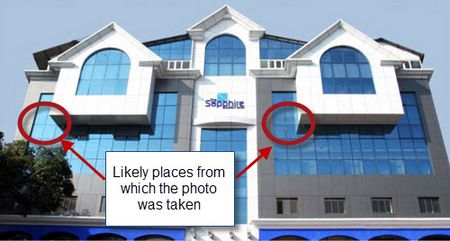
My first entry … always wanted to take part, never found anything that I found even familiar till now.  The minute I saw the photo it seemed familiar, spent some time searching on the Internet and now am quite sure it is the Margao Bus Terminal, in Margao, Goa, India. It is also known as the Kadamba Bus Terminal. The picture is taken from the Sapphire Comfort Hotel, opposite the bus stand across the main road (Margao Panaji Highway). Not sure about the exact floor / room from which the picture was taken, for my best guess, see attached photo with my markup:
Sapphire-Hotel-Margao-2

I started with the assumption that it was most likely the Margao Bus stand. First I confirmed the color combination of the state transport buses (the one standing in front of the building with red tiled roof in the middle) so I was quite sure my guess was in the right direction. Then compared the building with red tiles and the shed opposite it with satellite photos. The stadium in the background with floodlights also helped confirm the location. Lastly, in the top left of the photo, the building extends out and its distinctive pattern confirmed the hotel and the likely location from which the photo was taken.

I have been to Goa many times, mostly on backpacking trips, and I was last there about two years ago. Great blog, keep up the good work. I have been addicted to your blog for many years.

Details from the submitter:
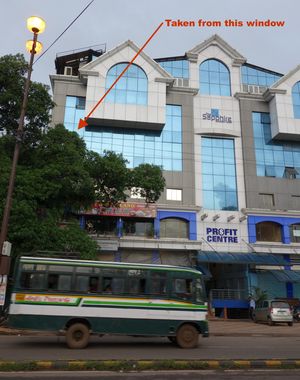
India Goa Margoa Sapphire Comfort Hotel VFYW RoomThe photograph was taken from my room on the fourth floor (fifth floor, American style) of the Sapphire Comfort Hotel in the town of Margao in the Indian state of Goa. I teach at a university in Japan, and I am spending the month of August in Margao at the invitation of a college here. This is my first visit to India and I came straight to Margao, so the view from my hotel was one of my first impressions of this country.

You have previously posted window photos taken from my house in Yokohama (a photo that also appeared in your book), my office in Tokyo, and, my personal favorite, a hotel room in Osaka. I had hoped that the Osaka photo would be chosen for the contest, because the abandoned, unfinished building outside the window is so haunting (though, I should add, atypical of that section of Osaka). But I suppose this Goa photo was a better contest choice. While I would not be able to identify the location if I had not taken the photo myself, I hope that it contains enough clues for some of your intrepid readers to solve it.

I have attached a photograph of the hotel taken from across the street, as well as a satellite photograph showing the location of the hotel:

India Goa Margoa Sapphire Comfort Hotel VFYW Map

(Archive)

Akin Now = Ryan

After the "legitimate rape" comment, Akin loses the propagandist-in-chief:

This is not about a sudden conversion of Sean Hannity into a pro-choicer. It's about the impact of that kind of comment in the culture wars in which the Democrats finally have an advantage, as I wrote last February. The politics of contraception and abortion now work against Republicans as much as for them. Nate Cohn also points out that "undecided voters are disproportionately women, and there’s no question that an overwhelming majority of voters, let alone women, support permitting abortion in instances of rape or incest":

Romney has been saddled with another cultural controversy that risks highlighting issues that the Obama camp thinks could yield gains among socially moderate voters critical to his chances in Colorado and Virginia. The Obama campaign was already spending millions trying to elevate this question in swing states, and the last thing Boston needs is incendiary remarks adding fuel to the fire.

Conservatives of all stripes are urging Akin to drop out. Allahpundit's contribution:

If the game’s on the line in the late innings and your pitcher’s getting shelled, why not go to the pen while you can? Even the Tea Party Express, imagining another Angle/O’Donnell nightmare scenario in November, is unsparing.

Calling for Akin to step aside, The National Review editors write:

[T]his issue offers Democrats a political opportunity, however, it is only a theoretical one: No state is going to ban abortion in the case of rape even if Roe v. Wade is overruled — and even if Akin were elected to the Senate. Everyone knows this.

No they don't. Weigel notes:

In Louisiana, a "trigger law" signed by the state's last Democratic governor would ban all abortions in the state if Roe v. Wade was overruled. In North Dakota, a "personhood" law gives human rights to "any organism with the genome of homo sapiens." In Virginia this year, a new "personhood" bill sailed through the Republican House of Delegates — it got gummed up in the Senate, but that took some doing.

More to the point, 173 co-sponsors, including Paul Ryan, have proposed a bill that would  precisely draw a distinction between "rape" and "forcible rape" (a term, by the way, that Akin now says he meant), as Frum pointed out earlier:

Akin's view of abortion—no exception for rape, incest, and life of the mother—is not his belief alone. It is also the view of Rick Santorum, the second-place finisher in the 2012 Republican nomination contest. On the eve of the Iowa caucuses, it became the position of Texas Gov. Rick Perry. It is the stance of Ken Connor, former president of the Family Research Council. Plainly, it is the position of a significant faction within the pro-life movement.

And indeed, it is the view of Paul Ryan. He opposes abortion even in rape cases because he has bought the entire – and radically new – theocon doctrine that a cluster of cells requires all the constitutional protections of a fully adult human being. That is as radical a position as requiring people in a vegetative state to be kept alive for decades on feeding tubes. It is not so much pro-life as neurotically opposed to death. Which is an odd thing for Christians of all people to fear.

Could Akin Survive? Ctd

Josh Marshall speculates that Akin will stay in the race. Mataconis thinks Akin is cooked:

I wouldn’t put too much stock in the head-to-head number just now. First of all, this is a flash poll conducted over only one night whereas PPP typically polls over three nights in order to get a representative sample, Second, as Ed Morrissey points out, the polls seems to have oversampled Republicans, which calls the head-to head numbers into question. What really matters are those unfavorable numbers, especially considering the fact that the poll oversampled Republicans. It’s going to be next to impossible for Akin to recover from this with numbers like that, especially if he stays in the race and McCaskill just keeps pounding the airwaves with this remark, and the huge number of Republicans who have disavowed him. 

If they're both right, the GOP has a fine old mess on their hands.

Paul Ryan’s Medicare Savings “Mirage”

Screen shot 2012-08-21 at 12.22.06 PM

Peter Orszag argues that competitive bidding – the cornerstone of the new version of Ryan's Medicare reform plan that is a public-private hybrid – simply doesn't work in lowering costs:

[T]here’s very good reason to believe that the 9 percent differential [pointed to as a spending reduction derived from competitive bidding] is a mirage — and that experience to date does not support claims that private plans in Medicare lower costs.

To see why, imagine two beneficiaries. One has medical expenses amounting to $150 and the other, $50. The average cost is $100. Now imagine that a private plan bids $90 to cover beneficiaries, so it looks to be about 10 percent cheaper than traditional Medicare. That plan, however, while it is designed to be very attractive to the $50 beneficiary, isn’t appealing to the $150 one, so that person stays in traditional Medicare.

The result is that total costs rise from $200 ($150 for the expensive beneficiary plus $50 for the inexpensive one) to $240 ($150 for the expensive beneficiary plus $90 for the inexpensive one). So even though the plan “looks” like it saves money, it doesn’t.

He points out that a risk-adjustment process is in place to counteract this "selection effect," but that it has a long way to go:

In 2006, Medicare Advantage plans were overpaid by more than $3,000 per beneficiary because they were able to select beneficiaries who cost less than their risk-adjusted payments. About $1,000 of that overpayment reflects what the plans were paid, rather than what they bid. So relative to their bids, the plans were overpaid by $2,000 per beneficiary — or roughly 25 percent of the bid, on average.

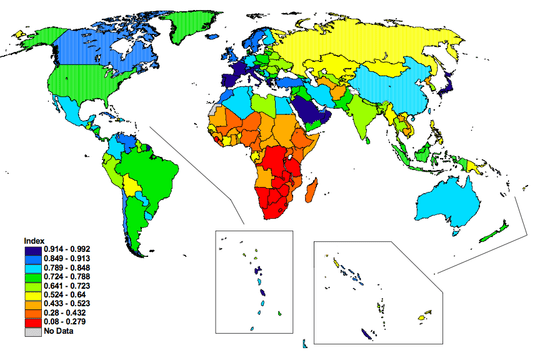
The map above is fascinating because it shows how inefficient the disproportionately private American healthcare system is. It's from a WHO study of the comparative efficiency of national health systems. You will note that Mexico and Canada are much more efficient in healthcare than the US. The US is on the same level as Indonesia and Iran in terms of value for money. In what other economic area does a private market lose out to public sector control in being efficient? In what other industry does the US trail Iran in efficiency?

Then there's the question of gaming the system:

Medicare Advantage program tries to apply a risk-adjustment formula to the patients, and Ryan proposes doing the same in his greatly expanded version of Medicare contracting-out. But this doesn't change the fact that the real profit-making opportunity here is to try to identify and exploit inevitable flaws in the risk-adjustment process. The winning strategy is to craft products that are appealing to customers the formula is willing to overpay for and unappealing to customers the formula would underpay for.

That's Yglesias. The difference, he stresses, lies in the government's role:

Now that could be a small problem or a it could be a giant problem, all depending on how good the government is at setting the rates. Which is to say that for bringing private bidders into the process to work well, you need really effective central planning. And to the extent that you have effective central planning, it seems to me that it makes sense to take advantage of the economies of scale that come from a single-payer system.

Meanwhile, Kilgore is optimistic about the government's unique ability to introduce cost-containing efficiencies:

Beyond that, I might add, Obama’s approach uses Medicare’s massive leverage to execute cost-saving improvements in how the entire health-care system operates, while the Romney/Ryan approach exposes Medicare much more than it is today to the cost pressures of the private market-place, which have boosted, not restrained, prices, even as it makes tomorrow’s retirees more “individually responsible” (i.e., stuck with the bill for) their health care.

Look: I'm a free market supporter. But as a free market supporter, I have to concede that we have precious little evidence that healthcare works like a classic market. Healthcare seems to be one critical area where the role of consumer is overwhelmed by the role of patient and third party payment. If your goal is cost-cutting, then Ryan-Romney could well take us in the opposite direction. Or perhaps at best achieve a fraction of the cost-cutting that the original Ryan plan envisaged and that Obama's pilot schemes and attack on fee-for service medicine promise.

Update from a reader:

You say that "The US is on the same level as Indonesia and Iran in terms of value for money." But you are wrong. If you look at the colors, Iran is as efficient as Mexico. Maybe you meant to say Iraq? Iran is in blue under the Caspain Sea.

The colors are a bit tricky to distinguish. But our reader is right, making the US in fact less efficient than Iran and on par with Iraq.

Ask Jesse Bering Anything: Why Is The Vagina Shaped Like That?

From a description of his new book:

In Why Is the Penis Shaped Like That?, the research psychologist and award-winning columnist Jesse Bering features more than thirty of his most popular essays from Scientific American and Slate, as well as two new pieces, that take readers on a bold and captivating journey through some of the most taboo issues related to evolution and human behavior. Exploring the history of cannibalism, the neurology of people who are sexually attracted to animals, the evolution of human body fluids, the science of homosexuality, and serious questions about life and death, Bering astutely covers a generous expanse of our kaleidoscope of quirks and origins.

Jesse is also the author of The Belief Instinct: The Psychology of Souls, Destiny, and the Meaning of Life. He recently filled in for Savage Love. Previous videos of Jesse here and here. “Ask Anything” archive here.

Fisking Ferguson III

A reader writes:

One statement that stuck out to me as particularly dishonest and hyperbolic was the notion that we are becoming a nation where only half of us pay the taxes while the other half receive the benefits:

We are becoming the 50–50 nation—half of us paying the taxes, the other half receiving the benefits.

The way Ferguson sets this up is a gross distortion on both taxation and spending and is meaningless as anything but a rhetorical device to play on the contempt that many Americans feel towards people who receive government assistance.

On the taxation side, if Ferguson was being honest with readers, he would have at least mentioned that the taxes he uses to make his point are federal income taxes – a point that Ramesh Ponnuru makes refreshingly clear in his NRO take-down of this freeloader myth – and then contrive some rationale why those taxes are all that we really should care about (which Ramesh also calls hogwash). This is putting aside the fact that the 50% level that conservatives decry is largely a result of the recession, or that most of those people are low-income elderly who rely on Social Security, disabled people unable to work, or students.

Second, Ferguson relies on the fact that 50% of America's households have at least one member that receives some sort of Government benefit – as if this 50% just happen to be the 50% who didn't pay any income taxes! I mean, I don't even have to check my references to know that three of the top sources of Government benefits – Defense, Social Security, and Medicare, which together account for around half of total spending – come from taxes that everyone pays, and benefit everyone once they qualify. I mean, Social Security and Medicare which probably account for the majority of those 50%, aren't even raised through federal income taxes. It looks to me that Ferguson counts only income taxes to support the first end of his ridiculous claim, and then relies upon benefits that aren't even financed through income taxes to support the second – it isn't even internally consistent.

Paul Ryan And Private Charity

A critical element in the GOP's attempt to unravel the 20th century's welfare state is the argument that individual charity will step in to help those in need. You can see this at its best in the work of the LDS church. They may have a completely heretical Christian view of the value of commerce, business and money – but they have a very orthodox Christian tradition of mutual caring, support and charity for the needy. This is also behind David Cameron's much more modest attempt to move from Big Government to what he has called Big Society.

And in general outlines, I support this. Many private charities, including religious ones, do amazing work in part because they are independent of the state and driven by zeal. The Salvation Army springs to mind – but so do countless food banks, shelters, volunteerism etc. Enlarging the space for these groups is essential if we are to restrain government and not forsake the needy. That's why I'd abolish every single tax deduction but that for charity. And a new study also finds that states with heavy religious faith traditions contribute more to charity than more secular ones. The red states out-give the blue states. Which speaks highly of their consistency.

Another aspect largely due to religion that Bill Maher and the GOP might equally ponder:

The Bureau of Labor Statistics' latest survey of consumer expenditure found that the poorest fifth of U.S. households contributed an average of 4.3 percent of their incomes to charitable organizations in 2007. The richest fifth gave at less than half that rate, 2.1 percent.

Paul Ryan falls into the richest fifth category:

The Ryans donated $12,991 to charity in 2011, and $2,600 to charity in 2010 — which are 4 percent and 1.2 percent of his income, respectively.

Lets round it out at 2.5 percent. The average is 3.5 percent. How much did the Obamas give in 2010? 14.2 percent – compared with Ryan's 1.2 percent – and Santorum's 1.7 percent. Romney was far more generous, largely through tithing – but he was still beaten in percentage terms by Obama in 2010. But it's Ryan who is the most prominent advocate of replacing state care with private charity. It's just that others will have to supply the charity. Judging by his past, he sure won't.