Re-Running The Bush-Kerry Race

Nate Cohn compares the 2012 election to 2004:

[T]he old culture war calculus has flipped from favoring Republicans to Democrats. If Obama can hold conservative minority voters, then Obama could win the election by simply by doing as well as Kerry did among white voters in 2004. One way to do that? Re-run the debates that dominated the 2004 campaign, like gay marriage and tax cuts for the wealthy. And that appears to be the Obama campaign’s choice, even while adding new issues like contraception, where Democrats are on even safer ground than they are on gay marriage. 

The Daily Wrap

Andrew was back in fighting form today on the Dish, shredding Paul Ryan's "zombie Reagonomics" and eviscerating Niall Ferguson's fact-lite Obama takedown. Later, Andrew discredited Continetti's claims of Obama partisanship, urged aginst using the word "hate" on discussing FRC and praised Mitt for allowing a reporter to attend a church service with him. In the wake of the Todd Akin "legitimate rape" remark, Andrew excoriated Republicans for their views on women while Frum recalled the popularity of this opinion. Obama hit the gas on the Romney-Ryan anti-woman attack, Blake Zeff called this the most negative campaign ever and Jane Mayer broke down Obama's fundraising problems.

Elsewhere, Cassidy reminded us of Ryan's sabotage on spending cuts, Ezra Klein explained how the Obama team built up Ryan and climate skepticism won few votes. Kilgore argued the pointlessness of conventions, Chye-Ching Huang made the case for keeping capital gains taxes, and Ezra and Yglesias took down Obama's handling of mortgage policies. Meanwhile, McArdle explored our attraction to Ponzi schemes, Kirby Ferguson borrowed creatively, and Iran struggled to censor. While Pussy Riot changed Russia and Jesse Bering made sense of the foreskin, the Polyglot Vegetarian explained why truffle oil was the ketchup of the middle class and Mary Jo Bang worked John Wayne Gacy and Cartman into the Inferno.

In other assorted coverage, processed gravy tricked people into thinking they were eating meat, babies liked baby-talk, and we learned that the treadmill originated in prison. Stay-at-home dads grew more numerous, asteroid insurance didn't make the cut and Carolyn Kormann mused on the sexy side of swimming. A cat lover endorsed keeping them inside, anti-gay fail here, Excel-related MHB here, VFYW here, and FOTD here.

G.G.

“We Are Not Self Made”

In the past, we've linked (twice) to Kirby Ferguson's video series, "Everything Is A Remix." Just as impressive is Ferguson's dissection of musical influences, and other forms of creative borrowing, in the video above. Ann Powers, musing on the Jonah Lehrer scandal, points to such practice's long pedigree in American life:

This is the essence of the popular arts in America: Be a magpie, take from everywhere, but assemble the scraps and shiny things you’ve lifted in ways that not only seem inventive, but really do make new meanings. Fabrication is elemental to this process — not fakery, exactly, but the careful construction of a series of masks through which the artist can not only speak for himself, but channel and transform the vast and complicated past that bears him or her forward.

Tim Parks assesses copyright in the world of letters:

In the recent past the duration of copyright after an author’s death was extended from 50 to 70 years. We sense at once that a decision like this is arbitrary and could easily change again.

Was it really necessary that James Joyce’s grandson could charge more or less what he liked for quotations of the author’s work, even in academic books up to sixty-nine years after his death? Does it make sense that to quote three or four lines from The Four Quartets in a book about meditation I have to pay T.S. Eliot’s estate £200? One feels the authors themselves might have rebelled, which gives us an insight into the real reason why works are allowed to go out of copyright protection. Because the author would have wished it thus. Once the immediate family has been protected, availability and celebrity is more important to an author than a revenue stream for descendents he has never met. The lapse of copyright is a concession to the author’s dreams of immortality at the expense of the family.

Obama’s Petulant Donors

Jane Mayer takes a long look at the president's fundraising dilemma and finds that one of the biggest problems is continued discontent among big donors who feel their egos haven't been adequately stroked:

Big donors were particularly offended by Obama’s reluctance to pose with them for photographs at the first White House Christmas and Hanukkah parties. Obama agreed to pose with members of the White House press corps, but not with donors, because, a former adviser says, "he didn’t want to have to stand there for fourteen parties in a row." This decision continues to provoke disbelief from some Democratic fund-raisers. "It’s as easy as falling off a log!" one says. "They just want a picture of themselves with the President that they can hang on the bathroom wall, so that their friends can see it when they take a piss."

Obama's problem more generally:

It’s not easy for Obama to play the current money game, since he has repeatedly called it an unethical contest. He reserved some of the harshest words of his Presidency for the Citizens United ruling, saying that he couldn’t "think of anything more devastating to the public interest." Indeed, advocates of campaign-finance reform think that it’s perverse to fault Obama for being insufficiently solicitous of billionaires. Meredith McGehee, the policy director of the Campaign Legal Center, says, "The whole question of whether the President’s donors are happy just boils down to how corrupting this whole system is. That the President, with all the other things on his plate, has to worry about keeping high rollers happy is just sad."

Ad War Update: Akin Loses His GPS

Over the weekend, the Obama campaign launched a new six-state TV ad attacking Romney-Ryan on women's issues:

One of those ad's claims is misleading; Romney doesn't oppose abortions in the case of rape or incest, though Ryan does. (The only kind of abortion Ryan doesn't oppose is when the pregnancy threatens the life of the mother.) Speaking of controversial views on abortion, as a result of his "legitimate rape" comment, Todd Akin has quickly lost the support of the national GOP and Rove's Crossroads GPS. Meanwhile, the Romney campaign is still trying to peddle its welfare lie about Obama (ad buy info is currently unknown):

The Romney campaign also released a web video touting a recent Ryan speech in Florida, while the Obama campaign rolled out a state-specific radio campaign:

Florida's spot focuses on Medicare, blasting Obama's rivals Mitt Romney and Paul Ryan for proposing a plan that would allow private insurers to compete with traditional Medicare on an exchange. … Other states' radio ads spotlight different issues. In Iowa, clean energy is the focus. Obama slammed Romney for his stance on wind energy when he campaigned in Iowa at the beginning of last week. Nevada voters will hear radio spots focusing on housing, and in New Hampshire – where Romney and Ryan are campaigning Monday – Obama's campaign is running spots hitting the Republican ticket for their position on federally subsidized Pell Grants for higher education. Other battleground states in the Obama radio buy include North Carolina, where veterans' support services are the focus; Ohio, whose ad also hits Romney and Ryan for their position on Pell Grants; and Virginia, where ads will run focusing on road and infrastructure projects.

Elsewhere, pro-Romney Restore Our Future is dropping $10.5 million in all eleven battleground states to hit Obama over the economy:

Ad War archive here.

Why Have Conventions?

Kilgore Ben Jacobs sees them as the political equivalent of an appendix:

At this point, conventions are merely an obsolete vestige of an earlier era in politics. They serve no real purpose, other than a simple gathering, but that’s fine. After all, dentists and comic book fans have conventions, shouldn’t politicians too?

Frum wishes American conventions were more like British ones:

It would be wrong to say no real work gets done at a convention. New political talent is surveyed, party activists network, fundraising begins for the next cycle. But what does not happen is open political work: policy discussion, platform debate, questions and answers between party supporters and party leaders. As the conventions have expanded into ever-grander extravaganzas, politics has retreated from view.

He advocates shortening them. Mataconis agrees.

The Housing Bust In Retrospect

Home_Sales

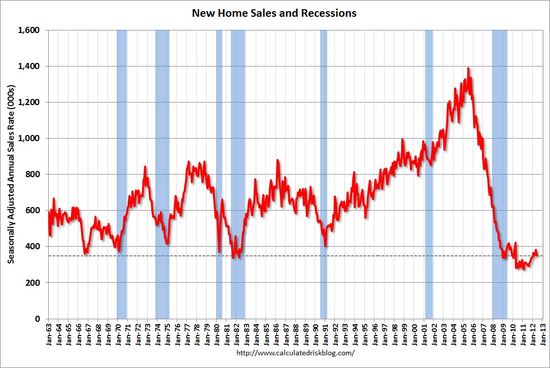
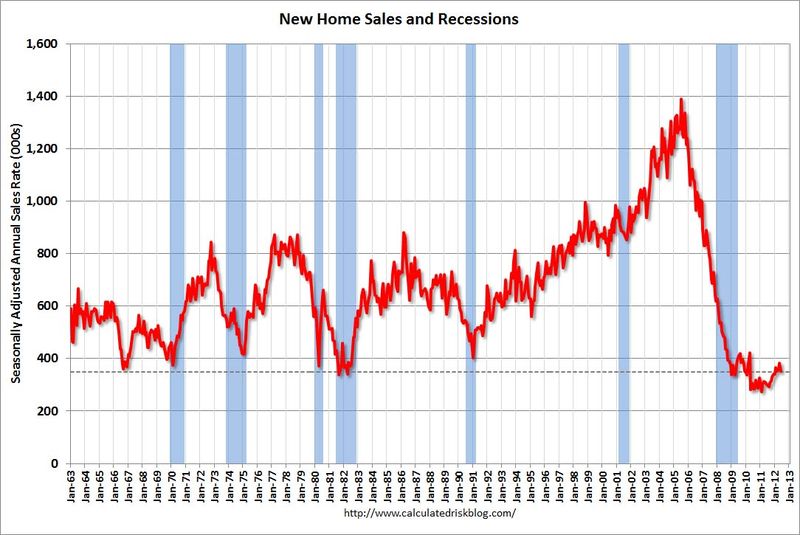
Binyamin Applebaum reviews the administration's mortgage policies. Yglesias reflects:

[T]he economic team wasn't saying there was nothing they could do on housing. Nor were they saying that doing more on housing was a bad idea. They were saying that given finite financial resources they thought investing money in homeowner relief was a poor use of money compared to other initiatives they deemed more stimulative. The basic idea was that you needed the best possible stimulus and thus the lowest possible unemployment rate and this would be the best possible housing policy. It made sense to me at the time, and I think it still makes perfect sense in retrospect.

Ezra Klein calls the White House's housing failures the "best case against the Obama administration":

[O]ne view is that the administration basically got the crisis backward. You couldn’t fix the housing crisis by fixing the economy. You had to fix the economy by fixing the housing crisis. And the administration’s housing policy wasn’t anywhere near sufficient to do that. This mistake was doubly disastrous because monetary policy, which would normally be a huge driver of recovery, typically works through the housing market, encouraging consumers to buy new homes while interest rates are low. Leaving the housing market’s dysfunctions to fester also meant that the Federal Reserve’s efforts to lower long-term interest rates had little affect on the economy.

(Chart from Calculated Risk)

Russia’s Vocal Minority

In the wake of the Pussy Riot verdict, Masha Lipman zooms in on the "minority of new Russians who are not willing to live by the old norms of fear and quiescence": 

It is this minority that have joined the mass rallies in Moscow since December. They are the ones who gathered outside the courthouse [Friday] and chanted, “Free Pussy Riot!” and “Russia without Putin,” and erupted with “Pozor! Pozor!” (“Shame! Shame!”) each time the police took away yet another busload of protesters. In total, some fifty people were grabbed by the police outside the courthouse. Among them was Garry Kasparov, world chess champion turned political activist.

But they are still a minority: young Muscovites may rage and chant outside the courthouse, but over fifty per cent of Russians showed negative opinions of Pussy Riot in an August national poll; just over thirty per cent were non-negative—of these, most said they were indifferent, and only five per cent said they were sympathetic.

Asteroid Insurance Gets Axed

NASA’s Extreme Environment Mission Operations (NEEMO) researches asteroids:

But the project's future is in danger:

When we visited the sea lab in early July, staff were getting ready for a visit from James Cameron and Sylvia Earle, in the hopes of drumming up more political support amidst a flagging budget. But in late July, the bad news surfaced: NOAA announced budget cuts that are likely to imperil it for good. "There were signals that the budget was tight but we didn’t think it would be zeroed out," Thomas Potts, director of Aquarius, told ABC News in July, when the $5 million budget was killed. The lab, which is used extensively during the year for a wide spectrum of non-space-related oceanic research, is no longer mission-ready.