Fisking Ferguson I

My old and good friend Niall Ferguson has written an essay arguing against re-electing Obama. So for the second time in four years, we will be backing separate candidates. One reason is that I believe that the Bush-Cheney wars turned out to be disastrous and a second war against Iran could be catastrophic. Niall has had no such change of heart and remains an advocate of American imperial power. Another is that I do not share Niall's view of the Obama administration's record, which I think he massively – and rather self-evidently – distorts.

Lets start with one sleight of hand noted many many times on this blog. Niall uses a February 2009 rough draft from the Obamaites in transition on the outlook for the next four years as a way to prove that their "promises" fell short. It does nothing of the sort:

Back then, the consensus was that the economy had shrunk some 3 percent in the last quarter of 2008. That was the data on which Romer at el based their predictions. We now know the recession was far worse – with a decline in the fourth quarter of close to 9 percent – three times the contemporaneous assumption.

Niall concedes this at one point:

It was pretty hard to foresee what was going to happen to the economy in the years after 2008.

But that doesn't prevent him from writing something as clearly propagandistic as this:

Unemployment was supposed to be 6 percent by now. It has averaged 8.2 percent this year so far.

By Niall's own admission, that proves nothing except the vagaries of prediction. But he still wants to use it to indict Obama. I cry intellectual foul. Even more amazing, this is his assessment of Obama's record on jobs:

The total number of private-sector jobs is still 4.3 million below the January 2008 peak.

Er … but Obama didn't become president in January 2009? Or did that fact also elude the fact-checkers? Most fair assessments of Obama's employment record give the guy some slack for his first twelve months because of the enormity of the crisis he inherited. But Niall insists not only on judging him by job growth after February 2009 but after January 2008! Almost the entire recession is on Obama's watch, including Bush's last year! And that, alas, is roughly the quality of the entire piece.

To judge Obama's record on jobs, you need a better benchmark. Lets try two. The first is the last administration's first term. Here's a graph comparing the two presidents on private and public sector job growth – and remember Bush had nothing remotely like the recession that Obama had to cope with:

BUSHvOBAMA_jobsREV

If you removed the blue and red labels, you'd assume that Obama was the conservative and Bush the leftist, wouldn't you? And that Obama was therefore far more successful. Yet Niall manages to argue exactly the opposite. Under Obama, there has been a serious reduction in public sector jobs – largely by state governments. But I'd say Obama's record in private job creation easily defeats his predecessor, even when dealing with the worst recession since the 1930s.

Or look at other countries, including Britain, where the Coalition government has followed Niall's advice that our main problem right now is the threat of soaring inflation. Here's the unemployment record globally for the past four years:
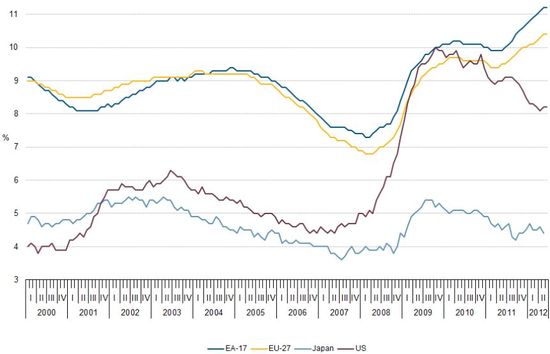
UnemplChart

Under Obama, the US has recovered more strongly than Europe or Japan. It's not dispositive proof of the superiority of Obama's policies but when compared with his predecessor and his global advanced economy competitors, he's doing pretty well. Good enough? Nope. But the task of drawing down such massive debt was bound to lead to a slow recovery. In America, it's been a lot faster than Europe or Japan. In 2008, unemployment was at 10 percent in Europe and the US. In Europe it's now over 11 and rising. In Britain, after following Niall's directives, half a million more people are unemployed than in February 2009, and all the predictions are for more unemployment ahead. Here, it's close to 8 and declining slowly.

Then there are the glaring omissions. Niall simply pretends the cost-control pilot schemes in the ACA do not exist at all. This is Simply. Not. True:

The Patient Protection and Affordable Care Act (ACA) of 2010 did nothing to address the core defects of the system: the long-run explosion of Medicare costs as the baby boomers retire, the “fee for service” model that drives health-care inflation, the link from employment to insurance that explains why so many Americans lack coverage, and the excessive costs of the liability insurance that our doctors need to protect them from our lawyers.

Agreed on the last two – but the idea that there is no attempt to unravel fee for service or try to get cost control in the ACA is something even the lowliest fact-checker should have caught. This is absurd propaganda, not journalism. It may be that the cost-controls fail. Fine. Make that case. But don't pretend there wasn't the most ambitious effort to control healthcare costs in decades.

More to come. The piece is sadly so ridden with errors and elisions and non-sequiturs it will require a few more posts.


Fiscal Hawks For Obama

Cassidy reflects on the Ryan pick:

Politics aside, the outlines of a long-term budget fix are easy to discern. Once the economy is strong enough to grow unassisted, Washington needs to adopt a range of spending cuts and revenue increases. Everything should be up for discussion: changes to the income-tax code, entitlement reform, restructuring the Pentagon, higher energy taxes, consumption taxes. Everything. Or close to it. But when, last summer, President Obama and House Speaker John Boehner tried to take some baby steps in this direction, Ryan helped sabotage their efforts. Now that he is on the national ticket—the third Republican Vice-Presidential candidate in a row from the right flank of the Party—what hope is there that a President Romney will face down the G.O.P. ultras and do what the country so evidently needs? And if there isn’t any prospect of this happening why should moderates and independents vote for Romney?

My feelings entirely.

How Obama Picked Ryan

Ezra Klein's article on the potential mother of meep-meeps is worth reading in full:

The Obama team never could have predicted that its efforts would help vault Ryan into the nomination for vice president. The difference between what they reasonably hoped a strategy like this could achieve and what it actually achieved is attributable to Ryan, who has proven a tremendously skilled politician — so skilled, in fact, that he’s convinced many Republicans that the fight Obama wants is the fight they should want, too. Many of them share House Whip Kevin McCarthy’s view. “It’s not so smart to raise [Ryan] up by picking him as an enemy,” he told Draper. “If he picks a budget fight with Paul, Paul will beat him.”

The White House, obviously, disagrees. The result, to paraphrase H.L. Mencken, is that the Obama administration knew the fight they wanted, and now they’re going to get it good and hard.

Correction Of The Day

"The original pool report of the service contained an incorrect title for a Mormon hymn sung during the service. The correct name of the hymn is, 'Because I Have Been Given Much' not 'Because I Have Given Much,'" – the NYT.

Don't miss McKay Coppins' report from Mitt's Sunday church service. It was exactly what we needed from the candidate, and he was right to follow his father's example of more openness about his faith. Now, how about those tax returns? His father released twelve years' worth.

Paul Ryan’s Zombie Reaganomics

I don't share some Obama-supporters' contempt for Paul Ryan. That's in part because he comes across as a sincere, decent, fine fellow – whose Randian worldview has produced a reformist zeal known most intimately to an adolescent male. Indeed, he reminds me most of all of myself in my teens – dreaming of how to cut government in half, relishing schemes to slash taxes and slash spending and unleash revolutionary growth which, in itself, would render all other problems more manageable. There is no libertarian quite as convinced as a teenage libertarian. And it's the adolescent conviction of Ryan that shines so brightly.

One can call it courage or arrested development. But he is, in some ways, a pellucidly bright plant bred in the conservative movement's hydroponic greenhouse. Barely exposed to natural light, these young fertile saplings are fed with a constant drip of Koch money, sprayed with SMUGRYANanti-liberal pesticides and brought eventually into the political marketplace with joyful children, a lovely wife and a set of abs Aaron Schock would die for (and probably has). He has no life or experience outside the greenhouse – which is why he glows with its certainties. Most important, he has that quintessential characteristic of the modern conservative – total denial of the recent past. Ryan was instrumental and supportive of the most fiscally reckless administration in modern times. He gave us a massive new unfunded entitlement, two off-budget wars and was key to ensuring that the Bowles-Simpson plan was dead-on-arrival. This alleged fire-fighter – whose credentials are perceived as impeccable in Washington – just quit being an arsonist.

But on one key subject, the ineluctably rising costs of healthcare for the elderly, Ryan has in the past proffered a real solution. At some point, seniors would be cut off from the funds they would require for the kind of comprehensive treatment many now expect. This is a rather blunt way of putting it – and Ryan may hope somehow to bring costs down with some kind of competition among private plans for Medicare recipients to ease the pain. But that hope is no more credible at this point than Obama's ACA hope for lower costs – except Obama has initiated several specific cost-control pilot projects, while Ryan is relying on the increasingly tenuous hope that competition within Medicare really will lower costs – i.e. that the sick elderly will act like twenty-somethings seeking a bargain on a smartphone. I doubt it – probably more than I do the ACA experiments. In the latest iteration of his plan, however, Ryan has made the premium support option voluntary – thereby effectively tabling its fiscal potential, and shunted off all the pain onto the post-boomers. Ryan doesn't reverse this generational warfare; he intensifies it by siding with today's seniors over tomorrow's.

I'll be frank, though, and say that some kind of premium support in Medicare seems to me the only solid way I can see right now to save us from fiscal catastrophe. If I had my druthers, I'd give the ACA a decade to make real progress on cost-cutting and then, if it failed, I'd move to premium support. Ryan's right on the unsustainability of the current program and has made cutting it a campaign promise. We owe him thanks for that.

But, no, he is not a serious fiscal conservative. Not even close. In 2012, decades after supply-side economics was proven not to add more revenues than it gave back, Ryan is still a true-believer. His view is that if you cut taxes massively, you will decrease the debt. But this is the primary reason we currently have the massive debt that began its ascent under Reagan, was arrested by Bush and Clinton and then exploded under Bush and Ryan. Worse, Ryan believes that you can cut taxes drastically, increase defense spending massively and still cut the debt. This, to put it mildly, is Zombie-Reaganomics. Tax rates are already far lower than they were in 1980 – and can't be cut still further and have the same impact. Besides, our problem right now is obviously lack of demand, rather than enervated supply. Companies are sitting on piles of cash. Interest rates are very very low. And yet we struggle under a debt burden Ryan would immediately drastically increase, with a promise to get to a balanced budget somewhere near the middle of the century. It makes zero sense to me.

But in many ways, it helps frame this election constructively. We all know we have a debt and a growth problem. Obama favors raising taxes on the wealthy, cutting defense and controlling costs in the ACA. He's also open to serious Medicare reforms if the GOP would join in. Bowles-Simpson was much more of a reach for a Democrat than for a Republican on entitlement reform. And I firmly believe that Obama would sign a Bowles-Simpson type deal in his second term if the GOP were to cooperate. I think he'd sign one this December if he could. Ryan never ever would. Obama's reason for ducking Bowles-Simpson was that the GOP wouldn't bite. Ryan's reason for ducking Bowles-Simson is that he is still a supply side fanatic.

On the Republican side, we now have a debt-reduction plan that actually cuts tax rates for the very rich along with everyone else, vastly increases defense spending, and "balances" the entire thing on gutting care for the old, the poor and the sick (the Medicaid proposal is truly Darwinian) and ending loopholes (which Ryan refuses to specify). I'm all for ending loopholes but even then, we wouldn't get a balanced budget for three decades because of all the defense spending and tax cutting.

This isn't conservatism. It's rightist theology. In a fiscal emergency, the Republicans are proposing not clear remedies but ideological fantasies that were already disproven in 1990. They have learned nothing. And the immense damage they inflicted on this country's fiscal health in the last decade would be nothing compared to what would come under a Ryan-Romney administration.

Because it compounds the errors that came before it.

Ask Jesse Bering Anything: What Role Does The Foreskin Play?

From a description of his new book:

In Why Is the Penis Shaped Like That?, the research psychologist and award-winning columnist Jesse Bering features more than thirty of his most popular essays from Scientific American and Slate, as well as two new pieces, that take readers on a bold and captivating journey through some of the most taboo issues related to evolution and human behavior. Exploring the history of cannibalism, the neurology of people who are sexually attracted to animals, the evolution of human body fluids, the science of homosexuality, and serious questions about life and death, Bering astutely covers a generous expanse of our kaleidoscope of quirks and origins.

Jesse is also the author of The Belief Instinct: The Psychology of Souls, Destiny, and the Meaning of Life. He recently filled in for Savage Love. Previous video of Jesse here. “Ask Anything” archive here.

Quote For The Day

"While nobody thinks that rape is ever "legitimate," plenty of Republicans—including e.g. a majority of the House Republican caucus in a series of votes in spring 2011 on amendments sponsored by Rep. Chris Smith of New Jersey—have distinguished between cases of "forcible rape" (where abortion ought to be allowed) and other forms of rape, where they are not so sure," – David Frum.

That strikes me as a useful avenue for Democrats to explore further.

Popcorn, Soda, Censorship

Iran films post

Iran's film censors have their work cut out for them:

There are 37 rules, laid out in 1983, 1993, and 1996 laws, detailing the ideas and images banned from movies. Many pertain to women: no close-ups of their faces, no makeup, no exposed necklines; men and women can't sit closely, appear to be alone together, touch, or exchange "tender words or jokes." Veiled women, bearded men, policemen, and soldiers can't be portrayed negatively without "a good excuse." No booze, no profanity against religion (yes, Iran protects faiths other than Islam), or neck ties, which are seen as a symbol of foreign culture. Oh, and no sorcery — sorry, Harry Potter.

Iranian journalist Reza Valizadeh explained in a 2010 interview "that beer becomes lemonade on state television and whiskey becomes orange juice." 

(Image from the Iranian film fan site CaffeCinema.com, which collects examples of the censor's not-so-subtle techniques including the opportunely placed pitcher above.)