Dispatch From A Parallel Universe

Continetti faults the president for increased partisanship:

Obama has missed opportunities to seize the ground of national unity and possibly split the GOP. He could have for example included defense funding in the stimulus bill, or decided to go back to the drawing board on health care after Scott Brown’s victory in Massachusetts, or embraced fully the Bowles-Simpson Commission’s recommendations in January 2011. He did none of these things. What we got instead was a mobilization of the center-left coalition toward partisan ends that had been on the agenda for years and in some cases decades. What we got was an unshackled and unhinged country whose people are at each other’s throats.

Was one-third of the stimulus as tax cuts GOP-hostile? Was a healthcare plan based on their own nominee's exact past policy confrontational? Or a climate policy also based on a conservative principle – cap and trade? How polarizing was Obama's vast expansion of natural gas exploration? Or withdrawing from Iraq and decimating al Qaeda? Or keeping Bush's tax cuts extended for the vast majority?

What the current movement right fails to get (but the left understands all too well) is that Obama is a moderate Republican president, and the polarization of the past three years has been a function almost entirely of the GOP's decision from 2008 on to oppose, obstruct and destroy a presidency that represented – and still represents – a massive rebuke to their extremism and failure this past decade.

They have responded by becoming an ultra-rightist, populist, revolutionary party, rather than a conservative one. Whatever its roots, it's the reason we are so far apart. Obama's moderate, pragmatic presidency isn't.
Qualifying Rape

Nate Silver thinks that the remarks of Missouri Republican Senate nominee Todd Akin – that "if it's a legitimate rape, the female body has ways to try to shut that whole thing down" – could drag him down as much as 10 percentage points. Here's hoping. (In the latest polls, the congressman held a slight lead over Dem incumbent Claire McCaskill.) But what's striking to me is the enduring reality that alleged fiscal conservatives in today's GOP almost uniformly have social views that one normally associates with soft-Islamists. It should be possible to be a total fiscal tightwad and still adopt a live-and-let-live philosophy in government – and yet that is emphatically not the GOP we have today. Akin is a classic Islamist-Republican, seeing women entirely as temptations for men who somehow have responsibility for their fate even when being raped. Women are entirely objects – their lives and crises simply requiring an air-brush to keep the whole neurotic ideology intact.

But Akin has predecessors:

Pennsylvania state Rep. Stephen Freind (R) … looks to be the first legislator to make the argument that rape prevents pregnancy, arguing in the late 1980s that the odds of a pregnancy resulting from rape were "one in millions and millions and millions." His explanation? The trauma of rape causes women to "secrete a certain secretion which has the tendency to kill sperm…." Arkansas politician Fay Boozman followed up during during his 1998 Senate campaign by arguing that "fear-induced hormonal changes could block a rape victim’s ability to conceive." Those remarks lead to a backlash when then-Gov. Mike Huckabee tapped Boozman to run the state’s health department. The argument was most recently – and perhaps most fully – articulated by National Right to Life president John Wilke in a 1999 essay titled "Rape Pregnancies Are Rare." Wilke made a pretty similar case to Akin: That the "physical trauma" of rape has a way of preventing pregnancy.

The truth is five percent of rapes result in pregnancy:

Rape-related pregnancy occurs with significant frequency. It is a cause of many unwanted pregnancies and is closely linked with family and domestic violence. As we address the epidemic of unintended pregnancies in the United States, greater attention and effort should be aimed at preventing and identifying unwanted pregnancies that result from sexual victimization.

Regardless of the backpeddling, argues Amy Davidson, Akin's thinking is of a piece with a larger GOP attitude:

[T]here is a notion, common in conservative rhetoric lately, that desperation is always elsewhere, and that the crises in ordinary lives do not need to be contemplated or worried about—not by nice people. They are rare; something has gone wrong; maybe the complaint isn’t legitimate; maybe it’s their own fault. That indifference goes beyond the question of rape and abortion.

That's simply the public tidying up that the fundamentalist psyche constantly requires to keep messy, human reality at bay. It's a function of a backwardness and cultural panic that cannot be entirely disguised by an open and affirming convention stage.

Cartman’s Inferno

Elissa Schappell welcomes Mary Jo Bang’s new translation of Dante’s classic:

Bang’s thrillingly contemporary translation of the first part (the juiciest part) of Alighieri’s 14th-century poem The Divine Comedy is indeed epic. While staying true to Alighieri’s interpretations of religious faith, the bounds of morality, and the soul’s journey toward God, Bang’s sin-soaked voyage through the circles of Hell teems with references to such latter-day personages as John Wayne Gacy, South Park’s Eric Cartman, Stephen Colbert, Emily Dickinson, Sylvia Plath, and the Rolling Stones.

In an interview, Bang defends her modifications:

[B]y ironing out the syntax, the narrative arc of the Inferno is easier to follow. There’s more of a sense of drama. We’re better able to suspend our disbelief and identify with the characters, especially with the character called Dante whose quest for self-knowledge and salvation presents him with archetypal stand-ins for every possible kind of selfishness and evil.

Of course some people feel quite territorial about the poetry of the past and have a strong negative reaction to seeing it altered. Appropriation literature, which you could argue translation is, inevitably alters a text, and if someone is highly invested in the original, there’s no pleasure in examining the terms of an author’s or a translator’s tampering. The fact is, the original still exists. As a reader you can always go back to that.

An excerpt from the translation can be read here.

Chart Of The Day

Stay_Home_Dads

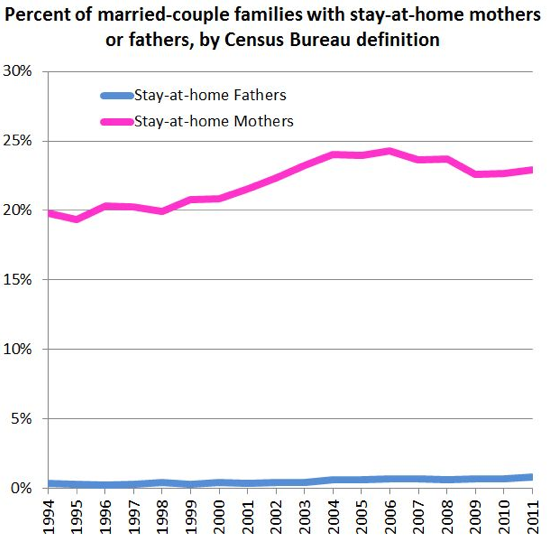
The NYT recently noted that stay-at-home dads are a growing trend:

In the last decade … the number of men who have left the work force entirely to raise children has more than doubled, to 176,000, according to recent United States census data. Expanding that to include men who maintain freelance or part-time jobs but serve as the primary caretaker of children under 15 while their wife works, the number is around 626,000, according to calculations the census bureau compiled for this article.

Philip N. Cohen puts those numbers in perspective:

In fact, when you look at the trend as published by the Census Bureau, you see that the proportion of married couple families in which the father meets the stay-at-home criteria has doubled: from 0.4% in 2000 to 0.8% today. The larger estimate which includes fathers working part-time comes out to 2.8% of married couple families with children under 15. The father who used the phrase “the new normal” in the story was presumably not speaking statistically.

On a related note, we'll be featuring Hanna Rosin on our "Ask Anything" video series in the next month to discuss her new book, The End of Men: And the Rise of Women.

The Original Meat Substitute

You can thank the Great Depression for the thick, fake stuff Americans love to pour on mashed potatoes. Pre-made gravy was part of the effort "to simulate meat in the diet of starving, depressed, out-of-work Americans":

After a series of failures with beans (though one of these lines of inquiry did lead, decades later, to the relatively well-received tofurkey), and some predictably mixed results with whey protein, Gravy Master was introduced in 1935. Caramel color, sugar, spices — with some flour and a pat of butter to make a roux, it would make a thick dark gravy. …  When they added hydrolyzed yeast extract (like autolyzed yeast — the main functional ingredient in marmite) a few years later, the deal was sealed. Hydrolyzing yeast tears open the cell walls and results in free glutamates, essentially MSG, the umami flavor that makes your brain think it’s eating meat.

Climate Skepticism Doesn’t Win Elections

Global_Warming

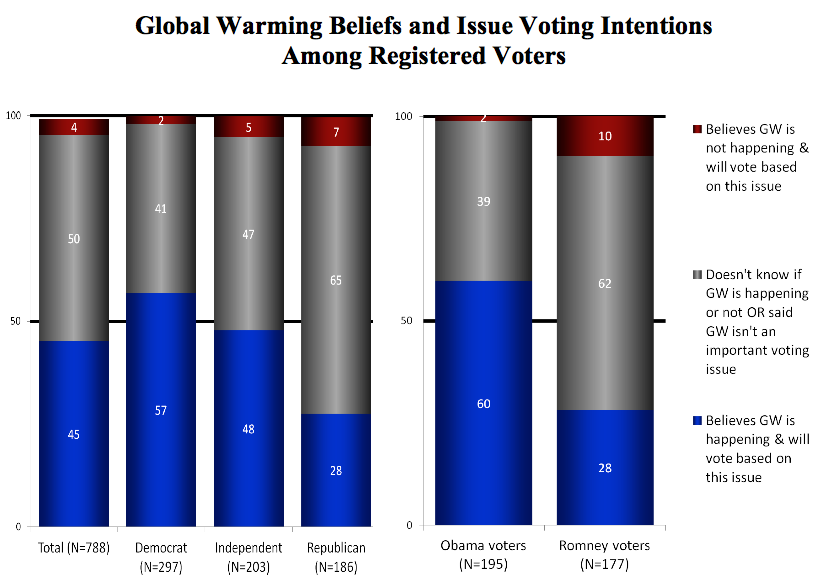
New research (pdf) from the Yale Project on Climate Change Communication suggests that "there are more 'pro-climate issues voters' than ardent climate naysayer voters—even amongst registered Republican voters." Brian Merchant considers the pros and cons if the GOP were to change its tune:

If Romney were to start including the talking point "I promise to seek out ways to address climate change" in his stump speech, 28% of "climate issues voters" would then be swayed to vote for him. Meanwhile, only 10% would be so disgusted by his global warming "alarmism" (what the fringy right calls agreeing with 97% of scientists in the field) that they'd be less inclined to go Romney at the ballot box. That's a net gain of 18% more voters!

Which makes sense, in theory. But we've got to remember that the 10% faction up there happens to include some of the most powerful, relevant elements of the Republican Party right now—the Tea Party leadership, anti-regulation oil & gas execs, and Fox News and the pundit class. And you don't want to piss them off.

Exercise With Conviction

The treadmill originated in prison:

In 1818, an English civil engineer named Sir William Cubitt devised a machine called the “tread-wheel” to reform stubborn and idle convicts. Prisoners would step on the 24 spokes of a large paddle wheel, climbing it like a modern StairMaster. As the spokes turned, the gears were used to pump water or crush grains. (Hence the eventual name treadmill.) In grueling eight-hour shifts, prisoners would climb the equivalent of 7,200 feet. The exertion, combined with poor diets, often led to injury and illness (as well as rock-hard glutes), but that didn’t stop penitentiaries all over Britain and the United States from buying the machines.

The Weekend Wrap

Sunforpoem

This weekend on the Dish, literary and religious coverage abounded. In literary news, Stephanie Nikolopoulos explained why Jack Kerouac was no Mr. Darcy, Kaya Genc described Oscar Wilde's short-lived day job, Verlyn Klinkenborg gave advice to young writers, Flannery O'Connor trained her withering criticism on Ayn Rand, Alexander Chee revealed what life is like in an artists' colony, Caroline Leung profiled a sex worker whose experiences provided fodder for her writing, and Maria Konnikova detailed why famous misquotations persist. Science fiction got its due, too - Alan Hurst pondered why Mormons excel at writing it and Charlie Jane Anders explored its connection to philosophy. Read Saturday's poem here and Sunday's here.

In wide-ranging religious coverage, Matthew Sitman argued that David Foster Wallace's life was a search for grace, Katherine Sharpe connected depression's stigma to a medieval sin, Rollo Romig used his first Ramadan fasting to point to God's unknowability, and Neuroskeptic noted the lack of religious invention during the past 20 years. Andrew Hartman thought the culture wars explained the GOP's Mormon/Roman Catholic ticket, Rowan Williams celebrated Marilynne Robinson's recovery of the word liberal, and Kenan Malik provided an 18-step guide to logic of religious freedom. Rick Warren struck again, this time turning to the Book of Daniel for diet advice, epitomizing the religious hucksterism that might explain why less Americans identify as religious – and more as atheist – than in the recent past.

In assorted coverage, two great trends of our time – the hipster and the rise of assholism – were put in perspective. Chas Danner highlighted the brilliant storytelling of Ed Gavagan, Greg Sargent ranted about Romney and Ryan's dodging of policy specifics, and the U.S. lost its fertility edge. A college professor offered cringe-inducing tales of student oversharing, Sky Dylan-Roberts spoke to the creators of beautiful tatoos and the stories behind them, and Paul Miller shared a dispatch from his year living without the Internet. In TV news, Emily Landau remembered the trailblazing show Degrassi Junior High and Steve Rinella of Meat Eater distanced himself from Bear Grylls. FOTDs here and here, MHBs here and here, VFYWs here and here, and the latest window contest here.

And last but certainly not least, we welcome Andrew back today. To mark the occasion we asked Barney Frank about the craziest thing Andrew's ever said.

– M.S.

(Photo by Flickr user kxcd)

A World Without Blemished Fruit

Minimi01

Thanks to genetic engineering, it's within reach:

A large percentage of all produce (40%) never even makes it to the grocery store or farmer’s market because of damage. This problem, compounded by the fact that apple consumption has been on the decline for decades, led Neal Carter, the founder and president of Okanagan Specialty Fruits, to search for solutions. He came up with the Arctic Apple, a genetically-engineered apple that doesn’t turn brown, even when bruised or cut open. It’s the closest science has come to creating the perfect apple specimen.

(From the Big Appetites series by Christopher Boffoli via Design Boom)

Prohibition In The Middle East

The Economist investigates Islam's ban on booze:

Historians believe alcohol originated in the Middle East. Indeed, the word may come from the Arabic al-kohl, eyeliner made by mixing distilled ethanol and antimony salts. Similar substances without the powder soon became popular drinks. Debauched nights in the courts of caliphates were enshrined in the khamriyaat, or odes to wine, by Abu Nuwas, an eighth-century poet. That has long since changed.

Nobody knows exactly when Islamic scholars decided that booze was sinful. In the 1970s political Islam led some countries such as Iran and Pakistan to ban alcohol, although many do not and exceptions are made for non-Muslims. In some countries the punishment for Muslims caught quaffing are severe: 80 lashes in the case of Iran.

But the laws may belie what's being consumed behind closed doors:

Between 2001 and 2011 sales of alcohol in the Middle East, where Muslims dominate, grew by 72%, against a global average of 30%. That rise is unlikely to be accounted for by non-Muslims and foreigners alone.