Obama’s First Medicare Ad

by Chas Danner

After almost a week, the above TV ad is the Obama campaign's first attacking Romney/Ryan on Medicare. It quotes the AARP, probably the gold standard opinion-shaper when it comes to seniors' issues, and surely the kind of analysis that trumps Romney's whiteboard. The campaign says the ad will air in Colorado, Florida, Iowa, New Hampshire, Nevada, North Carolina, Ohio and Virginia.

The Romney Rally

by Patrick Appel

Nate Silver discounts it:

I don’t think there’s been much in the polling data this week that should substantially change your view of the race. Mr. Romney has certainly gotten some encouraging numbers this week, particularly in state-level polls. It’s surprising how much even a one-point shift in the polls can change the way that the race looks and feels.

But from what we can tell, most other candidates have gotten larger bounces after naming their running mates. My gut-level view is that these facts read slightly negatively for Mr. Romney on balance — but I’m not confident enough about it that I’d want to venture much money on that conclusion.

Making The Registration Rounds

Obama_Florida_GT

by Zoë Pollock

The Boston Globe reports that Democratic numbers for newly registered voters in swing states are down considerably:

Democratic rolls increased by only 39,580, less than one-tenth the amount at the comparable point in the 2008 election. At the same time, GOP registration has jumped by 145,085, or more than double for the same time four years ago. Independent registration has shown an even stronger surge, to 229,500, almost three times the number at this point in 2008.

Philip Bump doesn't think registration is a huge indicator for turnout:

[V]oter registration is almost always a mid-summer time-kill meant to keep volunteers engaged and to provide a metric to the press. Newly registered voters — except when the registration is same-day — are far less likely to vote. Far less. It's not a turnout strategy, it's an energy strategy.

Relatedly, Sasha Issenberg studies increasingly sophisticated registration by mail tactics.

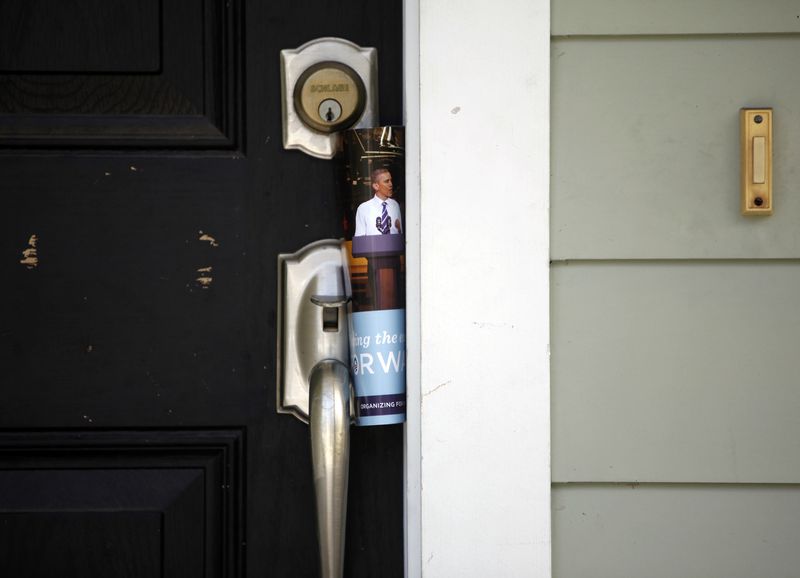
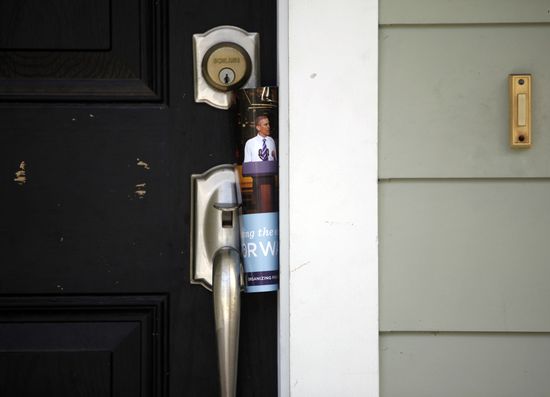
(Photo: Volunteers for the Obama 2012 campaign leave fliers on residences as they canvass for votes in South Tampa, Fl. By Angel E. Valentin/For The Washington Post via Getty Images.)

The Junk Science Of “Fetal Cosmetology”

by Gwynn Guilford

Amanda Schaffer details the latest news in the controversy surrounding the off-label use of dexamethasone to prevent girl babies from developing masculinized genitalia (Schaffer links to examples here and here):

[I]n June, researchers in Sweden, who have conducted some of the most rigorous research on the treatment since the late 1990s, announced that they would no longer enroll new patients for fear of long-term side effects. And last month, the record of the best-known American champion of the drug [Dr. Maria New] was questioned when patient advocates charged she’d misrepresented her work to patients and the government.

The Swedes documented some significant risks – particularly cognitive problems:

[O]ver a decade ago that in a group of 43 dex-exposed children, eight had severe medical issues: one had a developmental delay, one had “mental retardation” and one had “severe mood fluctuations that caused hospital admission.”

This all the more disquieting given that only one in eight fetuses that would be recommended to receive the dex treatment would actually stand to benefit from the anti-virilization treatment, notes Schaffer.

If this all sounds vaguely familiar, it's because we've wandered these bioethical bowers before – when Dan Savage and Alice Dreger, a leading expert on intersex issues, publicized New's research in 2010. At the time, Dish coverage focused on the eugenic gist of New's stated objectives, beyond simply genital virilization. Money quote from Dan:

Pediatric endocrinologist Maria New—of the Mount Sinai School of Medicine and Florida International University—isn't just trying to prevent lesbianism by treating pregnant women with an experimental hormone. She's also trying to prevent the births of girls who display an "abnormal" disinterest in babies, don't want to play with girls' toys or become mothers, and whose "career preferences" are deemed to "masculine."

Reader pushback at the time focused on the "gay cure" and its religious implications, though also on the considerable health risks of CAH aside from genital masculinization (most severely, something called "salt-wasting"). However, prenatal dex is prescribed exclusively to block "excessive adrenal androgen production" in the ninth week of gestation that's responsible for virilizing female genitalia. Lindsay Beyerstein argued, though, that preventing virilization was still a worthy medical aim:

[T]he potential medical consequences of virilization go far beyond cosmetic appearance or even gender presentation. In severe cases, the patient may need multiple painful surgeries to create separate vaginal and urethral openings. Dreger and her colleagues dismissed dex as "fetal cosmetology" until they were called to the carpet by authors from Harvard who forced them to acknowledge the medical consequences of severe masculinization. The ill-effects include incontinence, kidney damage from recurrent UTIs, vaginal narrowing that interferes with menstruation and the future ability to have PIV intercourse. Girls may need multiple painful surgeries to correct these abnormalities.

And the lesbian thing, noted Beyerstein, was really just so much sensationalism:
When pressed, even Dreger admits that most doctors who prescribe dex are only trying to prevent birth defects. Of course, the authors aren't lifting a finger to clear up the misconception they caused with their initial post, namely that prenatal dex is intended to prevent lesbianism…. If you wanted to be a crackpot about it, you could just as easily argue that dex is a conspiracy to turn boys gay. Prenatal dex makes male rats more receptive to being mounted by other males.

That might all seem moot now given the latest findings of the effects of the treatment. However, New's work at Mount Sinai continues, bolstered by what Dreger and company (PDF) argue is still more dodgy research.
The End Of WikiLeaks?

by Chas Danner

Joshua Keating thinks the group may be finished:

As [Julian] Assange remains in international legal limbo, granted asylum in Ecuador but with no foreseeable way to get there, and as WikiLeaks struggles to stay afloat in the face of money problems and denial-of-service attacks, it's worth reflecting on how we got here. How did an organization that once touted itself as the future of journalism — and for a time seemed to have a credible case for the claim — devolve into one man's soap opera?

Keating notes the numerous ways the group has put its relevance and credibility at risk, from over-politicizing itself, to faux neutrality, to the massive fight it's picked with the US and with news organizations. And then there are the leaks themselves, which now come less and less, and what has been leaked rarely proves to be as important or reliable as the group hypes it to be:

Even WikiLeaks' crowning achievement — Cablegate — may have been embarrassing to the State Department and put some U.S. government sources at risk, but didn't actually reveal much in the way of nefarious doings by U.S. diplomats. If anything, it often revealed them to be a bit more informed about their postings than their public statements might suggest. Yes, cables detailing the personal excesses of the Tunisian ruling family were one of several factors that helped spark protests in that country in early 2011, but WikiLeaks' claims that the Arab Spring was a direct result of its work doesn't pass the laugh test.

Then, of course, there is the man at the top. It seems Assange is more of an anchor than a leader, more a distraction than an inspiration. Regarding the convoluted asylum situation, Max Fisher explains what Ecuador is up to:

[Their] decision to grant Assange asylum appears, on the surface, bizarre or even irrational, given the apparent costs. The small-ish Latin American nation has effectively blown up relations with the much more powerful United Kingdom just over Assange, whose only real interest in Ecuador appears to come from one Ecuadorian officials' late 2010 hints of asylum. But it's possible that the diplomatic stand-off itself, and not Assange's freedom, is precisely Ecuador's goal. Though we can't know the Ecuadorian government's motivation for sure, engineering a high-profile and possibly protracted confrontation with a Western government would actually be quite consistent with Correa's practice of using excessively confrontational foreign policy in a way that helps cement his populist credibility at home. It would also be consistent with his habit of using foreign embassies as proxies for these showdowns — possibly because they tend to generate lots of Western outrage with little risk of unendurable consequences.

The Russian Fusion Of Church And State

Pussy_Riot_Gt 

by Gwynn Guilford

Today a Russian court found three members of Pussy Riot – Maria Alyokhina, 24, Nadezhda Tolokonnikova, 22, and Yekaterina Samutsevich, 29 – guilty of "hooliganism motivated by religious hatred." The three women were given two-year jail sentences backdated to their March 15 arrest. Theologian William D. Lindsey reflects on Pussy Riot's confrontation of Russia's religious and political elites:

Nadezhda Tolokonnikova' defense of the theatrical prayer to the Virgin Mary that Pussy Riot offered in February very specifically calls out the leaders of the Russian Orthodox Church, who are, she maintains, collaborating with the Russian state to wipe out civil liberties and to establish authoritarian control of the Russian people by a church-state alliance.  The nation's top religious leaders are benefiting lavishly from the deals they have cut with the state, she argues.

He points to the ironic trampling on religious freedom:

And so [Tolokonnikova] frames their protest in the Moscow cathedral in February as a protest against a collapse of church and state in which notions of Christian truth and Christian propriety are dictated from the top echelons of the church and enforced–ruthlessly, if need be–by the state when ordinary believers like the three members of Pussy Riot dare to offer prayers in language or gestures that offend the sensibilities of those at the top. 

Dashiell Bennett rounds up the latest in the show global support. Earlier coverage here and here.

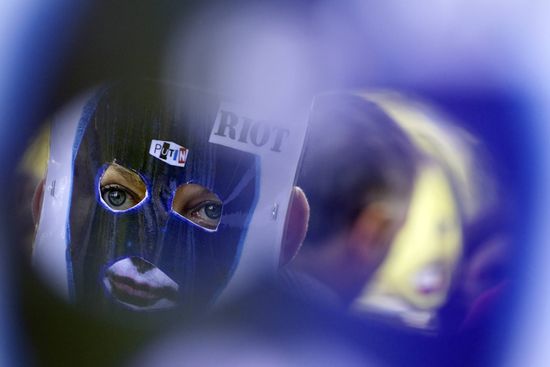
(Photo: Supporters of all-girl punk band 'Pussy Riot' protest in Brussels on August 17, 2012. A Moscow court on Friday found guilty three young members of a feminist punk band who captured global attention by defying the Russian authorities and ridiculing President Vladimir Putin in a church. Pro-Pussy Riot release rallies have stretched from Sydney to New York as a growing list of celebrities joined ex-Beatle Paul McCartney and pop icon Madonna in a campaign directed against Putin's crackdown on most dissent.  By Nicolas Maeterlinck/AFP/Getty Images)

Obama Baits The Press

by Patrick Appel

Obama's campaign manager e-mailed Romney's campaign manager this message:

I am writing to ask again that the Governor release multiple years of tax returns, but also to make an offer that should address his concerns about the additional disclosures. Governor Romney apparently fears that the more he offers, the more our campaign will demand that he provide. So I am prepared to provide assurances on just that point: if the Governor will release five years of returns, I commit in turn that we will not criticize him for not releasing more–neither in ads nor in other public communications or commentary for the rest of the campaign.

The Romney campaign responds here. Frum quips:

Do you ever get the feeling the Obama campaign wakes up every morning thinking, "What can we do today to goad the Romney campaign and the media to discuss something other than jobs?"

The e-mail exchange illustrates why campaigns usually respond to legitimate criticisms. The Obama campaign will attack Romney no matter what, but, if Romney had promptly released his tax returns, Obama would have been forced to pick up a weaker political bludgeon. Instead, Obama can focus attacks on an issue where many Republicans agree with him. 

Romney refusing to release his returns isn't a sign of strength. It's a sign of stupidity.

From Etch-A-Sketch To Whiteboard

by Chas Danner

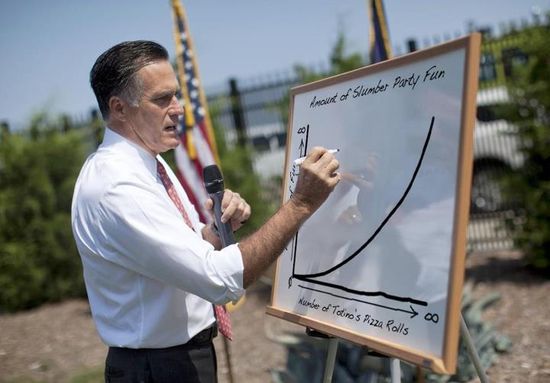
Mitt whipped out the whiteboard yesterday. Ginger Gibson passes along the rationale:

“I know there’s an effort by some people to try and bring as much confusion to the topic of Medicare as possible,” Romney said. “But I want to bring as much clarity as possible, so I’ve prepared a small chart here, which will describe differences in our respective plans for Medicare.” But after the 10-minute and 11-second news conference, Romney shed no new light on how he would overhaul the 47-year-old federal health care program for senior citizens and how (or if) his program differs from that of his running mate’s much-maligned proposal that is part of an effort to slash the federal budget deficit.

Elspeth Reeve says Romney isn't the wonk he pretends to be:

Romney has a reputation for loving data, as expressed through his love of PowerPoint. The PowerPoint presentation and the whiteboard are supposed to signal smart data-driven analysis. But the whole point is to actually show the data. Romney did not do that today, as you can see in this video  … Just because a campaign's talking points were written on a thing used to show details doesn't mean actual details were shown. 

And while the Obama campaign has responded with their own whiteboard, two different Tumblrs have already emerged to suggest some alternative content for Mitt's new prop:

Romneywhiteboard


The Coming Generation Wars

by Gwynn Guilford

Robert Samuelson sees a gathering conflict:

[T]he generations are in an undeclared war. Americans in their late forties, fifties, and sixties believe that the contract made with them should be kept. They want their Social Security and Medicare benefits. They are angry when what they thought were career jobs are unexpectedly terminated; corporate buyouts and firings weren’t part of the bargain. Meanwhile, their children and grandchildren are befuddled and frustrated. Their unemployment rates are high, and their wage levels—compared to those of the past—are low. Yet they feel guilty advocating trims to Social Security and Medicare, even when the transfers go from the struggling young to the comfortable old.