Chart Of The Day

by Patrick Appel

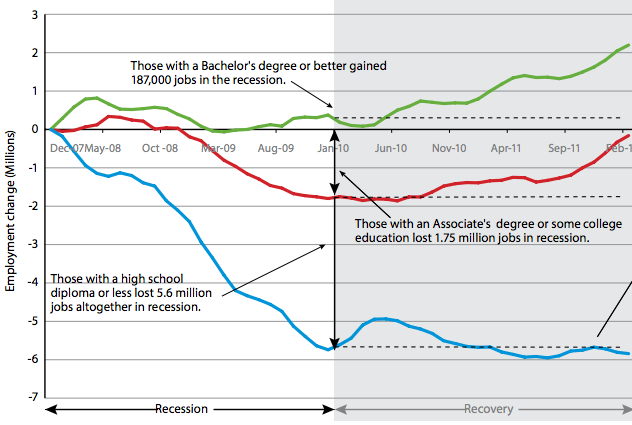
Blue = high school or less, red = associate's degree or some college, and green = bachelor's degree or better:

Degrees_Work

Kay Steiger captions this chart from a new report (pdf):

Though the report is upfront about the fact that college graduates are not immune from the recession (insert stereotype about an art history major working at Starbucks here), it notes those with bachelor’s degrees tend to overall be much better off than those with just a high school diploma: “One out of seven new four-year college graduates was underemployed in May 2012. In comparison, nearly half of the new high school graduates were underemployed in 2012.”

“At Least 13%”

by Gwynn Guilford

The Wire creator David Simon marvels at Romney's nerve in "declaiming proudly" that he paid at least 13% taxes every year:

Thirteen percent. The last time I paid taxes at that rate, I believe I might still have been in college…. I can’t get over the absurdity of this moment, honestly:  Hey, I never paid less than thirteen percent.  I swear.  And no, you can’t examine my tax returns in any more detail.  But I promise you all, my fellow American citizens, I never once slipped to single digits.  I’m just not that kind of guy.

Dreher piles on:

What Simon is getting at is Romney is an extremely rich man who pays significantly less of a percentage of his income in taxes than millions of people who make far less than he does, and he still seems to think he deserves a cookie. I’m sick and tired of him and his wife whining about how people are so mean to them about their taxes.

Your Little Purring Murderer, Ctd

by Chris Bodenner

A reader writes:

We got two kittens at the end of last year and I was soon at the end of my tether about the number of murdered birds they were bringing back to us as presents.  I searched Cat-bibshigh and low for an online solution and came across catgoods.com, which sells thin neoprene cat bibs recommended by the Audubon Society. Supposedly the bibs prevent cats from making the overarm pouncing motion necessary to catch birds, and disrupt the split second timing they need. I was desperate enough that I bought a couple. Yes, my cats do look like dorks, but no, they don’t seem to stop them running, jumping and climbing; and no they don’t object to wearing them (after the first few times, much like a dog on a leash).  And as far as we can tell the number of murdered birds and mice has diminished to almost zero. We now get ‘presents’ about once every 6 months instead of about once a day.  In addition the cats are more visible on the road and the bibs have proved to be invaluable for striking up conversations with neighbours.

I’m not in any way affiliated to the sellers, but since my cat owning life has been transformed I would love to see the bibs become more widely known and used. I blogged about my experiences here, which includes a pic of my dorky cats.

Seen above.

How Much Do States Make From Gambling?

by Patrick Appel

Less than meets the eye, according to Steve Malanga:

[A] reason that gambling has failed to close states’ deficits is that it doesn’t capture money for the government that otherwise would be spent on untaxed illegal betting, as supporters claim. A 2002 National Bureau of Economic Research study of 21 states by economist Melissa Schettini Kearney found that, in the first year after a state instituted a lottery, consumer spending on other purchases fell by about $42 per month per household—nearly as much as was being wagered on the new lotteries. After California’s lottery was introduced, the state’s grocers’ association reported a 7 percent decline in sales. One northern California retailer, Holiday Quality Foods, announced that it would stop selling lottery tickets because its profits had fallen 10 percent after starting to offer them.

Grading Seriousness On A Curve

by Patrick Appel

Douthat argues that Ryan has "pushed his party in a politically risky but more responsible direction ":

Most Republicans would have been happy to hang the White House’s decision to help pay for its health care bill with $700 billion worth of Medicare cuts around President Obama’s neck without proposing any entitlement reforms of their own. But Ryan didn’t just propose a much more sweeping Medicare overhaul, he proceeded to do the hard work of persuading his fellow House Republicans to actually vote for his entitlement-reforming budget – twice.

In a later post, he defends Paul Ryan's seriousness:

[T]he ongoing attempt to portray him as unserious and uncourageous holds him to a standard that no figure in American politics, President Obama very much included, comes even close to meeting. No other American lawmaker has been as active as Ryan across so many policy fronts these last few years. No other Republican — with the arguable exception of Tom Coburn, who’s retiring after this term — has staked out so many specific and controversial positions on difficult issues. Ryan’s supposedly “sophisticated” liberal critics like to downplay this reality, preferring to paint him as a kind of flimflam man instead. But they aren’t actually sophisticated, and he’s actually legit.

Jonathan Bernstein counters:

If you think that bipartisan budget-balancing is important then you really have to talk about Ryan's central role in keeping the Simpson-Bowles group from succeeding; had Ryan chosen to support a plan, it almost certainly would at least have been approved by the commission, and would have in my view at least have had an excellent chance of being adopted by Congress and signed into law. Granted: that would really have forced him to take on important interests and people within his own party, in a way that fantasizing about ending traditional Medicare and Social Security don't do. And because he wasn't willing and really has never been willing to do that, Douthat's case for Ryan just won't hold up.

Galupo's primary complaint about Ryan:

My problem with Ryan isn’t on the entitlement reform side; it’s on the revenue side. His assumption that another round of supply-side tax cuts will spark growth and unleash pent-up consumer demand strikes me as just as wooly-headed as the Tea Party freshmen’s knowledge of the federal budget.??

The Daily Wrap

GT_RIGHT-TO-DIE_120816

by Gwynn Guilford

Today on the Dish, Ryan lied about requesting stimulus money for Wisconsin and a reader contextualized the Ryan pick within Obama's long game. Jared Bernstein explained the $700 billion mystery, Larison debunked Ryan's appeal to younger voters and Patrick busted Avik Roy's fuzzy Medicare math.

Klein recommended sidestepping the media to understand Medicare, Romney proxies went after Obama about Osama, Americans failed basic economics and a reader likened Romneys to Will Farrell's Anchorman character. Meanwhile, the NYPD mishandled the mentally ill, readers pushed back on Wes Clark Jr.'s defense of his dad, and Barney regretted.

In sports news, baseball's mood swung dramatically, circadian rhythms skewed football odds and Ashley Fetters considered the upside of adding karate and wushu as Olympic sports.

And in assorted commentary, liquid lunches made workers more creative, while open-plan offices dragged on productivity. Smog subsumed China's cities, Allison K. Gibson talked tech cameos in fiction and clothes became art. 50 Cent said his late mother was gay, Alexis explored the dog shake and readers both weighed in on "pink boys" and defended the Lonely Planet. America's girth grew, Eve Bowen praised Edward Gorey and the inventor of Game of Thrones' Dothraki explained insults. Cats bared their cunning again and again, VFYW here, MHB here and an excruciating FOTD here.

(Photo: Tony Nicklinson reacts as a statement is read regarding the decision made by High Court judges not to allow him to ask a doctor to end his life on August 16, 2012 in Melksham, England. Nicklinson, who suffers from locked-in syndrome as the result of a stroke, has lost his High Court battle for the legal right to end his life when he chooses. By Matt Cardy/Getty Images.)

Policing The Sick

by Gwynn Guilford

Nick Pinto gives a chilling glimpse into the NYPD's treatment of the mentally ill:

In the space of a week in 2007, police officers shot and killed two emotionally disturbed men in Brooklyn. Khiel Coppin, 18, was holding a hairbrush under his shirt like a gun when police killed him in Bedford-Stuyvesant. David Kostovski, 29, was brandishing a broken bottle at police when he was shot in East New York. In 2008, when police responded to a call from the mother of 35-year-old Iman Morales, who wasn't answering his front door. When police arrived at the Bedford-Stuyvesant apartment, Morales, naked, retreated out the window and onto a ledge 10 feet above the sidewalk. Police called for an inflatable air bag to place on the sidewalk under Morales but didn't wait for it to arrive before shooting him with a Taser. Morales went stiff, fell headfirst onto the sidewalk, and died.

Part of the reason for the increased incidence of violent showdowns between the NYPD and the mentally ill is the shuttering of mental institutions.

The Campaign Has Issues

by Patrick Appel

If you want to hear about policy, Ezra Klein recommends going to the source:

In my experience, you’re actually getting a more serious conversation over the issues if you listen directly to the two campaigns than if you’re reading about the campaign as filtered through much of the media. I mean, here’s the most recent speech Obama gave. It’s almost all policy. And here’s the most recent speech on Mitt Romney’s Web site. It, too, is mostly policy. Even the attack ads are about Medicare!

Drum explains the difficulty of sustained substantive reporting:

This is the problem with substance: it doesn't change. Once you've outlined both campaigns' positions on something, there's not a lot new you can say about it. So you either repeat yourself (boring!) or report on campaign nonsense (non-substantive!). If there were dozens of issues to report about, that would solve the problem, but the plain fact is that most campaigns are won and lost based on three or four major positions. And if those are the things the campaigns are focused on, then those are the things you need to report on. 

Paul Waldman puts things in perspective:

Every campaign gets negative, and every campaign gets personal. Think back on the presidential campaigns you've lived through. Was there a single one about which you'd say, "That was really a substantive, serious campaign about issues"? Of course not. This is American politics. It's trivial, it's misleading, it's demagogic, and it's negative. We can set aside for another day the question of whether the fault for that lies primarily with the politicians or with the voters (I lean toward the latter), but we shouldn't be surprised when the campaign doesn't turn out to sound like a luncheon at the Brookings Institution.

“Whimsically Grim”

5592080672_4209ae95b7_b

by Zoë Pollock

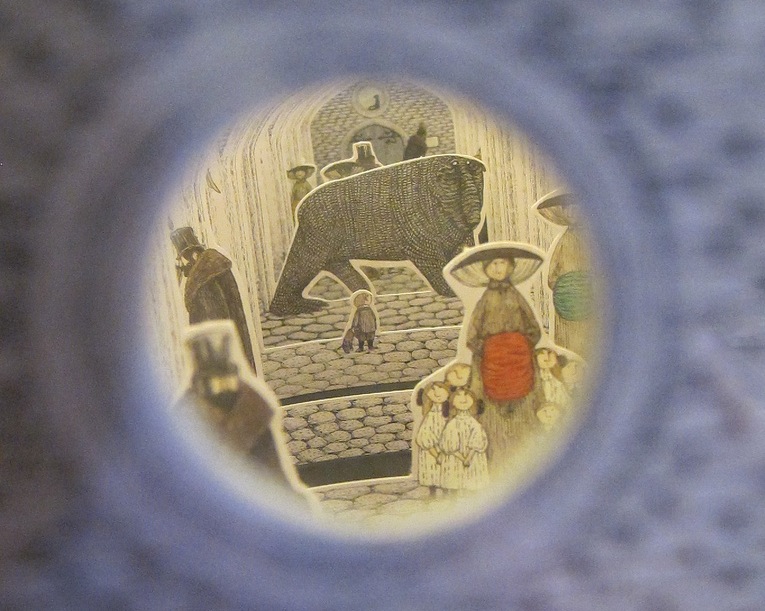
Eve Bowen delights in the work of Edward Gorey:

Whether they are Edwardian ladies, fur-coated gentlemen, ill-fated children, or unusual animals, his characters are almost always on some kind of journey. His stories often unfold in wallpapered rooms, on barren estates, or among statues, beast-shaped topiaries, and urns. “Few seem to return from the borders to which I’ve sent them,” he wrote to Peter Neumeyer, with whom he collaborated on three children’s books in the late 1960s. (Their correspondence has recently been collected in an absorbing, elegantly illustrated book, Floating Worlds.) Perhaps this is what gives Gorey’s work its talismanic power: his books and drawings, which are so often about imagined deaths and disasters, turn into lucky charms for his readers.

In a 1968 letter to Neumeyer, Gorey delineated "E. Gorey’s Great Simple Theory About Art":

This is the theory… that anything that is art… is presumably about some certain thing, but is really always about something else, and it’s no good having one without the other, because if you just have the something it is boring and if you just have the something else it’s irritating.

(Photo from the Edward Gorey House by Amy Hope Dermont)